
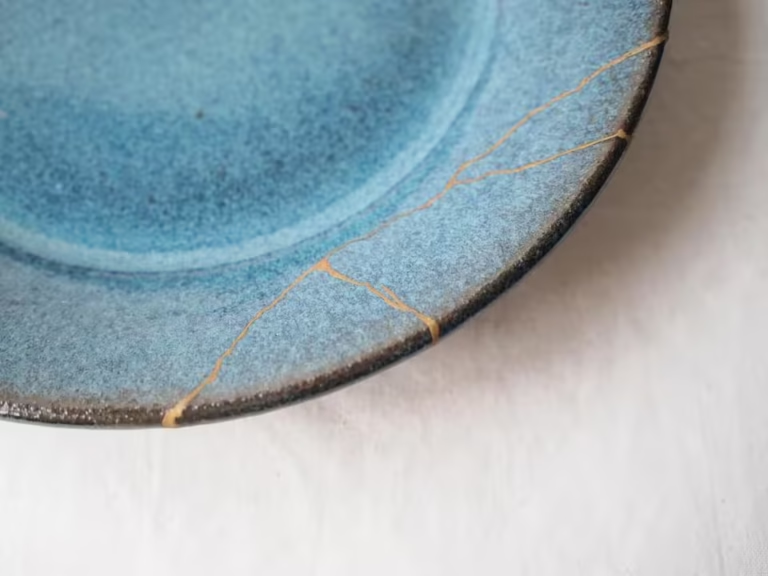
You hold the bowl. The crack runs from rim to base — thin as a hair, decisive as a scar. In most hands, this is the end of the story. In Japan, it is the moment the story earns its depth.
What Is Kintsugi
A bowl arrives at the craftsperson's bench in pieces. The fracture is clean in some places, ragged in others — the particular violence of a fall recorded in the ceramic's edge. A Western restorer would sand the seam invisible, match the glaze, return the object to the fiction of wholeness. The kintsugi practitioner does something different. They mix urushi lacquer with pure gold powder, fill the crack with it, and let it set. The repair does not disappear. It glows.
The name kintsugi (金継ぎ) is composed of two characters: 金 (kin, gold) and 継ぎ (tsugi, to join). To join with gold. The practice bonds broken ceramic pieces using urushi lacquer — derived from the sap of the urushi tree — and finishes each seam with powdered gold, silver, or platinum. It is also known as kintsukuroi (金繕い), golden repair, a term that remains in use among older practitioners.
What the gold line does is not decorative. It is a declaration. The history of the object — the moment it fell, the decision to restore it, the weeks of patient curing — is now visible in the surface. You can trace it with your eye. Craftspeople call this keshiki (景色): the topography of the repaired piece, like a landscape shaped by erosion. The bowl has become a record of what happened to it. That record is the point.
Where Western restoration traditions treat damage as something to be erased, kintsugi treats it as something to be acknowledged. The history of an object is not separate from its value. It is part of it. Breakage, properly honoured, does not diminish — it deepens.
The Legend of the Bakōhan Bowl
The story begins with a shogun and a bowl he could not bear to lose. Ashikaga Yoshimasa, the eighth shogun of the Muromachi shogunate, owned a Chinese celadon tea bowl known as the Bakōhan. In the fifteenth century, the bowl cracked. He sent it to China for repair. It came back held together with metal staples — large, crude, unmistakeable against the celadon glaze. Functional. Deeply inelegant.
Japanese craftspeople found this answer insufficient. They began looking for something else — a way of returning the bowl to use that did not treat the repair as a problem to be hidden. Working with urushi lacquer, a material already refined through centuries of Japanese craft, they developed a method that filled the seam, held the fragments, and finished the line in gold. The crack did not disappear. It became the most beautiful part of the bowl.
Kintsugi grew within the world of chanoyu (茶の湯) — the Japanese tea ceremony, which was then becoming one of the country's most demanding aesthetic and spiritual disciplines. In that context, the vessel from which tea is drunk is considered the most sacred of all utensils: the one object that passes between the hands of host and guest. A repaired bowl was not a compromised bowl. It was a bowl with a history — and in the tea ceremony, history was not a flaw. It was what made an object worth holding.
Over the centuries that followed, kintsugi moved beyond the tea room. It became something closer to a philosophy — a material argument, made in gold and lacquer, that the marks time leaves on things are not to be erased. They are to be made visible.
The Philosophy
Pick up a kintsugi bowl. Turn it in the light. The gold line catches differently at each angle — sometimes sharp and bright, sometimes warm and almost amber. You are not looking at a flaw that has been decorated. You are looking at a record. The bowl fell. Someone decided it was worth keeping. That decision is what the gold makes visible.
This is the territory that wabi-sabi (侘び寂び) occupies — the Japanese sensibility that does not merely tolerate imperfection but actively finds it more interesting than its absence. Wabi-sabi is not a style or an aesthetic trend. It is a way of paying attention: to the asymmetry that signals a human hand, to the surface that shows its age, to the crack that says this object has been somewhere and returned. Where uniformity signals production, irregularity signals a life.
There is also something in the gold lines that connects to the Japanese concept of ma (間) — the meaningful interval, the space between things that gives them their shape. In a kintsugi vessel, the seams introduce rhythm into an object that was previously seamless. The bowl now has lines of tension, movement, pause. It has a cadence it did not have before. The repair has not made the bowl whole again. It has made it something it was not before it broke.
You can find this argument everywhere in Japanese material culture — in the lacquerware that is meant to darken with use, in the ceramic glaze that shifts across decades of handling, in the garden stone that is valued more for what weather has done to it than for what the mason carved. Kintsugi is perhaps the most direct expression of this logic: the damage is not despite the object's value. The damage is part of it.
Traditional vs. Modern Methods
Walk into a shop selling kintsugi pieces and you will encounter two entirely different things that share a name. One uses natural urushi lacquer and pure gold powder, takes months, and produces a repair that will outlast the bowl it mended. The other uses epoxy resin and brass powder, takes an afternoon, and looks similar in a photograph. The difference matters — and it matters more the closer you look.
Genuine hon-urushi (本漆, true lacquer) kintsugi grows harder and more lustrous with the years. The urushi surface develops a depth that synthetic alternatives cannot replicate — a quality that Japanese craftspeople describe as coming alive in certain light. Pure gold powder does not tarnish. In a well-lit room, next to a piece finished with brass, the distinction is immediate and irreversible.
| Traditional Kintsugi | Simplified Kintsugi | |
|---|---|---|
| Materials | Natural urushi lacquer, wheat starch paste, wood powder, pure gold / silver / platinum powder | Epoxy resin, cyanoacrylate adhesives, brass powder |
| Food Safety | Fully food-safe once cured. Safe for hot liquids. | Varies by resin; food safety uncertain with some products. |
| Completion time | Several weeks to several months | Hours to a few days |
| Durability | Exceptional — pieces repaired with traditional urushi can last centuries | Lower — epoxy degrades with heat; brass powder oxidises and darkens |
| Finish | A deep, organic lustre that deepens with age | Bright initially, but loses vibrancy over time |
The Cost of Repair
You bring the bowl to a craftsperson. The break is clean — two pieces, a single fracture running the circumference. They examine it the way a surgeon examines an X-ray: tracing the line, assessing the edge, calculating what the repair will require. They do not name a price immediately. They look at the bowl first.
- Minor chip (a few millimetres) From ¥5,000
- Multiple fractures — a typical teacup or chawan ¥15,000 – ¥40,000
- Prestige finishes — thick-laid pure gold, complex repair ¥100,000 and above
These figures are not simply the cost of labour. They are the cost of shokunin-damashii (職人魂) — a phrase that has no clean English equivalent but means, roughly, the ethical commitment of a craftsperson to their work. The willingness to repeat a process until it is right, regardless of the time it takes. The refusal to move to the next stage before this one is ready. The understanding that a piece bearing one's name carries one's reputation into every room it enters.
A kintsugi master may spend weeks on a single bowl — laying lacquer, waiting for it to cure to the correct hardness, laying more, waiting again — before the gold is ever touched. The bowl you receive is not what you sent. It is what the bowl became during the months someone spent deciding it was worth the attention.
Owning a Kintsugi Piece
Not every kintsugi piece begins with a bowl that has broken in your hands. A separate tradition has developed around pieces made specifically as objects to be owned and contemplated: antique ceramics — sometimes shards, sometimes fragments from multiple sources — repaired by master craftspeople into works where history is not the backstory but the material itself.
Yobitsugi — Calling Together
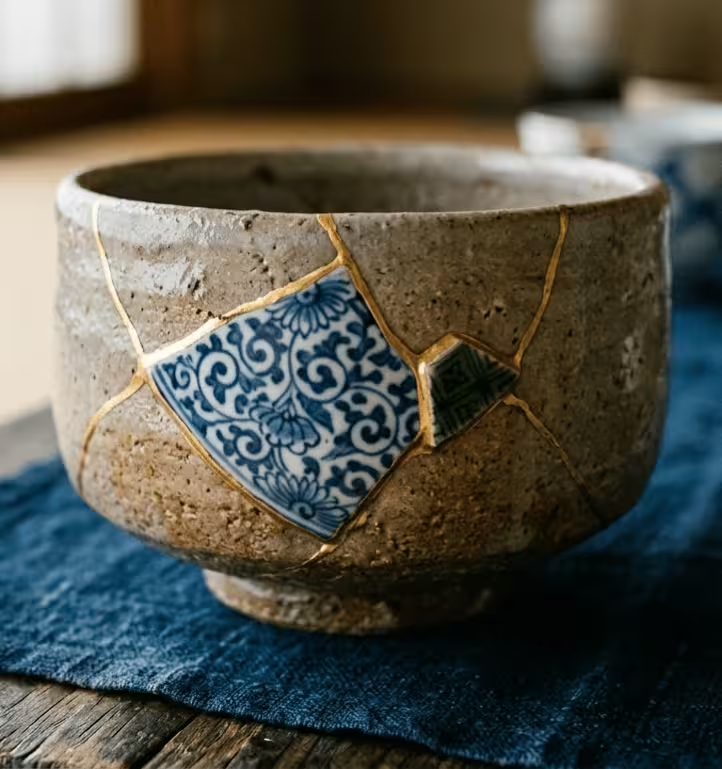
The most extraordinary expression of this tradition is yobitsugi (呼び継ぎ). The name comes from yobu — to call or summon — and tsugi — to join. It describes the act of calling together fragments from entirely different objects: different centuries, different kilns, different decorative traditions, and assembling them into a single new vessel.
A Meiji-period Imari shard fills a gap in an Edo-period Bizen bowl. Shards of blue-and-white porcelain complete a tea bowl whose original fragments are lost. The result is not reconstruction. It is something closer to collage — an object that holds within it multiple unrelated histories, made coherent by the craftsperson's decision to bring them together. No two yobitsugi pieces are the same. Each is a singular conversation between objects that never expected to share a form.
What to Look for When Acquiring a Kintsugi Work
Start with the base ceramic. Works built on pieces with established provenance — Imari, Bizen, Karatsu, Hagi — carry cultural weight that is part of the object's meaning. A kintsugi repair on a Bizen tea bowl is not the same as the same repair on an anonymous piece; the history the gold is honouring matters.
Then look at the gold lines themselves. A master's repair moves with certainty. The seam does not waver or pool. It has the quality of a deliberate brushstroke — not a fill. True urushi has a depth and quiet luminosity that synthetic alternatives cannot replicate. In good light, the surface appears almost to shift. You notice it without being able to say exactly what you noticed. That quality is what you are paying for — and it is what lasts.
Kintsugi Pieces, Kits & Recommended Studios
A curated selection of kintsugi works, artisan products, and recommended studios — with notes on provenance, materials, and what to look for at each price point.
Explore Kintsugi Picks →Making It Yourself
You lay the fragments on the mat. The break is clean. You have the lacquer, the wheat paste, the small brush. You apply the first layer and set it aside. Now you wait — not for minutes but for days, in a box with a damp cloth, while the urushi cures in the humidity it needs. This is the first thing the practice teaches: that you are not in charge of the timeline. The material is.
Working with your hands on a kintsugi repair requires a quality of attention that ordinary tasks rarely ask for. The pace is not natural to modern life. You cannot rush the curing. You cannot skip the intermediate layers. Each stage must be right before the next one begins. Many people who come to kintsugi expecting a craft project find themselves in something closer to a practice — the kind that changes how you move through the hour you give it.
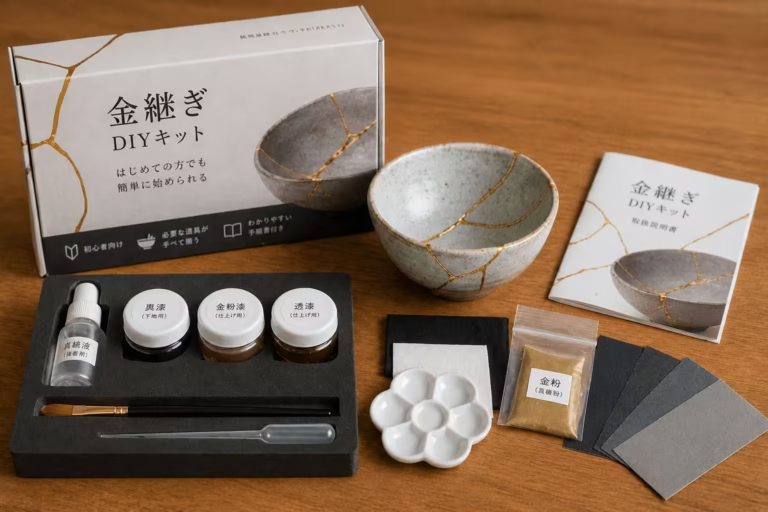
The best home kits use natural urushi lacquer: the authentic material, which produces repairs that are food-safe, structurally sound, and genuinely durable. Most quality traditional kits include urushi lacquer, wheat starch paste, wood dust for filling, and pure gold or silver powder. A note for those with urushi sensitivity: urushi contains urushiol — the same compound found in poison ivy — and can cause skin reactions during the uncured stages. For those who are sensitive, kits using new-urushi (derived from cashew resin) offer a close equivalent without the allergy risk. The resulting repair is not meaningfully different in appearance.
Kintsugi Kits and Workshops
A curated selection of beginner and intermediate kits, as well as in-person and online kintsugi workshops — including options suited to those with urushi sensitivity.
View Kits & Classes → Both traditional urushi and allergy-friendly alternatives are included.Frequently Asked Questions
What is the difference between kintsugi and kintsukuroi?
Both terms refer to the same practice of repairing ceramics with lacquer and gold. Kintsugi (金継ぎ) is the more commonly used name today. Kintsukuroi (金繕い) is an older term, still used, which translates more literally as "golden repair." The practice and the materials are identical; the difference is purely one of terminology.
Is kintsugi food-safe?
Traditional kintsugi using natural urushi lacquer is fully food-safe once the lacquer has cured completely — a process that requires controlled humidity and temperature and takes several weeks to months. Cured urushi is one of the most durable natural coatings known, and is safe for hot liquids. Simplified kintsugi using epoxy resins varies by product; food safety cannot be assumed and should be confirmed with the manufacturer before use with food or drink.
How long does a traditional kintsugi repair take?
A traditional repair using natural urushi lacquer takes several weeks to several months, depending on the complexity of the damage. Urushi requires careful curing at controlled humidity levels — typically between 70% and 85% relative humidity — and each layer must be allowed to cure fully before the next is applied. A master craftsperson may apply and cure multiple layers of lacquer before the final gold finish. This is not inefficiency. It is the nature of the material, and the reason traditional kintsugi repairs last for centuries.
Can I learn kintsugi without any prior experience?
Yes. The fundamental technique — bonding fragments with lacquer and finishing with gold powder — is accessible to beginners, and a number of well-designed kits provide everything needed to start. The first repair will not be perfect. This is consistent with the philosophy. What the process teaches — patience, attention, working slowly with a material that sets on its own terms — cannot be learned quickly, and is not diminished by being learned for the first time.
What is yobitsugi, and how is it different from standard kintsugi?
Standard kintsugi repairs a vessel using its own fragments, joined with lacquer and gold. Yobitsugi (呼び継ぎ) — literally "calling together" — takes fragments from entirely different objects and assembles them into a single new vessel. A piece of Meiji-era Imari porcelain might fill a gap in an Edo-period Bizen bowl. The result is not reconstruction but something closer to collage: a new object that carries multiple, unrelated histories within one form. Among serious collectors, yobitsugi pieces are particularly valued for exactly this reason — each is irreducibly singular.
The bowl you hold at the end of a kintsugi repair is not the bowl you started with. It is not the bowl before it broke. It is what the bowl became — in the breaking, in the decision to stay with it, in the months of patient work that followed. The gold does not restore. It records.
Authentic is not a style. It is a discipline.
This article contains links to our curated Kintsugi Picks page, which includes affiliate links. If you purchase through those links, Untranslated Japan may earn a commission at no additional cost to you. All recommendations reflect independent editorial judgment.