
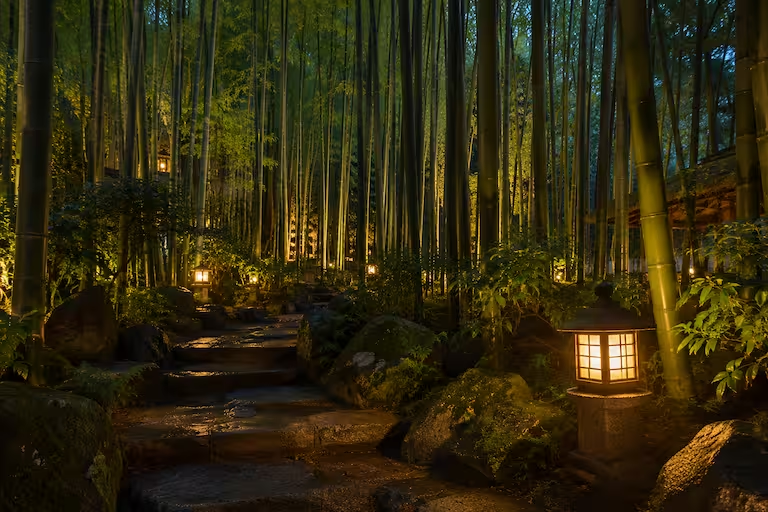
The lanterns come on just after dusk. There is no announcement. A member of staff appears quietly, moving along the edge of the pond, lighting each flame in turn. The Noh stage floats on the water before you, its reflection shifting with each small ripple. You are probably sitting on the engawa, the narrow veranda outside your room, watching. Not thinking about anything in particular. That is how Asaba begins.
Asaba is a traditional ryokan in Shuzenji, a small onsen town in the Izu Peninsula of Shizuoka Prefecture, roughly ninety minutes from Tokyo by train. It has been here, in one form or another, for more than five hundred years. It holds just sixteen guest rooms. It is a member of Relais & Châteaux — one of very few Japanese inns to carry that designation — and is sometimes described, with characteristic Japanese understatement, as the grand champion of the east.
None of those credentials quite explain what Asaba is.
Guests who have stayed here often struggle to articulate why it affected them as deeply as it did. The view is extraordinary, yes. The food is precise and considered. The service is warm without being performative. But beyond all of that, people return saying something harder to name: that time moved differently here. That they slept in a way they hadn't in years. That when they walked back through the gate on the morning of their departure, something fell away — and they weren't ready for it to.
That experience is not accidental. Asaba has been designing it, generation by generation, for five centuries.
A Stage with No Audience
The first thing you see when you enter Asaba is the Noh stage.
It stands — or seems to float — at the edge of a pond that covers roughly six hundred tsubo, around two thousand square metres. The roof curves upward at the corners. The pillars are lacquered dark. The whole structure is mirrored in the water below. Depending on the time of day and the season, the image shifts: pale in morning mist, sharp and golden in late afternoon, luminous in the dark.
The stage is called Gekkeiden — the Hall of the Moon and Laurel — and its history is older than Asaba itself. It was originally donated by Toshika Maeda, the final lord of the Daishoji domain in Kaga Province, to the Tomigaoka Hachimangu shrine in Fukagawa, Tokyo. In the late Meiji period, the seventh-generation owner of Asaba had it dismantled, transported several hundred kilometres, and reassembled at the edge of this pond in Shuzenji. The stage carries within it two distinct histories: that of the Edo-era aristocracy who built it, and that of the family who chose to give it a new home.
Noh is among the oldest theatrical forms in the world, and one of the most deliberately still. Where other performance traditions build toward climax, Noh expands into silence. A mask that has not moved will seem, to a patient observer, to change expression as the light shifts. A gesture held a moment too long becomes unbearable. What is not done is as significant as what is.
To stay at Asaba and watch this stage — not during a performance, simply over the course of a day and into the evening — is to absorb something of that philosophy without being taught it. The stage is there. The water holds its reflection. The light changes. Nothing is explained.
For those who wish to go further, there is the Shuzenji Geijutsu Kiko — roughly, the Shuzenji Arts Journey — a series of classical performances that Asaba has hosted for around forty years. Noh, Kyogen, Shamisen, Bunraku puppet theatre, and Biwa lute recitals are presented by some of Japan's most distinguished practitioners, including Living National Treasures. The performances take place on Gekkeiden itself, in darkness, with the audience watching from the inn. It is the kind of evening that alters what you consider possible from a hotel stay.
Five Hundred Years in the Same Valley
Shuzenji carries its history close to the surface. The hot springs here are said to have been discovered by the Buddhist monk Kukai — known posthumously as Kobo Daishi, the founder of Shingon Buddhism in Japan — in the early ninth century. According to the legend, he struck a rock with his staff beside the river to create the waters, which he offered to a sick old man he found bathing in the cold stream. The spring that follows from that act of compassion, if you accept the story, has been flowing for over twelve hundred years.
The history of the town grows darker in the Kamakura period. Minamoto no Yoriie, the second shogun of the Kamakura shogunate, was confined here by his political rivals and assassinated in 1204. The temple that gives the town its name — originally built by Kukai — stands above a narrow river gorge and holds the weight of that history quietly.
Asaba was founded into this landscape more than five centuries ago. The origin is modest: a man named Yukitada Asaba, who had accompanied a Zen monk to Shuzenji, opened a small lodging house beside the temple gate while serving as its caretaker. From that guesthouse, ten generations of the Asaba family have built, refined, dismantled, moved, and rebuilt — always in the same place, always with the same core conviction about what hospitality should feel like.
Ten generations is long enough that the concept of "tradition" starts to feel inadequate. What has been passed down at Asaba is not a set of practices, but a set of judgements: what to keep, what to release, what to bring in from elsewhere. The Noh stage was brought in. The contemporary art — works by Tatsuo Miyajima and Lee Ufan hang in the salon and lobby — was brought in. The bespoke bedding was developed and refined over decades. At every turn, the question being asked is not "what has always been done?" but "what should be done now?"
The answer, again and again, has been: less. And more carefully.
The Waters Beneath the Bamboo
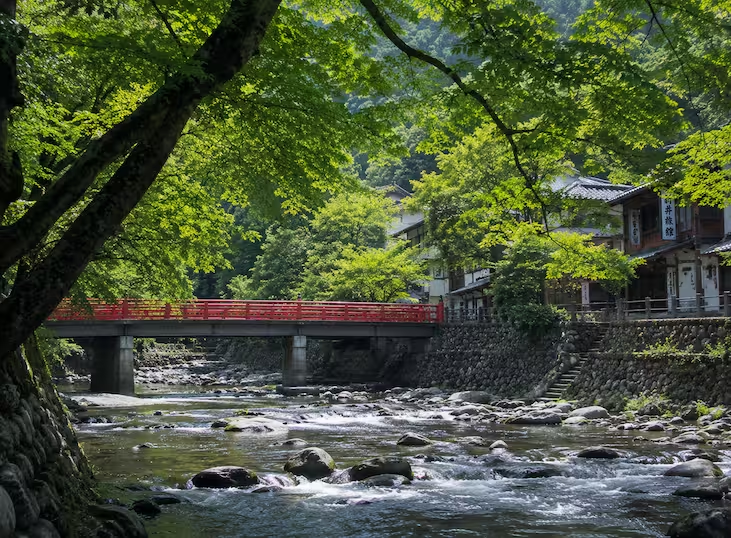
The story goes that Kukai created Shuzenji's hot spring by striking a riverside rock with his staff. Whether or not you take the legend literally, the water that flows through Asaba's baths is genuinely ancient — a sodium bicarbonate spring, known to be gentle on the skin and nervous system, that has been flowing here for centuries.
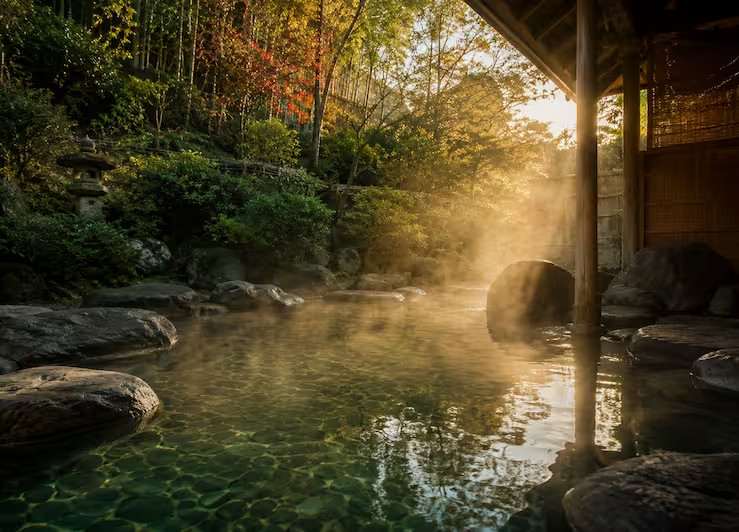
There are three ways to take the waters at Asaba. The outdoor bath — the rotenburo — looks out over bamboo and the pond, and is divided by time between men and women. The indoor hinoki cypress bath runs on a natural flow-through system, never recirculated, always at source temperature. And there is a private bath, reservable at any time without advance notice, for those who want the water entirely to themselves.
The no-reservation policy on the private bath is worth pausing on. Most ryokan that offer private bathing require you to book hours ahead. Asaba removes that friction entirely. The decision to bathe — like the decision to walk in the garden, or to sit in the salon, or to return to your room and do nothing — should be made on impulse, in the body's own time. Administration should not interrupt the rhythm of a stay.
Guests write about returning to the baths again and again — three, four, five times over the course of a night and morning. This is less about the water's particular qualities than about what surrounds it: the bamboo sound, the cold air above the steam, the distant reflection of the stage on the pond. The bath at Asaba is not a wellness amenity. It is part of a continuous sensory environment that you move through and return to, like breathing.
A Kitchen That Knows What to Leave Out
There are no theatrical presentations. No ingredient lists recited tableside. No towers of rare seafood assembled for visual impact. The cuisine at Asaba is kaiseki in spirit — seasonal, sequential, considered — but guided by a principle that might be summarised as: the best ingredient, prepared to let you taste it, served at the precise moment it should be eaten.
That last part matters more than it sounds. At Asaba, the kitchen and serving area are located adjacent to each guest room, not in a centralised catering space. Hot food arrives hot. Cold food arrives cold. The dashi, which underpins almost every dish in the Japanese culinary tradition, is prepared with a consistency that guests notice even if they cannot name what they are tasting. It is the kind of cooking that reveals itself slowly, over the course of an evening, as something more than the sum of its individual dishes.
The Dishes Worth Knowing
In summer, sweetfish — ayu — caught from the Kanogawa River is served simply, over charcoal, with the river's mineral character still present in the flesh. From autumn through winter, the Amagi Shamo chicken — a heritage breed raised in the mountains of the Izu interior — is minced and formed into small dumplings, simmered in a light broth with green onion. The broth absorbs the flavour of the bird over the course of the pot. At the end, rice and egg are added. The result is something that sounds unassuming and tastes, to the right palate, exactly right.
Year-round, the inn is known for its Anago Kurogome Zushi: conger eel pressed with black rice into a dense, subtly sweet sushi that has no obvious precedent elsewhere. And for breakfast — served in the room, unhurried, as the morning light enters — a bowl of freshly cooked rice is brought with shaved bonito and local wasabi, beside a tamago-yaki rolled egg made to order, and dried fish air-cured on the premises. Regulars say they return partly for this breakfast. It is not complicated. That is the point.
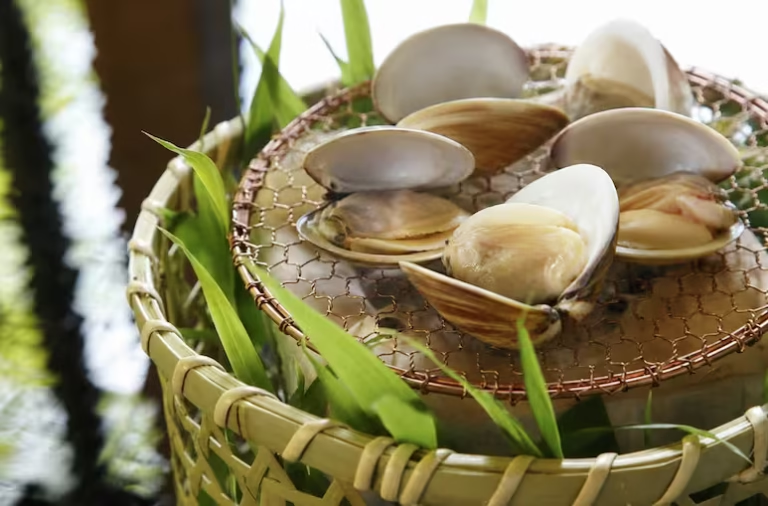
Those seeking elaborate luxury ingredients — premium wagyu, sea urchin towers, gold leaf — will find them available as optional additions. But the core meal, as designed, is a lesson in reduction. What remains when you remove everything unnecessary is not emptiness. It is clarity.
Hospitality That Anticipates, Not Interrupts
On the morning of departure, the okami — the inn's mistress, the woman who holds the whole enterprise together — comes to the gate to see you off.
Guests write about this moment more than almost any other. Several have described it as the instant the spell breaks: you step through the gate, the outside world re-enters your field of awareness, and you feel something close to grief. Not because anything dramatic happened. Because something quiet and consistent has been quietly and consistently held around you for the past day or two, and now it is not.
That quality of care is difficult to systemise, which is why it has to be cultivated rather than trained. At Asaba, the nakai — the room attendants — are present without being obtrusive. They anticipate without asking. The rhythm of the stay — when meals arrive, when the bath is checked, when the futon is prepared — follows an internal logic that you feel before you understand it.
The bedding itself is a minor expression of this ethos. The inn's owners have spent years sourcing and testing the futon and linens, commissioning bespoke sets rather than accepting standard hospitality-grade materials. The criterion, according to those who manage it, is simple: you should feel nothing — no pressure, no texture, no temperature — only the absence of discomfort and the presence of rest. Some guests have purchased the bedding set to take home. This is, in its way, the highest endorsement a ryokan's sleep can receive.
The trust that accumulates across these details — the meal that arrived at the right temperature, the bath that was ready when you wanted it, the staff member who appeared precisely when you needed something and nowhere else — is not built in a single night. It is the product of a place that has been keeping its promises, in the same valley, for five hundred years.
How to Read Asaba — Choosing Your Room
Asaba's sixteen rooms divide, roughly, into three temperaments: those that face the Noh stage and ask you to witness; those that turn toward the garden and ask you to listen; and one that stands apart entirely, asking nothing except that you remain.
Hanare Tenko does not share a wall with the main building. You reach it along a private tatami corridor, and when you arrive, the separation feels physical: the sounds of the inn recede, and what remains is the murmur of a stream, the shift of bamboo, the particular silence of a garden designed for no one else.
At 220 square metres, it is Asaba's largest accommodation. Yoshino cedar, grain-straight and fragrant, lines the ceiling. The floors are finished in the naguri technique — hand-adze marks left deliberately visible, each one a record of a craftsman's decision. The bath is stone and hinoki cypress, fed by a source-flow spring, open to the garden. At night, the bamboo beyond the tub is softly lit. Above it, stars.
Tenko is the only room at Asaba that accepts children under seven, and accommodates up to seven guests — making it the rare luxury that works for three generations under one roof without losing an inch of its composure. Plan early.
Villa Tenko — Official Hotel Site
Multi-generational stays, families with young children, complete privacy. Up to 7 guests. The only room accepting children under seven.
View at Asaba Official Site →At 126 square metres, this second-floor suite was redesigned to do one thing exceptionally well: place the Noh stage — Gekkeiden, floating on its pond — directly in your line of sight from almost every position in the room.
The main room holds a low daybed alongside the traditional tatami. Lie back and the stage fills the middle distance like a painting that changes with the hour: sharp-edged in afternoon light, dissolved in morning mist, luminous against dark water after the lanterns are lit. The bedroom maintains its own view of the stage — so the last thing you see before sleep and the first thing you see on waking are the same.
The half-open bath is fitted with a koyamaki cypress tub. Open the window fully and the steam carries the cold air of the garden into the room. The Noh stage is visible from the water. This is, for many guests, the single most memorable hour of their stay.
Hagoromo — Official Hotel Site
First visit or anniversaries. Unobstructed view of the Noh stage from bed, bath, and sitting room.
View at Asaba Official Site →Nadeshiko does not face the Noh stage. This is not an oversight — it is a different proposition. The room looks toward bamboo, a waterfall, and the terraced hillside garden; its orientation is inward and seasonal rather than theatrical. Where Hagoromo offers spectacle, Nadeshiko offers duration.
The room was created by combining two former guest rooms into one: 97 square metres with an 18-tatami bedroom, a separate sitting room, and a broad hiroen — a sunroom-like veranda where the arriving guest is first received with fresh-made fu-manju and tea. The television is hidden behind a cabinet door. The tokonoma holds a single scroll and one flower. The bamboo beyond the window does the rest.
In summer, the green is almost overwhelming — alive, layered, catching every variation of light. In autumn, the hillside turns. The sound of the waterfall is constant, and once you have stopped noticing it consciously, you will notice how quiet everything else is. Nadeshiko is the room for guests who understand that stillness is not the absence of movement. It is the presence of the right kind.
Nadeshiko — Official Hotel Site
Return guests and solo travellers. Garden and waterfall orientation. 97 square metres with separate sitting room and sunroom veranda.
View at Asaba Official Site →When to Come
Each season at Asaba is distinct enough to warrant its own visit. Spring brings the shidare-zakura — weeping cherry — to several of the garden-facing rooms, and the contrast of blossom and still water is difficult to improve upon. Summer introduces the ayu sweetfish and, in the evenings, fireflies along the Kanogawa river and the inn's outer garden. Autumn through winter is the season of the Amagi Shamo chicken pot and the deepening silence that comes when the summer visitors have gone. The classical performances of the Shuzenji Geijutsu Kiko fall most frequently in these months.
Weeping cherry blossom against still water. Best: late March to late April.
Ayu sweetfish from the Kanogawa. Fireflies in the outer garden at dusk.
Amagi Shamo chicken pot. Performing arts programme in full swing.
Deepest silence. Lanterns on the stage against cold air. The most private season.
If you want to attend one of the Shuzenji Geijutsu Kiko performances, contact the inn directly well in advance. The schedule changes seasonally and is not always listed publicly. An evening performance on Gekkeiden changes the quality of the whole stay — it is worth the planning.
Practical Information
Shinkansen to Mishima (~45 min on Hikari), then Izu-Hakone Railway to Shuzenji Station (~30 min), then taxi (~7 min)
3450-1 Shuzenji, Izu City, Shizuoka Prefecture
Check-in: 14:30 / Check-out: 11:30
Approx. ¥70,000–¥200,000+ per person per night, inclusive of dinner and breakfast
Under seven not accepted in most rooms. Villa Tenko is the exception.
Minimum two-night stay required on 31 December and 1 January
Questions
Is Asaba worth the price?
This is a question worth answering directly. Asaba is expensive — currently in the range of ¥70,000 to well over ¥200,000 per person per night depending on the room and season, inclusive of dinner and breakfast. If you are comparing it against other forms of luxury travel — business-class flights, high-end city hotels, destination restaurants — Asaba will often come out ahead in terms of what it leaves behind. It is one of those rare experiences that guests report having thought about for months afterward. The consistency of that response, across many different kinds of travellers, suggests that what Asaba provides is not merely comfortable but genuinely formative.
Do I need to know anything about Noh to appreciate Asaba?
Not at all. In fact, arriving without expectations about Noh may be an advantage. The stage's presence in the garden — the way it holds the light, anchors the view, organises the silence around it — communicates something before and beyond any knowledge of its artistic tradition. If a performance is scheduled during your stay and you attend, you will understand less than a Japanese specialist and more than you think. That gap is part of the experience.
When is the best time of year to visit?
There is no wrong season at Asaba, but a first visit might most naturally fall in autumn — late October through December — when the garden is at its most atmospheric, the Amagi Shamo chicken pot is on the menu, and the performing arts programme is in full swing. Spring is compelling for the cherry blossom; summer for the ayu and the fireflies and the particular quality of early-morning light over the pond. Shuzenji's appeal in winter is quieter and more personal.
Can non-Japanese-speaking guests enjoy Asaba fully?
Yes. Asaba has hosted international guests for many years, and its Relais & Châteaux membership reflects a history of engagement with non-Japanese visitors. English-speaking staff are available. More to the point, the core of what Asaba offers — the garden, the stage, the water, the silence, the food, the quality of sleep — requires no translation. Some things that cannot be translated are also the things that do not need to be.
How does Asaba compare to other top ryokan, such as Tawaraya or Hiiragiya in Kyoto?
The comparison is worth making carefully, because all three are genuine masterworks of Japanese hospitality, and choosing between them is a matter of temperament rather than quality. Tawaraya and Hiiragiya belong to Kyoto — they are inseparable from the cultural density of that city. To stay there is to be at the centre of something. Asaba, by contrast, places you at the edge of a valley, beside a river, in a town that has been held quietly out of the way of mainstream Japan for most of its history. The silence at Asaba is structural, geographical. It is not curated; it is grown. For those who come to Japan seeking a particular quality of stillness rather than cultural saturation, Asaba is frequently the right answer.
After a Noh performance ends, the stage is empty. The lights remain. The water holds whatever reflection it can find. And in that silence — after the performers have gone — something lingers that was not there before the performance began. Noh practitioners would call this yugen: the profound, mysterious sense of the universe that great art leaves behind. It does not translate cleanly into English. Few worthwhile things do.
The gate you walk through on the morning of your departure is the same gate you arrived through. But it feels different. Something has been arranged inside you, without your quite noticing.
Some things cannot be translated. Asaba is one of them. That is exactly why it is worth making the journey.