
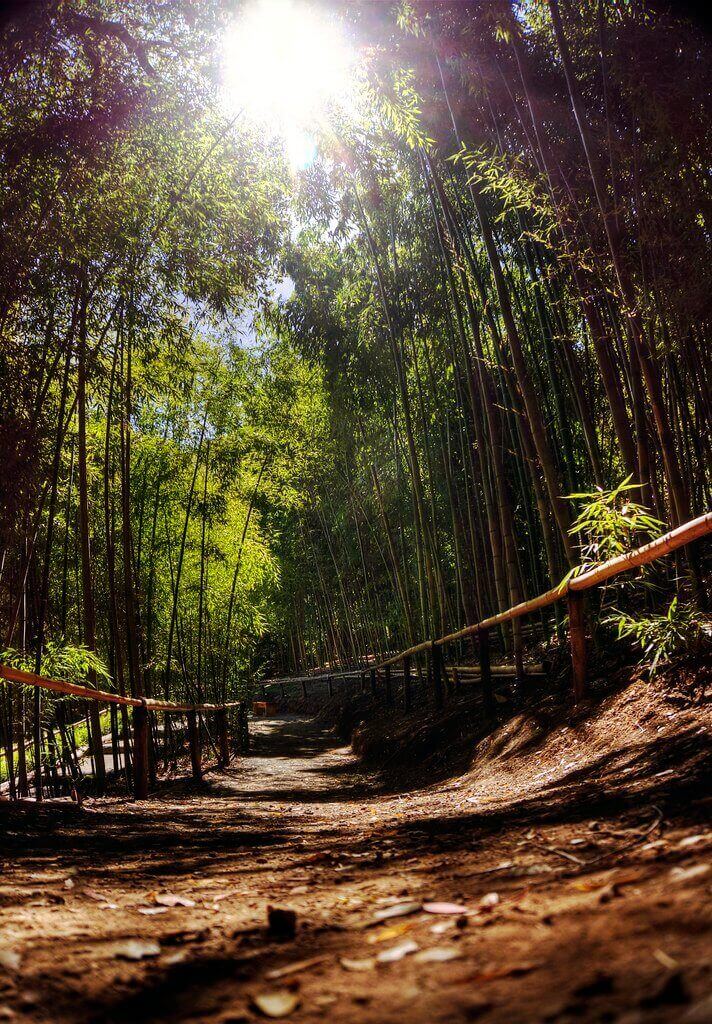
Past the hot spring town of Atagawa, the road narrows and bends toward the mountains. There are no signs worth noting. No souvenir stalls, no crowds gathered around a public footbath. What waits at the end of a lane cutting through bamboo is a garden of roughly 10,000 square metres — and a ryokan that asks nothing of you except that you arrive.
Why Oku-Atagawa — and Why It Matters Where You Go
Among the hot spring towns scattered along Izu's eastern coast, Atagawa has long been associated with water of particular intensity. The prefix oku — meaning inner, or deep — signals something further still: a stretch of the valley where the tourist infrastructure simply ends. No convenience store within easy reach. No late-night noise. The mountain and the heat rising from beneath it.
Gyokusui was built here for reasons that feel deliberate rather than incidental. In an era when ryokan compete on lobby aesthetics and elaborate buffet spreads, this inn has held to a single organising principle: quiet. Thirteen rooms is a considered number. It means the corridor is wide enough that you never hear the conversation in the next room. It means the handful of guests passing at breakfast are strangers who feel, somehow, like companions in the same private choice.
The guests who come here are not searching for something. They have come to set something down.
The Philosophy of the Yumori — Keeping 100°C Water Fit to Bathe In
There is something worth knowing before you step into a bath here. The water emerges from the ground at close to 100°C.
No one bathes in 100°C water. But at Gyokusui, diluting it with cold water is treated as a last resort — something that weakens the mineral content and, in the inn's view, diminishes the spring itself. So what do they do? A yumori — a hot spring keeper — adjusts the temperature by hand, every day. Reading the outdoor air, the season, the flow rate, the volume of each bath, finding a way to bring the water to a comfortable temperature without compromising what makes it worth bathing in. It is a craft. There is no industrial system that can replicate it.
To say a spring is kakenagashi — free-flowing, undiluted — is to say that the water is alive. No two baths are identical. The rotenburo you enter at midnight and the indoor bath you step into at dawn are, strictly speaking, different water. To know this while bathing at Gyokusui is to experience something that goes well beyond relaxation.
The Baths — What Is Available and How They Differ
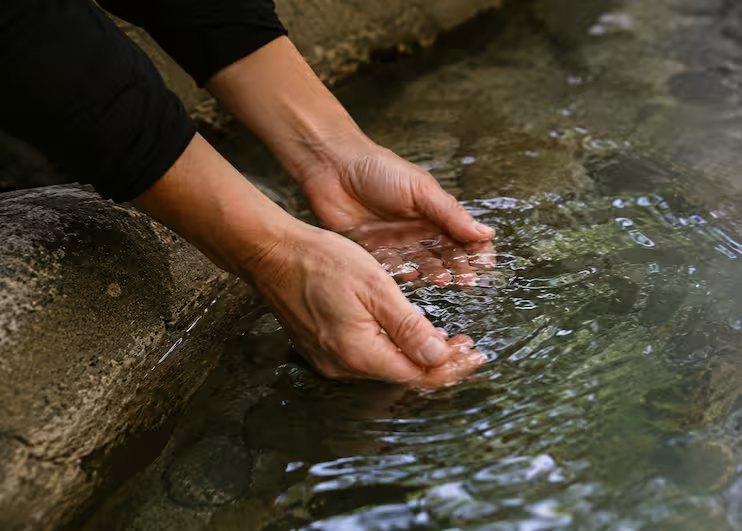
Gyokusui's bathing options fall into three distinct forms. Rooms with a private open-air or semi-open bath allow you to enter at any hour — midnight, before dawn, whenever the impulse arrives — without a reservation or a shared timetable. Private reserved baths, booked in advance, give couples and families a larger rotenburo entirely to themselves; the absence of other eyes changes the quality of stillness in ways that are difficult to describe but easy to feel. The large communal baths — indoor and open-air, alternating between men's and women's sides each morning and evening — remain the centre of the experience for solo travellers.
Choosing Your Room — A Guide by Purpose
In an inn of thirteen rooms, the choice of room shapes the entire stay. The right answer depends on the nature of the journey you're making.
For a first stay, this is where to begin. The inn's own spring water, drawn from deep beneath the property, becomes yours to use without a clock or another person in sight. For anniversaries, honeymoons, or simply a marriage that deserves an unhurried night — having the bath in the room changes what the hours mean. Waking at two in the morning and stepping directly into warm water under an open sky is something a ryokan can offer that almost nothing else can.
Japanese Style Room with Garden · Open-Air Bath with Free-Flowing Source
First visit or couples. Private bath with kakenagashi spring water. Book via Trip.com — English interface, international cards accepted.
Book with Trip.com →For those who want not to look at the garden but to inhabit it. From a window facing the grounds, the light shifts across the bamboo through the morning and afternoon in ways that repay attention. This room suits a particular kind of traveller: one who has deliberately left the itinerary empty. Reading, sitting, watching the way a garden behaves in different weather — these are things the room accommodates rather than interrupts.
Renovated 2024 · Japanese and Western Special Room · Garden View · Footbath Tree Terrace
For slow stays and garden views. Indoor bath. Book via Trip.com.
Book with Trip.com → For those working with a tighter budget: comparing plans without meals is reasonable. That said, Gyokusui's identity is assembled from three things together — the water, the food, the garden. On a first visit, a plan with both dinner and breakfast gives a more accurate picture of what this place actually is.10,000 Square Metres — Ma Made Visible
The garden at Gyokusui covers roughly 10,000 square metres. To describe this as an amenity would be to miss the point entirely. A garden of this scale in a ryokan context is not meant to be admired from a distance. It is meant to be occupied — walked through slowly, returned to at different hours, sat beside while something other than thought takes over.
The bamboo grove is its centre. Bamboo appears still but is always moving: the sound of the leaves shifts with every change in wind, and the depth of the green varies hour by hour with the angle of light. Walking through Gyokusui's bamboo is to stand inside a season rather than observe one from outside. In early spring the shoots push up through the ground. In summer the canopy filters the light into fragments. In autumn and winter, lanterns illuminate the grove at night, casting a depth into the garden that daylight alone does not produce.
A water-mirror terrace — added in a recent renovation — fits the existing grammar of the garden without announcing itself. Sky and bamboo reflect in the surface below. It is an embodiment of ma: the Japanese concept of meaningful interval, of the space between things carrying as much weight as the things themselves. Some rooms include a terrace with a hammock. To lie in it facing upward, bamboo behind you, is to encounter the kind of stillness that makes the word "travel" feel briefly inadequate.
Dinner as Ceremony — On Dashi, Vessels, and the Rhythm of a Meal
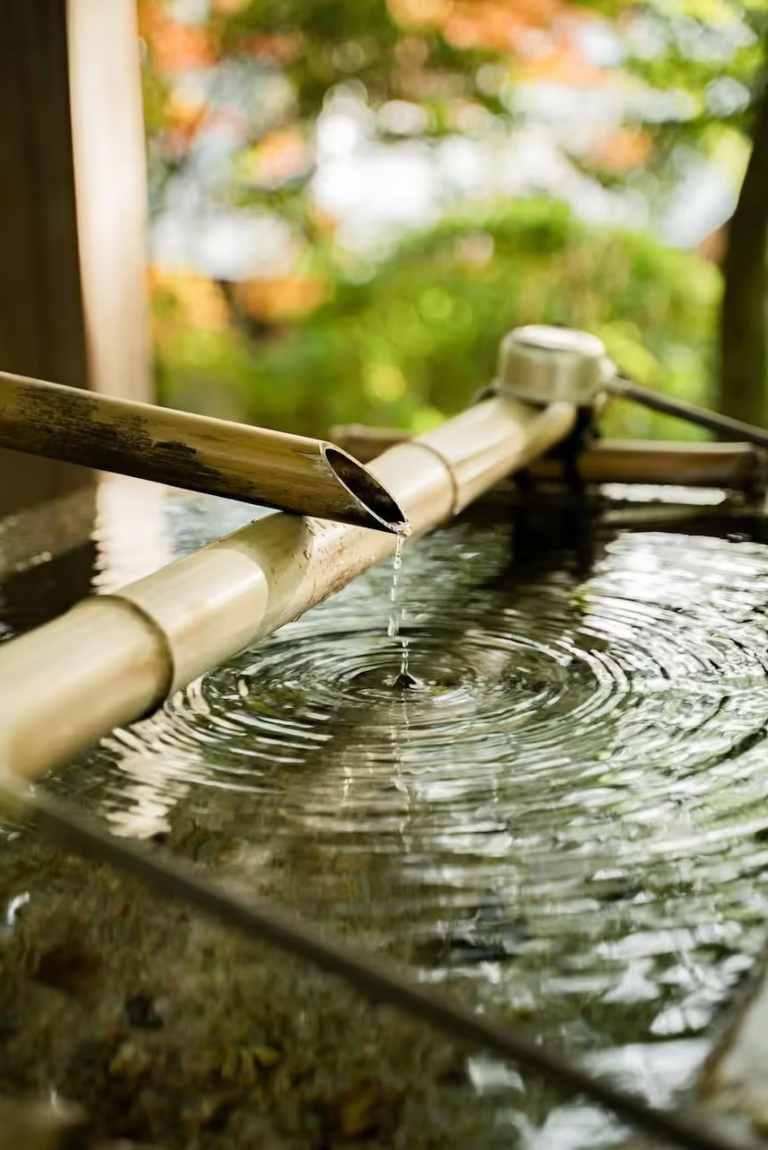
Something worth noting about guest reviews of Gyokusui: the food is rarely described simply as good. What comes up, repeatedly, is the quality of the dashi, the beauty of the serving vessels, the way the plating itself holds attention. These are not separate compliments. They are three angles on a single experience.
A ryokan dinner becomes a ceremony rather than a meal when it is set within time — when one course arrives, is finished, and then a pause opens before the next. In that pause, the sound of the garden enters. The light from a lamp shifts. Gyokusui serves dinner in-room or in private dining spaces, which means the pacing of the meal belongs entirely to the guest rather than to the movement of other tables. The kitchen's approach to local ingredients — seafood from the waters around Izu, treated with restraint rather than display — explains the reviews that say "nothing felt excessive" and "you taste what it actually is."
Who This Inn Is For — and Who It Isn't
No inn is for everyone. Gyokusui will be a defining memory for some guests and a mild disappointment for others. It seems worth being clear about the difference.
Gyokusui will resonate deeply with
- Those who feel the noise and speed of city life as a genuine weight, and who travel specifically to be relieved of it
- Travellers who value the quality of water over the size of a facility
- Those who want their time — with a partner or entirely alone — protected rather than programmed
- Anyone drawn to the intelligence behind objects: architecture, ceramics, the arrangement of a meal
- International visitors with a serious interest in Japan, looking not for a staged version of the country but for contact with something that has persisted quietly on its own terms
Gyokusui may not be the right fit for
- Guests with limited mobility — the inn involves steps and changes in level, with no elevator. Contact the inn directly before booking
- Those who plan to use the inn primarily as a base for day trips — Oku-Atagawa is not easily walkable from a station. A rental car or confirmed shuttle is advisable
- Guests who need extensive English-language support throughout the stay — confirm staff language capability at time of booking
Before You Book
Oku-Atagawa, Higashi-Izu, Kamo District, Shizuoka Prefecture
13 rooms (small-scale ryokan)
Free-flowing (kakenagashi) / rooms with private open-air bath / reserved private rotenburo
In-room or private dining room (plan dependent)
Approx. ¥29,000–¥98,000 per person (based on two guests sharing)
Approx. 5–10 min by car from Atagawa Station (Izu Kyuko Line). Shuttle availability: confirm with inn directly.
Trip.com (English interface available; international cards accepted)
Steps and level changes throughout. Limited barrier-free options. Confirm with inn before booking.
Questions
Should I book a room with a private bath or use the reserved private rotenburo?
For couples, a room with a private open-air bath offers freedom that is hard to replicate — enter whenever you wish, without timing a reservation around the inn's schedule. The private rotenburo, booked separately, tends to offer a different and often larger outdoor setting, and suits guests who want to experience the communal baths as well as a private moment in a distinct space. The two are not mutually exclusive if your budget allows.
Is Gyokusui suitable for solo travellers?
Very much so. The inn's character — unhurried, quiet, attentive without being intrusive — suits solitude particularly well. The large communal baths remain fully available to solo guests, and certain plans are priced for single occupancy. Trip.com filters by guest count, making solo options straightforward to find.
Can international visitors book and communicate easily?
Trip.com offers an English-language interface and accepts major international credit cards. The extent of English spoken by inn staff is worth confirming at the time of booking. That said, the core of the experience here — water, food, garden — requires no shared language to reach.
What is the best time of year to visit?
The bamboo grove is at its most vivid green in early summer (May–June). Autumn and winter (October–February) are when the evening lantern illumination of the garden is most affecting — warm light against cold air, the contrast between the heat of the bath and the chill outside sharpened. High-traffic periods — Golden Week in late April and early May, Obon in mid-August — are worth avoiding. Silence is what Gyokusui does best, and it does it least well when every room is full.
Is there much to do outside the inn?
The Atagawa Tropical & Alligator Garden, local galleries and pottery studios in Izu-Kogen, and the coastal walking paths near the station are all within reasonable driving distance. But Gyokusui tends to produce a particular effect: guests find they don't want to leave. Walk the garden, sink into the bath, wait for dinner. For one night, at least, that tends to be enough.