The Cultural Guide
How to Read Tokyo: A Cultural Traveler’s Guide to the City Beneath the Surface
A COMPLETE GUIDE TO TOKYO — WHAT TO NOTICE, WHERE TO SLOW DOWN, AND WHY IT MATTERS
There is a version of Tokyo designed for tourists. It has a checklist. Senso-ji at dawn, Shibuya crossing at dusk, a ramen bowl somewhere in between. It is not wrong. But it is a translation — and something is always lost in translation.
Tokyo is not a city you see. It is a city you read. Beneath its scale — the density, the noise, the impossible efficiency — is a layered text: four hundred years of Edo urban logic, the ash and rebuilding of two catastrophes, a postwar reinvention that never erased what came before. Every neighbourhood is a sentence. Every specialist street is a chapter. The city does not announce its depth. It rewards those who slow down enough to notice it.
This is not a list of things to do in Tokyo for cultural travelers. It is a way of moving through the city with your eyes open to what it is actually saying.
____
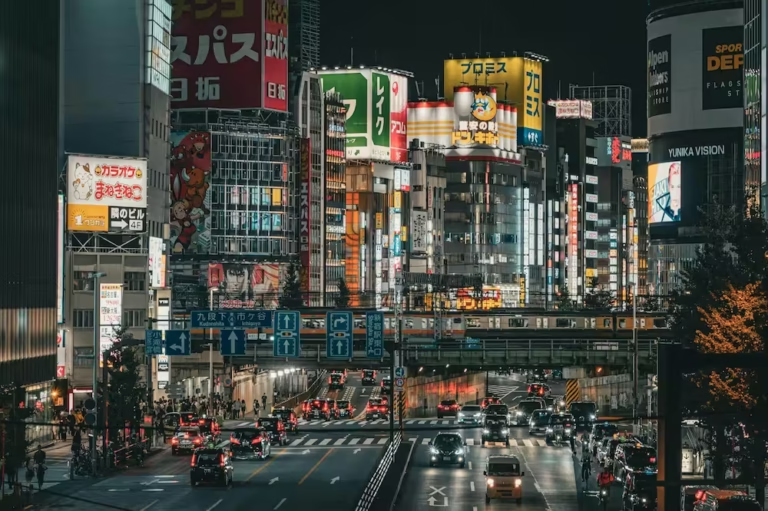
1. Edo Never Left: The Persistence of Old Tokyo
Modern Tokyo was built on top of Edo — the feudal capital that, for two and a half centuries, was the most populous city in the world. The catastrophes came: the 1923 earthquake, the firebombing of 1945. And still, the structure persisted. The low city — shitamachi — survived not just in memory but in the way streets still bend, the way neighbourhoods still gather around their local shrines, the way certain shops still occupy the same corners they have for generations.
Shitamachi (下町) does not mean “old.” It means a particular way of living — close to the ground, close to the neighbour, organised around craft and commerce. The Shitamachi Museum in Ueno reconstructs the streets of early twentieth-century Tokyo in precise, human-scaled detail: the interior of a merchant’s home, a copper craftsman’s workshop, a narrow alley connecting lives. Spend an hour there before you walk anywhere else and Tokyo begins to make a different kind of sense.
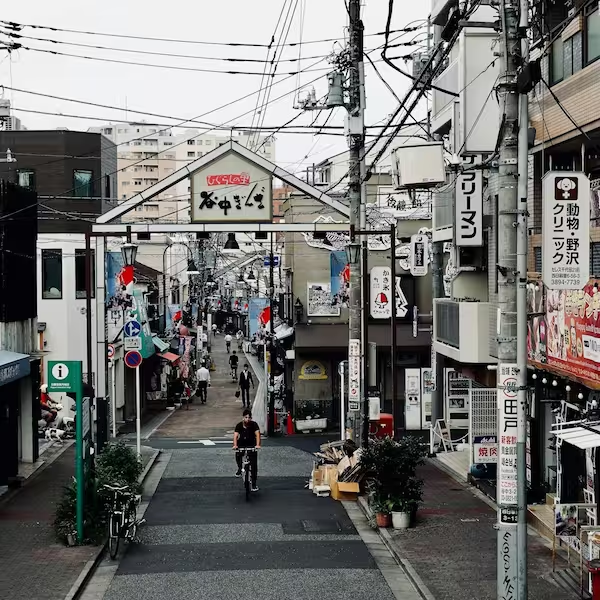
Yanaka is the neighbourhood most often cited as shitamachi’s living remnant — not because it is untouched, but because it burned less and rebuilt slower. The cemetery there is not morbid. It is a garden of old names, famous and anonymous, and the cats that sleep among the graves seem entirely at peace with history.
The shotengai (商店街)— the covered shopping street — holds a tobacconist, a tofu maker, a shop selling nothing but pickles. Each is a small argument against convenience.
If you want to understand how Edo organises space rather than simply walk through it, a structured walk through Asakusa with a guide who reads Japanese cultural history makes the invisible visible. Browse Tokyo cultural walking tours → Many of these move slowly enough to stop, look, and ask questions — which is exactly the right pace.
2. The District as Archive: Tokyo's Specialist Neighbourhoods
One of Tokyo’s most distinctive qualities is invisible unless you know to look for it: the city is organised by category. Not just broadly — not simply “fashion district” or “financial district” — but with a granularity that borders on the obsessive. There are streets dedicated entirely to professional kitchen equipment. Blocks where every shop sells only used academic textbooks. Buildings in which every floor sells a different genre of music.
This is not a quirk. It is the Edo merchant tradition of kabu-nakama (株仲間) — guilds of traders in the same business clustering together, building expertise through proximity. The logic held. It still holds.
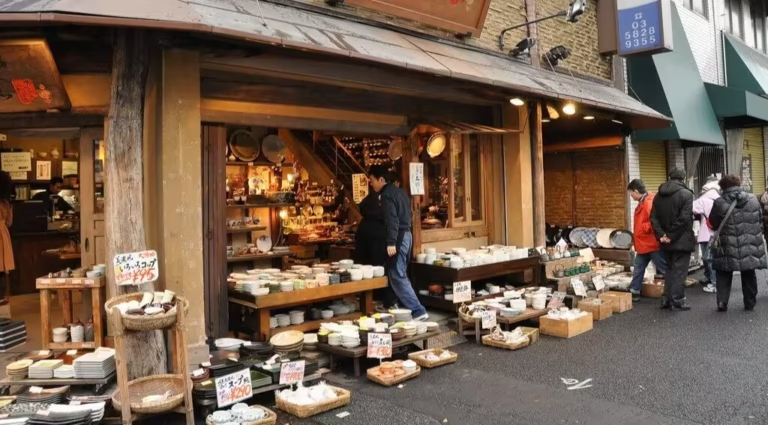
Kappabashi — the kitchen district running north from Asakusa — is a kilometre of shops supplying professional Japanese restaurants. Lacquer soup bowls stacked floor to ceiling, display food made from plastic so convincing you want to eat it, bamboo steamers in every diameter. The knife shops here are not tourist traps but working professional suppliers. You can handle a blade, feel the weight of different steels, ask questions through gesture or broken Japanese and be taken seriously. (For a deeper understanding of what Japanese knives represent as cultural objects, see our guide to Japanese knife culture.)
Jimbocho is where Tokyo keeps its books. The second-hand bookshops run for several city blocks, floor-to-ceiling shelves of academic texts, Meiji-era woodblock prints, postwar manga, maps of cities that no longer exist. Most of the stock is in Japanese, but that is not the point. The point is what it means for a city to dedicate this much space to the preservation of old thought.
Nihonbashi — Tokyo’s zero-kilometre point, where all road distances in Japan were once measured — was the commercial heart of Edo. The bridge that stands there today is not the original, but the old textile merchants, the lacquerware shops, the dried goods dealers have not entirely gone. Mitsukoshi, Japan’s oldest department store, still occupies its corner. To stand in Nihonbashi is to stand at the origin of Japanese commercial culture.
3. Gardens, Museums, and the Architecture of Stillness
Tokyo is the loudest city in the world. It is also, in its hidden pockets, one of the quietest — and the contrast is not incidental. It is designed. The gardens and contemplative spaces of Tokyo were built precisely to exist in opposition to the city around them. To step through the gate of a formal garden in Tokyo is to perform a deliberate act of subtraction.
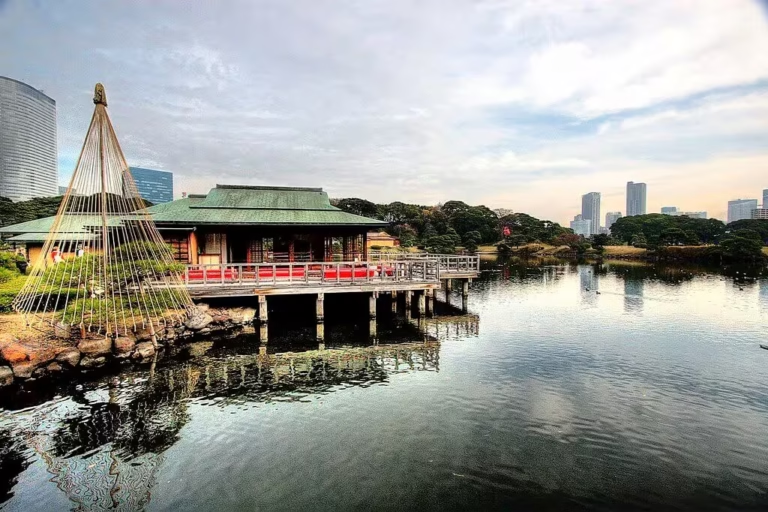
Hamarikyu Gardens sits at the edge of Tokyo Bay, surrounded now by towers of glass and steel. Its tidal pond was dug in the seventeenth century when this land belonged to the Tokugawa shogunate. The teahouse at the water’s edge — reached by a wooden bridge, serving matcha and a sweet — offers the rare experience of sitting still in central Tokyo with no soundtrack except water and wind. The towers are still visible beyond the tree line, but they have become, from inside the garden, entirely abstract.
The Japan Folk Crafts Museum (Nihon Mingeikan) in Meguro is one of the city’s most under-visited institutions and one of its most philosophically rich. Founded by the theorist Yanagi Sōetsu, it exists to argue a single proposition: that objects made anonymously, by hand, for daily use, are the truest expression of a culture’s beauty. The collection — textiles, ceramics, furniture, lacquerware from across Japan and Korea — is not about rarity or status. It is about the dignity of the ordinary. (The philosophy of mingei connects naturally to the Japanese tradition of repair and reuse — explored further in our article on kintsugi.)
The Nezu Museum in Omotesando holds a small, superb collection of East Asian antiquities — bronzes, ceramics, Buddhist sculpture — but its most remarkable feature is the garden behind the building. Designed by architect Kengo Kuma to lead visitors into progressively deeper quiet, the path descends through bamboo and moss until the city disappears entirely. It is an argument about architecture: that beauty requires approach, and approach requires slowness.
4. Where Old and New Coexist: Reading Tokyo's Layered Identity
No other city holds its historical strata so lightly. Tokyo does not preserve its past behind glass — it folds it into the present, rebuilds around it, lets it be overwritten and then allows traces to resurface. The result is a city that reads, in different neighbourhoods, like different centuries occupying the same streets simultaneously.
Ginza is the most legible example. The brick grid laid down in the Meiji era — Japan’s first modern commercial street, designed by a British architect in 1872 — long since gave way to glass towers. But the rhythm of the boulevard, the premium on craft and precision, the expectation that what is sold here is the best available: these persist. The flagship stores of Japan’s finest traditional lacquerware and textile companies share postcodes with Chanel and Apple. Neither seems incongruous. That is the point.
Kiyosumi-Shirakawa spent most of the twentieth century as a lumber and industrial district on the eastern bank of the Sumida River. The warehouses that stored timber from across Japan have become, over the last two decades, the epicentre of Tokyo’s third-wave coffee culture and contemporary art scene. The transformation is not erasure — the bones of the old buildings are still visible, the scale of the streets still industrial. The cultural memory of the place has been rewritten, not demolished. Walking through it, you feel the overlap.
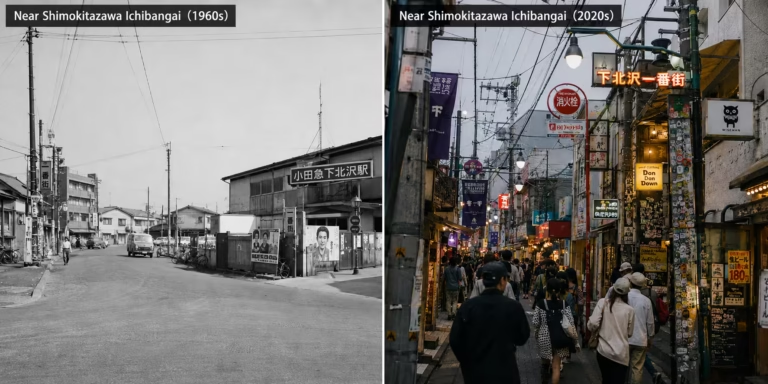
Shimokitazawa resisted redevelopment loudly and partially successfully. When the city proposed running a major road through its centre, the neighbourhood organised. What remains is a tangle of narrow lanes, live music venues, vintage clothing shops, small theatres, and coffee shops in spaces that should not exist — converted garages, former storage rooms, basements of uncertain provenance. It is chaotic and deliberate at once, which is more Tokyo than Tokyo usually admits.
5. The Craft of Eating in Tokyo: Beyond the Restaurant
Tokyo holds more Michelin stars than any other city. That fact is usually cited as a measure of quality. It is more interestingly a measure of density: within a few square kilometres, you can eat at a level of craft that does not exist at this concentration anywhere else on earth. But the more revealing entry point into Tokyo food culture is not the three-star restaurant — it is the system that feeds it.
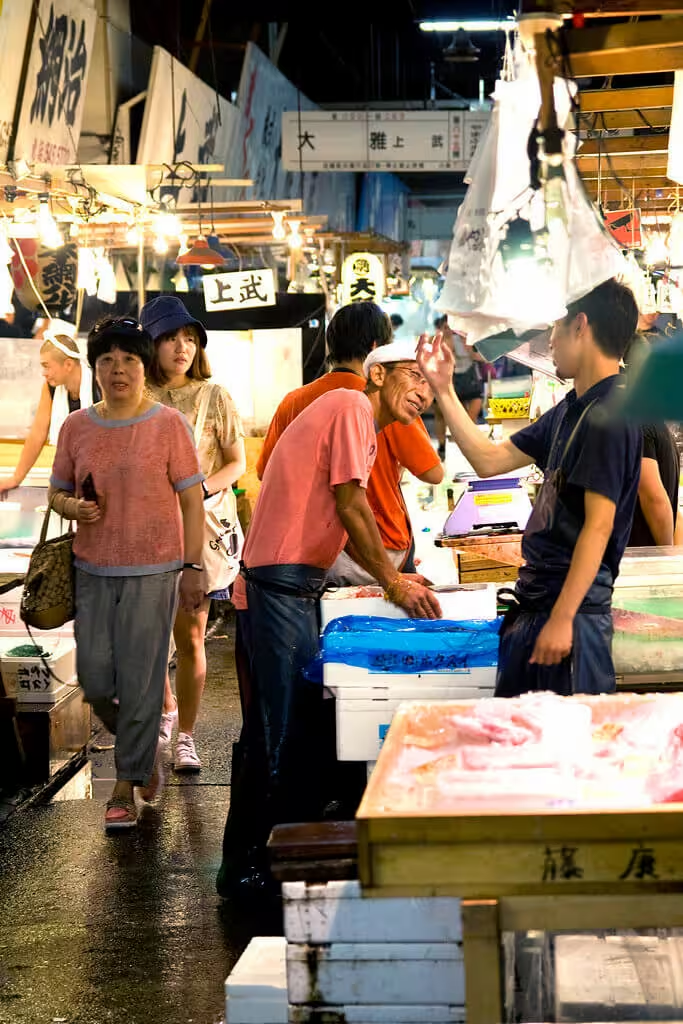
Tsukiji Outer Market survived the relocation of the inner wholesale market to Toyosu because it could not be moved. What remains is a narrow grid of stalls selling every ingredient that defines Japanese cooking: dried bonito shaved to silk, wasabi roots sold by the gram, tamagoyaki fried in the narrow pans designed for exactly that purpose. Walk it early. Ask before you eat. It is not a spectacle — it is a supply chain with centuries of logic.
The depachika — the basement food hall of a Tokyo department store — is a phenomenon with no true equivalent anywhere else. It is where regional Japanese food culture is edited, curated, and presented to the capital. Regional lacquerware sweets from Kyoto. Pickles from Kyushu. Confectionery from Hokkaido. Every prefecture sends its finest to Tokyo, and the department store arranges it all with the seriousness of a museum. Isetan in Shinjuku and Mitsukoshi in Nihonbashi are the canonical examples. An hour in either is an education in Japanese geography as much as gastronomy.
For those who want a structured entry into Tokyo’s food culture with cultural commentary, guided food walks through Tsukiji or Yanaka are consistently excellent. Explore Tokyo food culture experiences.
6. How to Move Through Tokyo Without Filling It Up
The temptation in Tokyo is to fill every hour. The city makes it easy: transport is frictionless, the density of things-worth-seeing is extreme, and the traveler’s anxiety about missing something is well-fed. Resist it. The concept of ma — the Japanese idea of negative space, the pause that gives meaning to the notes on either side of it — applies to travel as much as it does to music or architecture. A day in Tokyo that includes three neighbourhoods, fully walked, is richer than a day that covers nine. The neighbourhood you understand is worth more than the five you have merely visited.
The case for one neighbourhood. Choose a district — Yanaka, Kiyosumi-Shirakawa, Shimokitazawa, Nihonbashi — and give it a full morning. Walk the side streets. Enter the shops that have no English signs. Sit in a kissaten, the old-style Japanese coffee shop, and stay long enough for the light to change. The neighbourhood will show you things that no itinerary can schedule.
What to book in advance. Some experiences genuinely require advance reservation: the better teahouses, guided cultural walks, any structured food experience. For these, booking through a platform like Klook or Viator is practical and gives you confidence that the experience is English-accessible. Browse bookable cultural experiences in Tokyo. Everything else — the markets, the museums, the gardens, the walks — benefits from arriving without expectations.
Leave the afternoon of your last full day deliberately empty. Not as a concession to fatigue, but as a commitment to the city. The best thing that happens in Tokyo often happens in the gap you were not trying to fill.
Frequently Asked Questions
What makes Tokyo different from other Japanese cities as a cultural destination?
Scale and density, but not in the way you might expect. Tokyo’s distinctiveness is not that it has more of everything — it is that it has specialists in everything, organised into districts that have been refining their focus for centuries. Kyoto preserves. Osaka celebrates. Tokyo edits. The capital draws culture from across Japan and concentrates it, making it possible to understand the breadth of the country’s traditions without leaving the city.
What is shitamachi, and why does it matter for understanding Tokyo?
Shitamachi(下町) — literally “low city” — refers to the merchant and artisan quarters of Edo, the city that became Tokyo. It was home to the working population: craftspeople, traders, performers, and the culture they made. It is the origin of most of what we think of as distinctively Tokyoite: the directness, the humour, the pride in craft, the density of small specialist shops. Understanding shitamachi is understanding where the city came from.
Which Tokyo neighbourhoods are best for slow, intentional travel?
Yanaka and Nezu for intact shitamachi atmosphere. Kiyosumi-Shirakawa for the intersection of old industrial Tokyo and contemporary culture. Nihonbashi for commercial and historical depth. Shimokitazawa for the contemporary city in its most resistant, human-scaled form. Each rewards walking without a destination more than walking toward one.
Is it possible to experience traditional Japanese culture in central Tokyo, or do I need to leave the city?
Not only possible — Tokyo offers access to traditional culture that is more varied and concentrated than almost anywhere else in Japan. The capital has drawn the finest examples of regional craft, food, and performing arts for centuries. What Tokyo lacks is the setting — the ancient temple town, the mountain village, the untouched coastline. The culture itself is entirely present.
What should a first-time cultural traveler to Tokyo NOT do?
Do not try to see everything. Do not organise your days by proximity on a map rather than by cultural coherence. Do not mistake activity for depth. One neighbourhood understood is worth more than five photographed. Tokyo will not give you everything it holds in a single visit — and the traveler who accepts this returns.
Closing Reflection
Tokyo is a city that rewards patience. It does not explain itself. It waits to see if you are paying attention.
If you are planning a stay beyond Tokyo — a night at a traditional ryokan, a slower pace in the countryside — our guide to staying in Japanese ryokans offers a careful introduction to what to look for and what to expect.
A Note on Affiliate Links
Some links on this page may be affiliate links. This means that if you purchase through them, Untranslated Japan may earn a small commission—at no additional cost to you. These commissions help support our mission to document and share Japan’s hidden craftsmanship.
Our editorial standards remain strictly independent. Affiliate partnerships do not influence our selection. We only feature products that meet our rigorous criteria for craftsmanship, usefulness, transparency, and cultural integrity.