The Cultural Guide
What Kyoto Actually Says: A Cultural Guide Beyond Temples, Crowds, and Checklists
A curated guide for the unhurried reader
You arrive in Kyoto with a plan. Most people do.
Kinkaku-ji in the morning, Arashiyama by noon, Fushimi Inari before the light fades, Nishiki Market on the way back. The map is dotted, the itinerary is tight, and the logic is sound — there is a lot to see, and you only have three days.
There is nothing wrong with this. Kyoto will let you do it. The temples will be beautiful. The photographs will be real. And then you will leave, and somewhere on the flight home, you will find yourself trying to remember what, precisely, you understood.
This guide is not about seeing more. It is about slowing down long enough for the city to speak — in the particular language it has been developing for twelve hundred years. That language lives in a weaver’s rhythm, in the space between two stones, in the way a street name holds the ghost of a trade that died two centuries ago.
How to Walk Kyoto: A Few Rules for Moving Slowly
To see the Kyoto that exists beneath the surface, you do not necessarily need more time. You need a different set of permissions. These are not rules for seeing less; they are rules for shifting your frequency to match the city’s own.
—
Rule One: Choose a Direction, Not a Destination
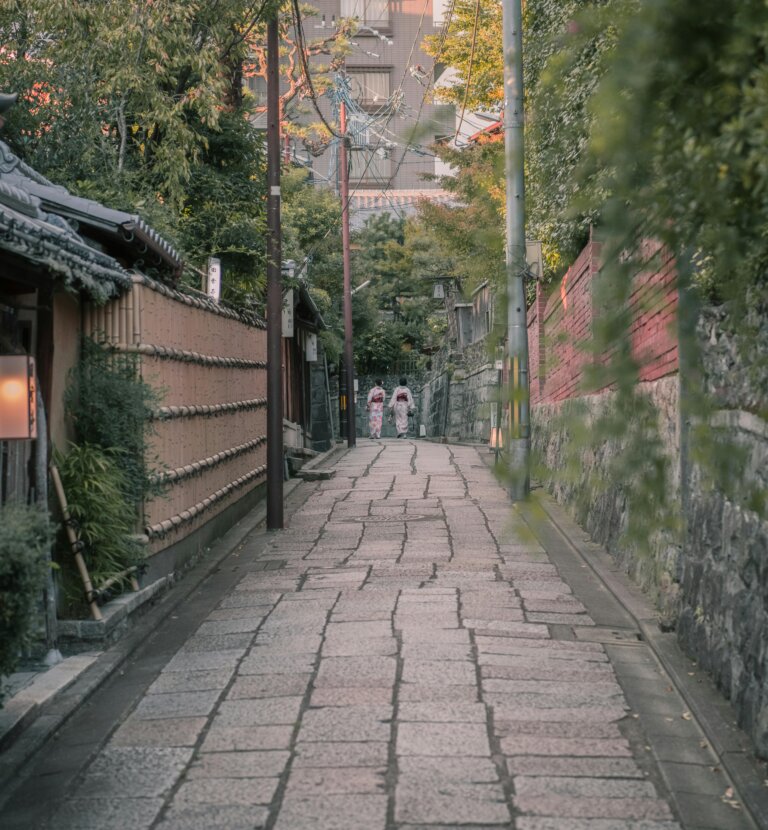
In the morning, pick a direction rather than a site. North from Nishiki Market into the quieter residential streets above Oike. East from Gion before the tourist infrastructure wakes up, into the narrow lanes that run parallel to Hanamikoji but carry a fraction of its traffic. West into the blocks around Nishijin where the streets narrow and the signage thins and the city begins to feel like it is going about its business rather than presenting itself to you.
Walk until something makes you slow down. A sound from behind a wall. A shopfront so small and so particular in its focus — one craftsperson, one material, one technique — that stopping feels like the only reasonable response.
This is the whole method. Not a checklist. Not a map with pins. A direction, and permission to stop.
—
Rule Two: Go Early to the Famous Places, Then Leave Them
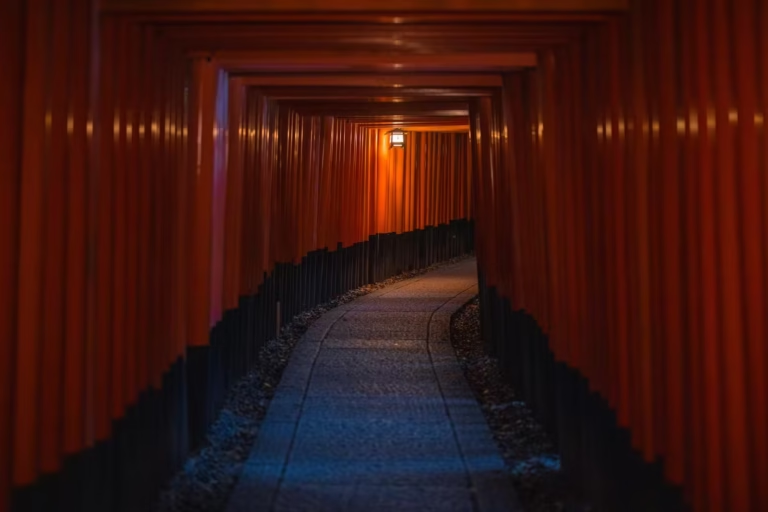
Seven in the morning is the operative phrase. The crowds arrive at nine, sometimes ten. The ninety minutes before that window belongs to a much smaller number of people, and in that window the city’s famous places briefly become something closer to what they actually are: quiet, particular, unhurried. The stone path at Fushimi Inari at that hour is something photographs have not adequately prepared you for. Set the alarm. Visit early. Then leave before the tour groups arrive, and let the rest of the day belong to the less-visited version of the city.
—
Rule Three: Move One Block Away
The crowds in Kyoto are not spread evenly. They concentrate with extraordinary precision around a small number of famous coordinates, leaving the streets between them — sometimes a single block away — nearly empty.
Arashiyama’s bamboo grove is genuinely beautiful and genuinely overcrowded simultaneously. Walk fifteen minutes south from the grove and the path empties, the river appears, and you find yourself in a version of Kyoto that has not yet been converted into a backdrop. The same principle applies almost everywhere. The famous street, and the street behind it, are rarely the same experience.
—
Rule Four: Look for Working Buildings, Not Only Monuments
The declared monuments of Kyoto are worth your time. So are the buildings that have not been declared anything.
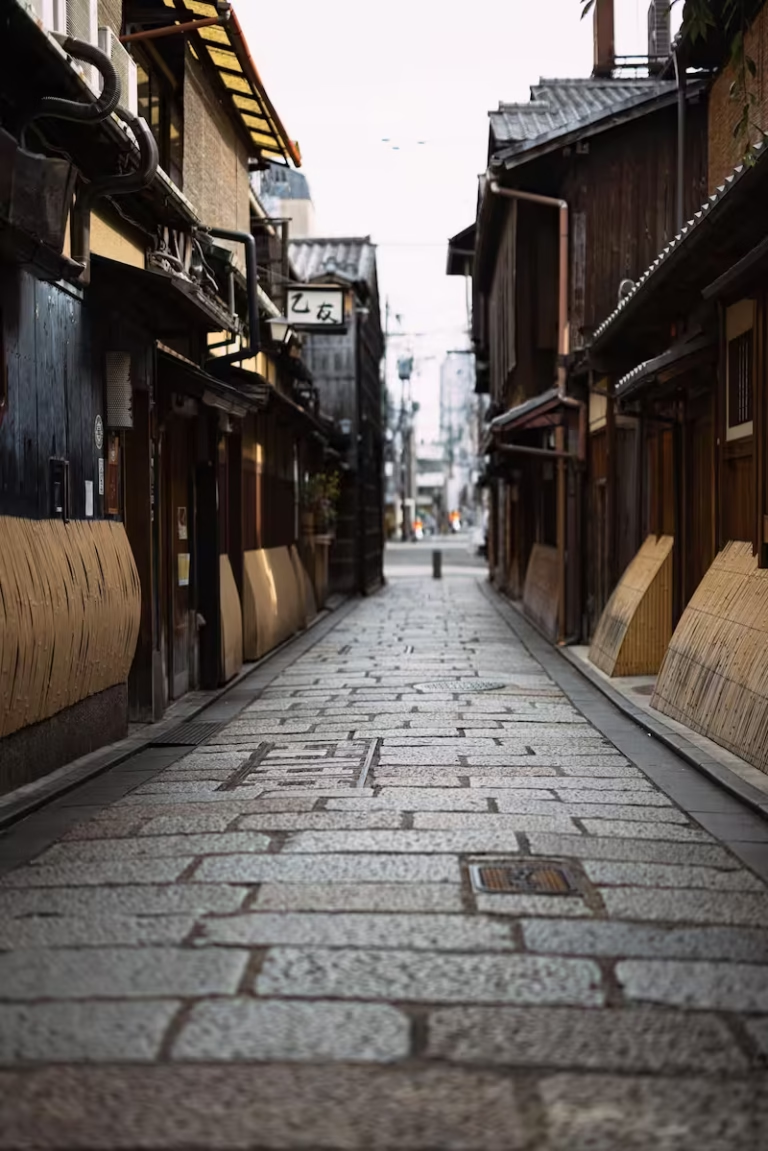
The machiya — the narrow wooden townhouses that line the older streets — are not museums. Many are still lived in. Others have become small workshops, tea rooms, galleries with no sign outside. A gate left slightly open — not as an invitation to enter, but as a reminder that Kyoto’s most revealing moments are often glimpsed, not consumed.
—
On where to stay:
The neighbourhood you sleep in shapes your experience in ways that transport cannot replicate. A machiya-style guesthouse in Nishijin or Okazaki puts you inside the city’s logic from the first moment of the day — the morning light through shoji screens, the walk to breakfast through a residential street rather than a hotel corridor.
→ Machiya-style stays in Nishijin — Trip.com — Sleep inside the city’s geometry.
Kyoto Roji: The Unnamed Lanes Where the City Feels Most Honest
There is a category of street in Kyoto that does not appear in guidebooks, does not have a hashtag, and does not have a sign at its entrance explaining what it is.
It is just a gap between two buildings. Barely wide enough for two people to pass. Stone underfoot, weathered wood on either side, a pot of something growing by a door that is clearly someone’s front entrance. You are not sure, at first, whether this is a public lane or the beginning of someone’s private life. So you slow down. You look for signs: another pedestrian, a shop curtain, a small shrine, the visible logic of a path that continues through.
Thirty seconds later you emerge onto a street you recognise, slightly disoriented, holding the specific feeling of having been somewhere that was not arranged for you.
This is a roji — a lane. And the unnamed version of it is the most useful thing to know about in Kyoto.
—
Why Kyoto Has So Many Lanes
The lanes came first. Then the houses along them. Then the lives.
The Japanese have specific words for the variations. A roji is technically a dead-end lane. A zushi passes all the way through, connecting one street to another. A tsukinuke was created by punching a lane through a building or plot — which is exactly what happened with Tenshi-tsukinuke, a lane in Shimogyo driven straight through the grounds of a Shinto shrine. The name means, roughly, “piercing through the angel.” The shrine is still there. So is the lane.
Knowing these words is not essential. But knowing that Kyoto’s lanes have names — and that those names are often small histories — changes the way you move through them. You are not lost. You are reading.
—
The Lanes Worth Finding
The more useful approach: treat the famous lanes as orientation points, and pay attention to what runs beside them.
The lanes on either side of Hanamikoji in Gion carry a fraction of the foot traffic, with essentially identical architecture. The numbered lanes between Pontocho and Kiyamachi — locals call them bango roji — are a parallel city alongside two of Kyoto’s most visited streets, with small bars and restaurants that have no presence online and no queue outside.
—
Nishijin: The Lanes That Still Have a Job to Do
Nishijin is where the lanes stop being picturesque and start being functional.
Walk into the residential lanes here and you are inside a neighbourhood that is still working — in the most literal sense. Behind some of these walls, someone is at a loom. The sound reaches you before anything else: not a mechanical clatter but something drier and more deliberate, wood and thread finding their rhythm together. A house that looks entirely ordinary from the outside is, from the inside, a workspace that has been operating for generations.
The number of active weaving households has declined significantly over recent decades. But the ones that remain give the neighbourhood a density of purpose that is rare in any city. You feel it in the lanes: less performance, more intention.
If you want to understand what Nishijin’s lanes are built around before you walk them, a weaving workshop puts the whole neighbourhood in context. Sitting at a loom — even briefly — makes the sound behind those walls legible in a way that no amount of reading quite achieves.
→ Nishijin weaving workshop — GetYourGuide — Recommended before or after walking the residential lanes.
Nishijin deserves more than a lane guide can give it. We will cover the district in full — its history, its craftspeople, and what is being lost and what is choosing to stay — in a separate piece.
—
Ajiki Roji: When a Lane Chooses Its Future
Not all of Kyoto’s unnamed lanes stayed unnamed.
Ajiki Roji, a short dead-end lane near Kiyomizugojo station, was a row of machiya longhouses — over a century old, largely empty — quietly deteriorating for years. In 2004, the landlord made a decision: rather than demolish or redevelop, she would offer the spaces to young craftspeople and artists who needed affordable studios. No commercial formula. No theme. Just old buildings and people who needed somewhere to work.
Twenty years later, the lane holds a textile artist, a shamisen maker, a custom hat workshop, a small coffee shop, and a handful of others, most of whom are both making things and living there.
Opening days and hours vary by studio, and some spaces are not designed for casual entry. Check the Ajiki Roji website before visiting, and treat the lane first as a lived space rather than a shopping destination. What you find when you arrive — whether one door is open or three — is part of the experience, not a disappointment.
—
A Practical Note on Walking Roji
Kyoto’s residential lanes are not attractions. Walk through — most are public thoroughfares — but move at a pace that registers as a person passing rather than a person inspecting. Do not photograph into open windows or doorways. If a lane feels entirely private, trust that feeling.
The lanes that are open to visitors will make it clear in the way only public spaces can: other people, going about ordinary business, with no particular awareness of you.
—
Where to Practise This Kind of Walking
Nishijin — Residential lanes and working craft streets. No destination needed; follow the sound.
Gion side lanes — Before Hanamikoji becomes crowded. Seven in the morning is a different street from eleven.
Pontocho / Kiyamachi numbered lanes — Early evening, when the small bars open and the lanes find their other register.
Ajiki Roji — Weekends, when some studios may be open. Check before you go.
Ninenzaka / Sannenzaka — Before eight in the morning, or used as orientation rather than destination.
What to Bring Back From Kyoto — And Why the Choosing Matters
The souvenir shops around Kyoto’s major temples sell things that look like Kyoto. The objects in a craftsperson’s workshop are Kyoto — the difference being that one is a representation and the other is the thing itself.
Kyoto’s craft traditions are numerous and serious: kyo-yuzen silk dyeing, nishiki-ori weaving, kyo-shikki lacquerware, washi paper. Choosing one — learning even a little about how it is made before you purchase it — changes the nature of the transaction. Every choice the craftsperson made, in colour, in weight, in finish, is embedded in the material. That is what you are taking home. The most effective way to understand this is to make something before you buy something.
A yuzen dyeing workshop will walk you through the basics of Kyoto’s signature textile technique — resist paste, hand-painting, multiple fixings. You will produce a simple piece. It will not be the work of a master. But you will understand, physically and permanently, why a properly made yuzen piece costs what it costs.
→ Kyo-yuzen dyeing experience — GetYourGuide — Understand the object before you own it.
A knife-making workshop at a Kyoto blacksmith takes you beside a working forge for a half-day session: heating steel, shaping the blade under guidance, learning through your hands why a well-made Japanese knife behaves the way it does. You will leave with something you made. More usefully, you will leave with a calibration for quality — an understanding of what separates a blade that has been formed from one that has simply been finished — that is difficult to acquire any other way.
→ Authentic knife-making experience at a Kyoto blacksmith — GetYourGuide — Understand the blade before you buy one.
For a deeper reading of Japanese knife traditions, regional styles, and how to choose well: Japanese Knives →
The best craft shops in Kyoto are not always the most visible. Look for places where the owner can tell you about the maker, where provenance is a natural part of the conversation, and where there are not fifty identical versions of the same object. The selection is usually smaller. That is exactly the point.
—
Closing Reflection
There is a moment that happens in Kyoto — not in a famous garden, not in a storied temple, but somewhere unremarkable: a side street, an empty staircase, a courtyard glimpsed through a gate.
Something in you pauses.
The view is not dramatic. No one has told you to stop here. There is no information board explaining the significance. And yet you stop, and for a few seconds the ordinary noise of being a visitor in a foreign city — the mild anxiety, the mild excitement, the persistent feeling of performing rather than experiencing — drops away.
This is what Kyoto is, at its best: a city that, if you move through it slowly enough, occasionally makes you forget that you are looking at it, and instead makes you feel that you are simply inside it.
You cannot plan for this moment. You can only slow down enough to be available for it.
Fewer things. Truer things.
Frequently Asked Questions
What is there to do in Kyoto besides visiting temples and shrines?
Kyoto’s craft culture, neighbourhood life, and aesthetic traditions offer a parallel city that most itineraries miss. Nishijin’s working weaving district, yuzen dyeing workshops, the slow streets of Okazaki — these are not alternatives to the famous sites; they are the context that makes those sites legible. One deep craft experience alongside two or three well-chosen temples will be more memorable than a checklist of twelve.
What is Nishijin, and can visitors experience it?
Nishijin is Kyoto’s historic silk weaving district, in the northwest of the city. At its height it employed tens of thousands of weavers producing complex textiles for Japan’s imperial court and aristocracy. Today the district is smaller but still active — some machiya have working looms on the ground floor, and the sound is audible from the street. Visitors can book weaving workshops for hands-on time at a traditional loom, or visit the Nishijin Textile Center for demonstrations.
What is the best time of day to visit Kyoto to avoid the crowds?
Before eight in the morning. Most tour groups begin at nine or ten, leaving the ninety minutes before that window to a much smaller number of people. Fushimi Inari Taisha at six is meditative in a way the midday version cannot recover. The trade-off is simple: earlier alarm, better city.
What is the difference between "roji" in a city and "roji" in a tea garden?
In Japanese, “roji” refers to two distinct concepts depending on the Kanji used. 路地 (roji) denotes the narrow, charming alleys and residential lanes iconic to cities like Kyoto, serving as paths for daily life. In contrast, 露地 (roji), literally meaning “dewy ground,” refers specifically to the garden path leading to a teahouse in the Way of Tea (Sado). While the former is a physical street, the latter is a spiritual threshold designed to purify the guest’s mind before the ceremony.
How many days do you actually need in Kyoto?
Enough to stay in one neighbourhood for a full day without moving on. Three days structured around two or three areas will produce a more coherent experience than a week of efficient coverage. If you have three days, consider spending one of them not at a major site at all.
A Note on Affiliate Links
Some links on this page may be affiliate links. This means that if you purchase through them, Untranslated Japan may earn a small commission—at no additional cost to you. These commissions help support our mission to document and share Japan’s hidden craftsmanship.
Our editorial standards remain strictly independent. Affiliate partnerships do not influence our selection. We only feature products that meet our rigorous criteria for craftsmanship, usefulness, transparency, and cultural integrity.