
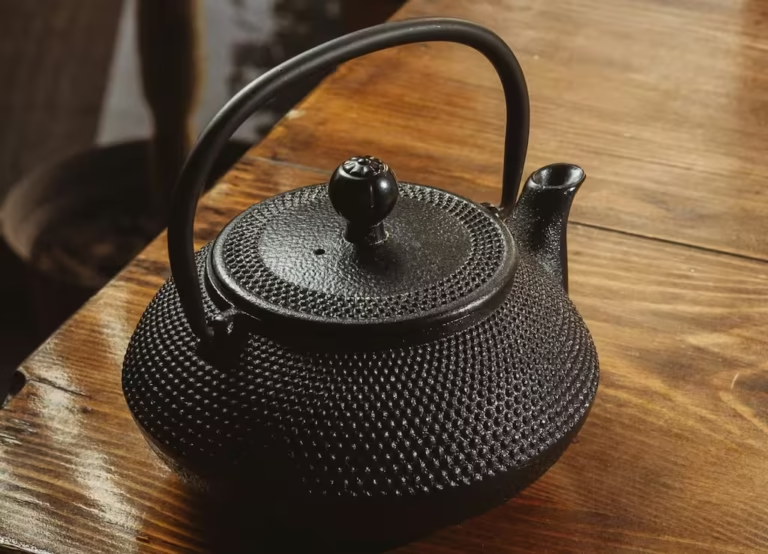
You pick it up and feel the weight before you understand it. Not heavy the way something cheap is heavy — dense, without apology, like something that has decided to stay. You hold it a moment longer than you need to. Then you set it on the heat and wait.
The Weight of a Concept
There is a category of object that asks something of you before it gives anything back. The Nanbu Tekki tetsubin — Japan's cast iron kettle from Iwate Prefecture — belongs to this category. It requires seasoning, attention, patience. It rusts if you neglect it and deepens if you don't. It is not a passive object. It is a relationship.
Most kettles heat water. A tetsubin does something quieter and more insistent. As the iron warms, a thin mineral layer — called yuaka — begins to form on the interior walls. Use it long enough and this layer fully seals the iron, making the water softer, the tea less bitter, the whole ritual more intentional. The kettle improves. Slowly. Over years of use.
No two well-used tetsubin look the same. That is the point.
The Japanese concept of mono no aware — the bittersweet awareness that beautiful things pass, and are made more beautiful by passing — finds an unusual expression in ironware. A tetsubin does not fade or chip or peel. Instead it accumulates: patina, history, the specific quality of the hands that have held it. In an era of planned obsolescence, choosing a tool that improves with age is itself a quiet statement about what you value.
A Feudal Commission, A Craft That Stayed
The story begins with a feudal lord and his obsession with tea.
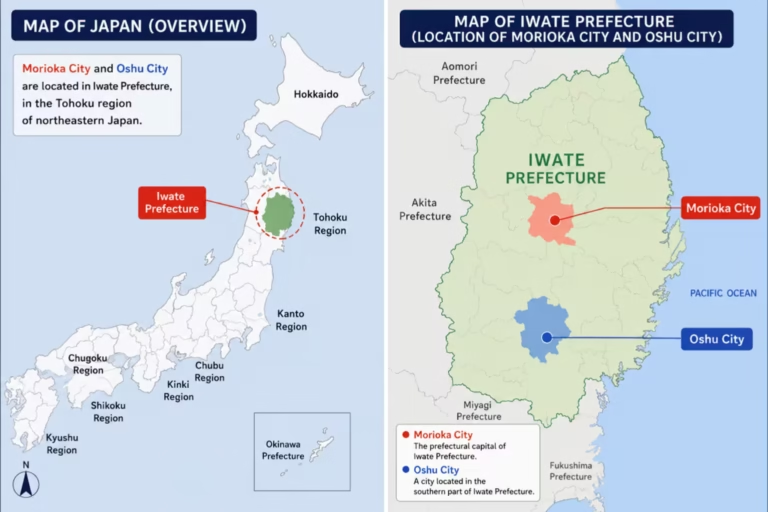
In the early 17th century, the Nanbu clan ruled a domain in what is now Iwate Prefecture, in the far north of Japan's main island. The first domain lord, Nanbu Nobunao, was a devotee of chado — the way of tea — and he wanted proper iron vessels: chagama, the round, spoutless tea kettles used in formal ceremony. The land around Morioka, the domain's capital, happened to provide everything such a craft requires: high-quality sand iron ore, abundant charcoal, and the pure waters of the Nakatsu River.
So he imported expertise. Skilled foundry masters were summoned from Kyoto and beyond, offered land and patronage, and encouraged to root themselves in the north. They did. The craft did not remain a luxury. It spread.
Farmers needed tools. Households needed pots. The tetsubin itself — a kettle with a handle and spout, portable where the chagama was not — emerged around 1750, invented by a craftsman named Koizumi Nizaemon. It moved the ritual of tea from the formal tea room into the daily home. By 1975, it became the first craft in Japan to receive official designation as a Traditional Craft of the nation.
The name holds a quiet irony. Nanbu — written with characters meaning "southern region" — was the name of a clan that ruled firmly in the north. The craft named for a southern direction has always belonged to a northern place.
Two Cities, One Name
Today, the Nanbu Tekki designation applies exclusively to ironware produced in two cities: Morioka and Oshu. They are distinct traditions. Morioka's lineage runs from those 17th-century Kyoto foundry masters — its aesthetic is refined, its forms often classical. Oshu's Mizusawa district has an older iron-working history still, reaching back to the 12th century when iron was cast for Buddhist ceremony and armour under the Oshu Fujiwara clan.
The geographic protection of the name functions like Champagne in France: only ironware produced within these two cities carries the right to be called Nanbu Tekki. This matters, because the world is full of imitations. It matters more than it might seem.
How a Tetsubin Is Born
You do not understand a tetsubin until you understand what it costs to make one.
There are two methods. The first is namagata: a green-sand moulding method in which layers of increasingly fine sand are shaped and packed around a form, then broken apart after casting. Because the same pattern can be used to make successive moulds, namagata is well suited to consistent production. These are the tetsubin you will find at more accessible price points — still handmade, still genuine, but made at scale.
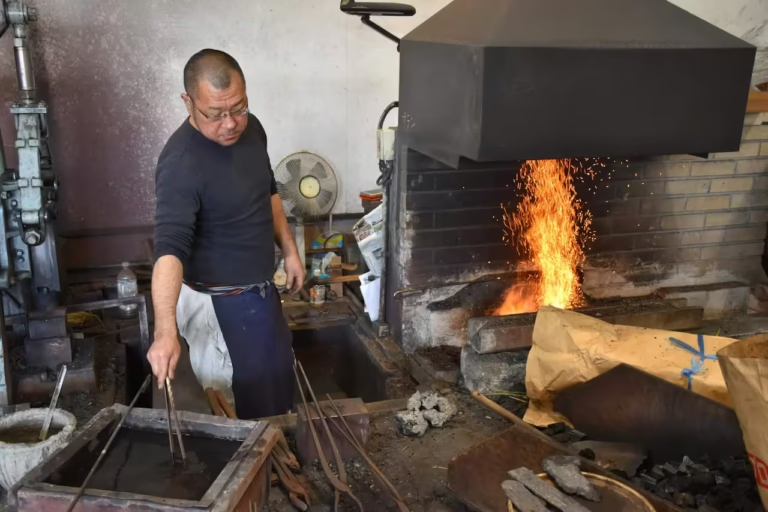
The second method is yakigata: a mould made from a mixture of river sand and clay, built by hand, dried, and fired in a kiln before molten iron is poured into it. What makes yakigata significant is what happens to the mould afterward. It is built to be broken — used a handful of times at most, then destroyed, with each casting rendering the fine details slightly less distinct. The first piece from any yakigata mould is the sharpest. The most resolved. Some moulds survive only a single pour.
This is where the arare pattern — those hailstone dots — becomes more than decorative. In yakigata production, each dot is pressed individually into the damp sand while it is still wet. An artisan works across the entire surface, tool in hand, repeating a gesture hundreds of times per piece. The pattern serves a function too: the raised texture increases surface area, improving heat distribution and making the kettle easier to grip with a damp hand. Beauty and utility arrived at the same destination by different roads.
When the mould is ready, iron is heated to approximately 1,400 to 1,500 degrees Celsius and poured. The metal flows into every pressed groove and dot. It cools. The mould is broken away. The raw casting is then fired again — this time at around 800 to 900 degrees — forming an oxide layer on the iron's surface. What remains is finished by hand — ground and treated with urushi lacquer, then coated with ohaguro, an iron-based solution mixed with tea, which produces the characteristic deep black surface of a finished tetsubin. The whole process, from design to finished piece, may take weeks.
What Happens When Iron Meets Water — Over Years
Fill a new tetsubin with water and you will taste iron. This is not a flaw. It is the beginning of the relationship.
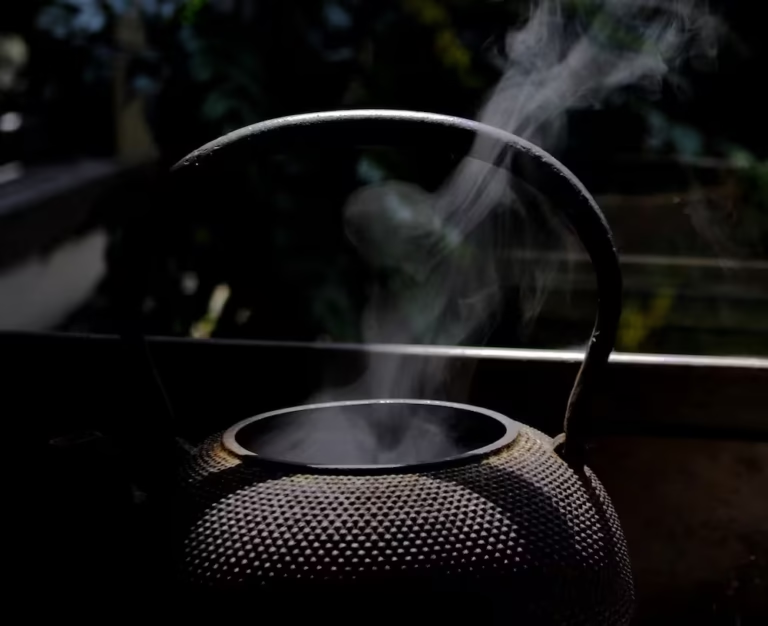
With regular use — boiling water, emptying the kettle fully, allowing it to dry — the interior begins to change. Minerals in the water precipitate and bond with the iron, forming the yuaka layer. Once this layer is established, the iron taste disappears. What replaces it, tea drinkers report, is a rounding of the water: calcium and other minerals are absorbed, hard water is softened, the sharpness that can make tea astringent is gently removed.
This is not superstition. The function is real. Whether you register it as a meaningful improvement to your morning tea depends on your water source, your palate, and perhaps your patience with processes that require months before they begin to deliver.
A well-maintained tetsubin, treated with care, can be used for a generation. More than one generation. The oldest pieces in Iwate foundry collections are measured not in decades but in centuries. To buy a tetsubin is not to acquire a kettle. It is to begin something that will likely outlive you.
The Paradox of Scale
For the first three centuries of its existence, Nanbu Tekki was essentially a domestic craft — beloved in Japan, largely unknown abroad. Then Japan's economic bubble burst in 1991. The domestic market contracted sharply. Iwachu, one of Morioka's oldest and largest foundries, made a decision: take the craft international. They developed colourful enamel-coated teapots — still iron, still handmade, but designed for Western interiors and Western aesthetics. The response was immediate. Across Europe and the United States, the name Iwachu became shorthand for Japanese cast iron. Demand grew. Production scaled.
Today, Iwachu produces approximately one million pieces per year. Their colourful teapots sit in boutiques across Paris and Copenhagen and Melbourne. They are, by any measure, a success.
They are also a useful provocation. A craft tradition rooted in the philosophy of "use long and use well" — of slow accumulation, of the single carefully chosen object — now produces at industrial volume for a global market that refreshes its interiors on Instagram timescales. The philosophy and the production now sit in uneasy tension. This is not an accusation of Iwachu. It is the situation all living craft traditions face: to survive, they must grow. To grow, they must negotiate with the forces that their philosophy was built to resist.
The makers in smaller studios — families who have been casting iron since the 1600s, producing a few hundred pieces annually by yakigata methods — hold the other end of this tension quietly. They do not advertise the paradox. They simply keep making.
How to Know If It's Real
The international popularity of Nanbu Tekki has produced a significant counterfeit market. Cast iron kettles manufactured in China and marketed as "Japanese ironware" or "tetsubin" have proliferated across online marketplaces. They are not the same object. They are not the same philosophy.
Authentic Nanbu Tekki carries the official 南部鉄器 designation mark and originates from registered workshops in Morioka or Oshu, Iwate Prefecture. When purchasing online, ask directly: where is this made? Any legitimate seller will tell you immediately and precisely.
Price is also a signal. A genuine handmade tetsubin produced in a sand mould typically starts from around USD $80–120. A yakigata piece from a named artisan begins at $300 and rises steeply. If you find something marketed as Nanbu Tekki for $30, it is not Nanbu Tekki.
Choosing a Piece That Will Outlast You
The question is not which tetsubin is best. The question is which tetsubin is right for you — and right for the next thirty years of your mornings.
Sand-mould production. Genuine Nanbu ironware from Iwachu or OIGEN. Classic forms: round body, arare pattern, iron lid. Capacity 1.2–1.5L. Suitable for induction hobs depending on the model. From approx. USD $80–120.
Sand-mould production from a smaller foundry — OIGEN, Suzuki Morihisa, or Koizumi Seizando. More limited ranges, stronger craft lineage, and a quieter sense of provenance. From approx. USD $150–300.
Where to Buy Authentic Nanbu Tekki
Browse Iwachu tetsubin on Amazon → Browse OIGEN ironware on Amazon → When buying from either source, confirm the production location is Morioka or Oshu, Iwate Prefecture. A legitimate seller will confirm without hesitation.Questions
Nanbu Tekki or Nambu Tekki — which spelling is correct?
Both are correct transliterations of the same Japanese characters, 南部鉄器. "Nambu" more closely reflects the historical pronunciation of the clan name; "Nanbu" reflects a common modern romanisation. In English-language retail and international markets, both spellings are used interchangeably. When searching online, try both — you will find the same products under each spelling.
Can I use a tetsubin for daily boiling, or is it only for tea ceremony?
A tetsubin is made for daily use — that is precisely its purpose. Unlike the chagama, the formal tea ceremony kettle, which sits over a brazier and has no handle or spout, the tetsubin was designed for the domestic kitchen: portable, handleable, practical. Use it every day. It benefits from regular use. The yuaka layer that develops with consistent boiling and drying is what makes the kettle more valuable over time, not less.
How do I tell the difference between authentic Nanbu Tekki and a Chinese imitation?
The most reliable indicators are origin and price. Authentic Nanbu Tekki is produced exclusively in Morioka or Oshu, Iwate Prefecture, Japan, and will be clearly labelled as such. The official designation mark, 南部鉄器, should appear on the packaging of genuine pieces. On price: authentic sand-mould tetsubin begin at approximately USD $80; anything marketed as Nanbu Tekki below this threshold should be questioned. When buying online, ask the seller directly for the production location and workshop name. A legitimate seller will answer without hesitation.
What is the difference between yakigata and namagata, and does it justify the price difference?
Namagata, or sand mould, allows a single mould to be used repeatedly, which makes consistent production possible at lower cost. Yakigata, or clay mould, produces a mould that may yield only one or a handful of pieces before the fine detail is lost. Each yakigata piece is therefore slightly different, with the sharpest detail and most resolved surface on the first pour from any mould. The price difference reflects the labour, the mould cost, and the rarity. For daily use, namagata is excellent. For a piece intended to become an heirloom, yakigata is worth considering.
Is Nanbu Tekki compatible with induction cooktops?
Many Nanbu Tekki tetsubin are induction-compatible, but not all. The iron body conducts heat well on induction; the key variable is the base flatness and diameter. Always check the individual product specifications before purchasing if induction compatibility matters to you. Both Iwachu and OIGEN offer induction-compatible models within their ranges, clearly labelled. For older or artisan pieces, confirm with the seller — some traditional forms have rounded bases designed for use over a flame, not a flat induction surface.
To buy a tetsubin is not to acquire a kettle. It is to begin something that will likely outlive you.
Fewer things. Truer things.
Disclosure: This article contains affiliate links. If you purchase through them, Untranslated Japan may earn a small commission at no additional cost to you. We recommend only pieces we believe in and link only to products we would purchase ourselves. Authentic is not a style. It is a discipline.