
The bathwater was salty. Not because anyone preferred it that way. The island had no freshwater source of its own, so the communal baths were filled with heated seawater. You'd soak in it like the ocean, then rinse off with a small pour of real water before you stepped out. That was the routine. Every day. For the thousands of people who lived on a concrete island roughly the size of a city block, off the coast of Nagasaki.
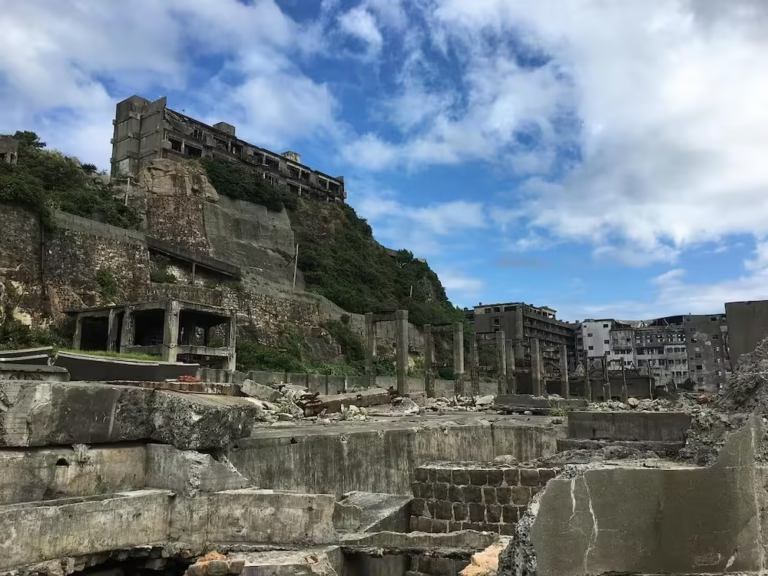
Most articles about Hashima Island — also known as Gunkanjima, or "Battleship Island" — don't mention the bathwater. They mention the ruins. The crumbling concrete towers. The empty streets where grass is slowly pushing through. The aerial drone footage. The UNESCO World Heritage listing. The fact that the island was left largely abandoned after 1974.
None of that is wrong. But something is missing. This article is about what gets left out — and why it matters.
What You'll Find If You Search "Hashima Island" in English
Search for Hashima Island in English and you'll mostly find two things.
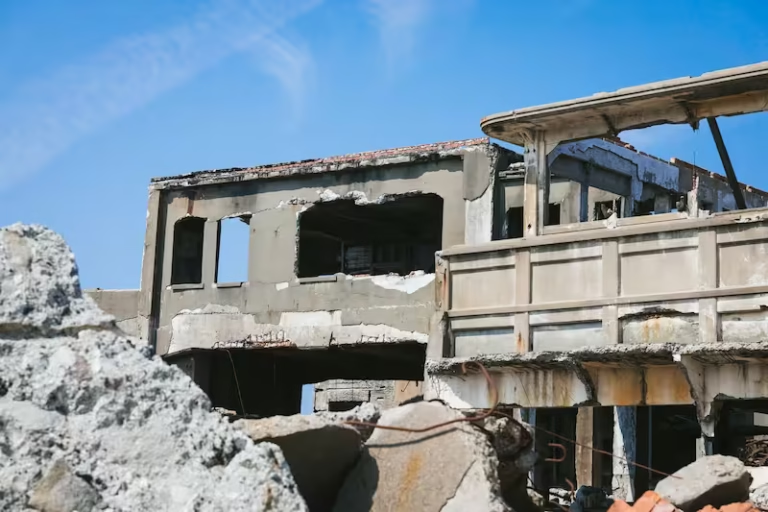
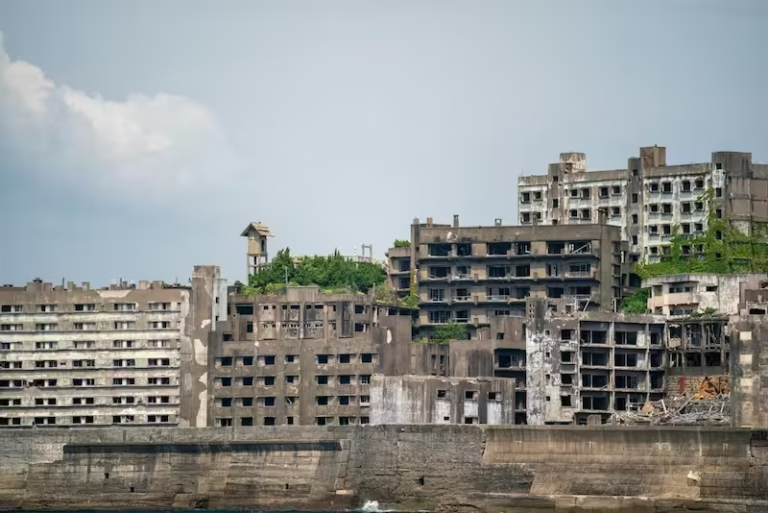
The first is aesthetics. Dramatic photos of broken windows. Collapsed staircases. Paint peeling from walls that once held families in. The visual shorthand for "beautiful decay" that travel and photography media love. Hashima gets compared to post-apocalyptic landscapes. Called a ghost island. Treated as a place where modernity has already collapsed.
The second is the UNESCO story: the 2015 World Heritage listing that brought Hashima to wider international attention, and the diplomatic controversy that came with it.
Neither frame is badly researched. But both are answering different questions — one about why we are drawn to ruins, one about what kind of history a World Heritage site is allowed to tell. Japanese-language testimony tends to start somewhere else entirely: with the people who were already there. Former residents often ask something quieter: what was it like to live here?
Before the Ruins: What the Island Actually Was
Hashima sits about 15 kilometres southwest of Nagasaki. The entire island is roughly 480 metres long and 160 metres wide. If you walked its perimeter in one go, it would take you about 12 minutes.
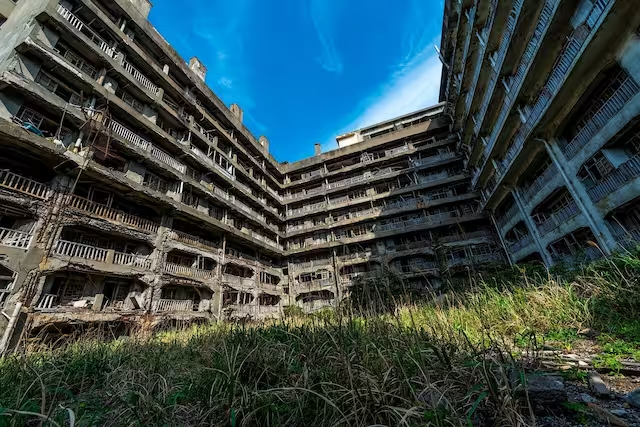
Mitsubishi began mining coal there in 1890. Over the following decades, as the coal beneath the seabed proved valuable, the island was steadily built upward. Because there was no land to expand onto, the only direction was up. Japan's first reinforced concrete apartment building was constructed on Hashima in 1916. By the time the island reached peak population in the early 1960s, more than 5,000 people were living in an area smaller than most suburban shopping centres.
The population density was, at its highest point, roughly five times that of Tokyo. Per square metre, it was one of the most densely populated places on Earth.
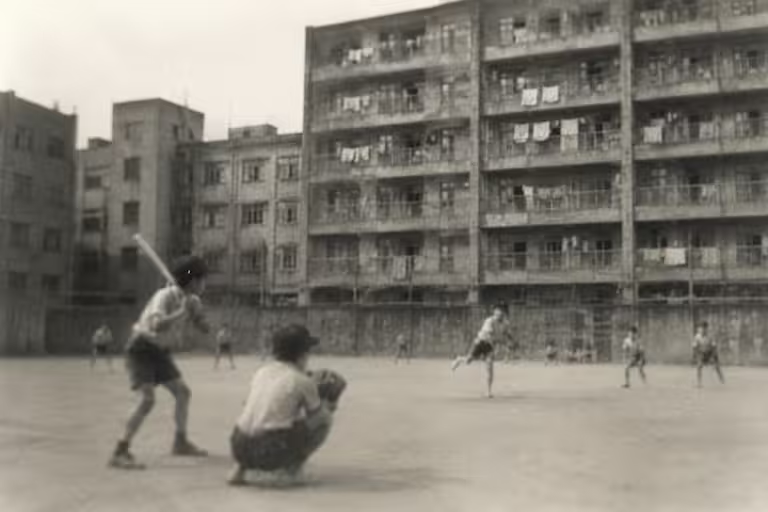
And yet — and this is the part that English articles tend to gloss over — it functioned. It had a school. A hospital. A cinema. Shops. A rooftop garden where residents grew vegetables. A community so tightly knit that many former residents describe it, decades later, in terms that sound less like a workplace and more like a village.
The Voices That Don't Travel Well
In 2022, a woman named Yi Gwi-nam (also known as Iwamoto Chiyo) published a personal essay through the Gunkanjima Digital Museum, a cultural preservation organisation based in Nagasaki. She was 93 years old at the time of writing. She was born on Hashima in 1928.
Her father was Korean, from a family near Busan, and came to Hashima through relatives already working in the coal mine. Her mother — Japanese, from Kagoshima — died shortly after giving birth to her. She describes living on the second floor of a ten-storey building. The communal bath was in the basement. The water was heated seawater — "just like bathing in the ocean," she writes. She describes her Korean grandparents, her grandfather with his long beard, her grandmother who was slim and gentle and lived to 93.
She remembers wearing a white kindergarten apron with Mitsubishi's three-diamond mark embroidered on the bib. At Hashima Elementary School, two teachers — Yamaguchi and Nakamura, both trained at Kwassui Girls' School in Nagasaki — would arrive in formal crested kimono and hakama, becoming figures of admiration for the children.
These are small details, but they change the scale of the place. Hashima was not simply a mine with housing attached. For children born there, it was a complete world — company-run, sea-bound, and intimate enough that a white apron or a teacher's formal dress could remain vivid nearly a century later.
Her essay later moves into much darker wartime memories — hospital work, mine injuries, Chinese prisoners of war, and the aftermath of the Nagasaki atomic bombing. This article focuses on her childhood memories not to soften that history, but to show how many layers one life on Hashima could contain.
The Word for Leaving
A 2024 article by Mansion Lab interviewed Higashi Kenichi, who spent four years of his childhood on the island in the 1950s before returning to the mainland. He now gives public talks about life on Hashima. He describes the rooftop spaces children used as playgrounds, the shared rhythms of the community, and the way density, rather than making life cramped, created a kind of constant social warmth.
One of his most striking memories is not of a building, but of departure. On his final day on Hashima, Higashi remembers saying goodbye to his classmates, boarding the boat with his family, and then seeing his classmates gathered near the school grounds, waving as the boat passed. He uses the word watatta — "crossed over" — to describe the act of leaving Hashima.
That word matters. To a visitor today, Hashima is a place you "go to" by tour boat. For former residents, leaving the island was not simply moving house. It was crossing a boundary: from an enclosed world of schoolyards, rooftops, baths, neighbours, and sea walls into the mainland beyond.
The Part That Gets Complicated
There is a part of Hashima's history that English articles do cover — but often superficially, or in ways that flatten a genuinely complex situation.
During the Second World War, Korean and Chinese labourers worked on Hashima under conditions that have been the subject of significant historical and diplomatic debate. When Japan submitted Hashima as part of its "Sites of Japan's Meiji Industrial Revolution" UNESCO World Heritage nomination in 2015, South Korea objected, arguing that the nomination failed to acknowledge the forced labour that took place on the island during the war. Japan agreed, as part of the UNESCO process, to acknowledge that some workers had been brought to the site against their will. The diplomatic tension over whether Japan subsequently followed through on those commitments continues to this day.
This is real history. It matters.
The essay by Yi Gwi-nam is, itself, a document that complicates easy narratives on all sides. She was born on the island to a Korean father and Japanese mother, in 1928, well before the wartime period. Her account is one of family, community, and a childhood that felt, by her own telling, ordinary. This does not erase the experiences of wartime labourers. But it does show that Hashima's Korean history is not only a history of wartime suffering — it is also a history of settlement, of families, of people who lived there as residents, not only as workers.
The full picture is harder to hold than either narrative on its own. That is probably why it rarely appears in shorter-form English coverage. If you visit Hashima, or read about it — the question of wartime labour is not a footnote. It's part of the island's story, and it deserves more than a sentence.
The Closure and the Silence After
By the early 1970s, the mine was no longer economically viable. The island's mine closed in January 1974. Within three months, every resident had left.
They didn't leave slowly. There was no long farewell. The closure was announced, and people packed and went. Some residents describe the departure as surprisingly sudden — a community that had taken decades to build, dispersed in weeks.
What they left behind is what you see today: apartments still furnished, a school with desks still in rows, a theatre with seats still facing a screen that no longer plays anything.
English coverage tends to read this emptiness as atmosphere — as the "frozen in time" quality that makes Hashima so photogenic. Former residents tend to read it differently. For them, the emptiness isn't aesthetic. It's the specific absence of specific things. The bath that ran on seawater. The corridor outside a particular apartment. A view from a particular rooftop. These are not interchangeable ruins. They are precise locations where a life was lived.
Practical Information
Hashima is open to tourists via licensed boat tours departing from Nagasaki. Landing on the island is not always possible — weather conditions and wave height determine whether boats can dock — but tours run regularly and offer narrated circuits of the accessible areas.
A note on managing expectations: the island is genuinely striking. But if you approach Hashima only as a ruin, you'll see only a ruin. If you go knowing that 5,000 people once woke up there every morning, went to work, raised children, argued with neighbours, and came home to seawater baths — the same place looks different. That's not a small difference. That's the whole point.
By licensed boat tour from Nagasaki harbour. Several operators run daily departures.
Never guaranteed. High waves can prevent docking even when tours operate. Check conditions in advance.
Standard tour: approximately 2.5–3 hours including travel time. Spring and autumn offer the most comfortable conditions.
Worth visiting before or after the boat trip. Oral histories, reconstructed interiors, and photographs from the inhabited period. Located in Nagasaki city.
Nagasaki city. Staying near the waterfront, Oura, or Minamiyamate keeps you close to tour departure points and the museum.
Think of Hashima as part of a wider Nagasaki stay rather than a quick half-day excursion. The slow approach toward the island's silhouette is part of the experience.
Hashima Boat Tour & Nagasaki Accommodation
Book a Hashima boat tour through Klook → Browse Nagasaki accommodation on Trip.com →Questions
Can you still land on Hashima Island?
Yes, but it depends on weather. Tours run regularly from Nagasaki, but landing on the island requires calm seas. Even if landing isn't possible, the boat circuit provides a close view of the island's exterior. Check in advance with your tour operator.
What is the difference between Hashima and Gunkanjima?
Hashima (端島) is the island's official name. Gunkanjima (軍艦島) — "Battleship Island" — is a nickname based on the island's silhouette, which resembles a Japanese warship. Both names refer to the same place.
Why did the UNESCO World Heritage listing cause a controversy?
South Korea objected to the 2015 nomination on the grounds that it did not acknowledge the forced labour of Korean and Chinese workers on the island during the Second World War. Japan committed, during the UNESCO process, to ensuring this history would be reflected in how the site is presented. The question of whether that commitment has been fulfilled remains a subject of ongoing diplomatic discussion.
Where did the residents go after the island closed?
Most relocated to Nagasaki city and the surrounding Kyushu region. Former resident communities have remained in contact, and some members participate in oral history projects and cultural preservation work. The Gunkanjima Digital Museum was established partly to document their testimonies before they are lost.
Is the Gunkanjima Digital Museum worth visiting?
Yes — particularly if you want context that goes beyond what you'll see on the island itself. It houses reconstructed interiors, photographs from the island's inhabited period, and recorded testimonies from former residents. Some guided options include former residents as guides.
Untranslated Japan covers Japanese culture, craft, and experience for readers who want more than the surface. If you read Japanese, the primary sources linked throughout this article are worth exploring directly. If you don't, we hope this piece brought you a little closer to what they contain.
Disclosure: This article contains affiliate links. If you purchase through them, Untranslated Japan may earn a small commission at no additional cost to you. We recommend only experiences we have researched carefully and believe are consistent with the values of this site.