
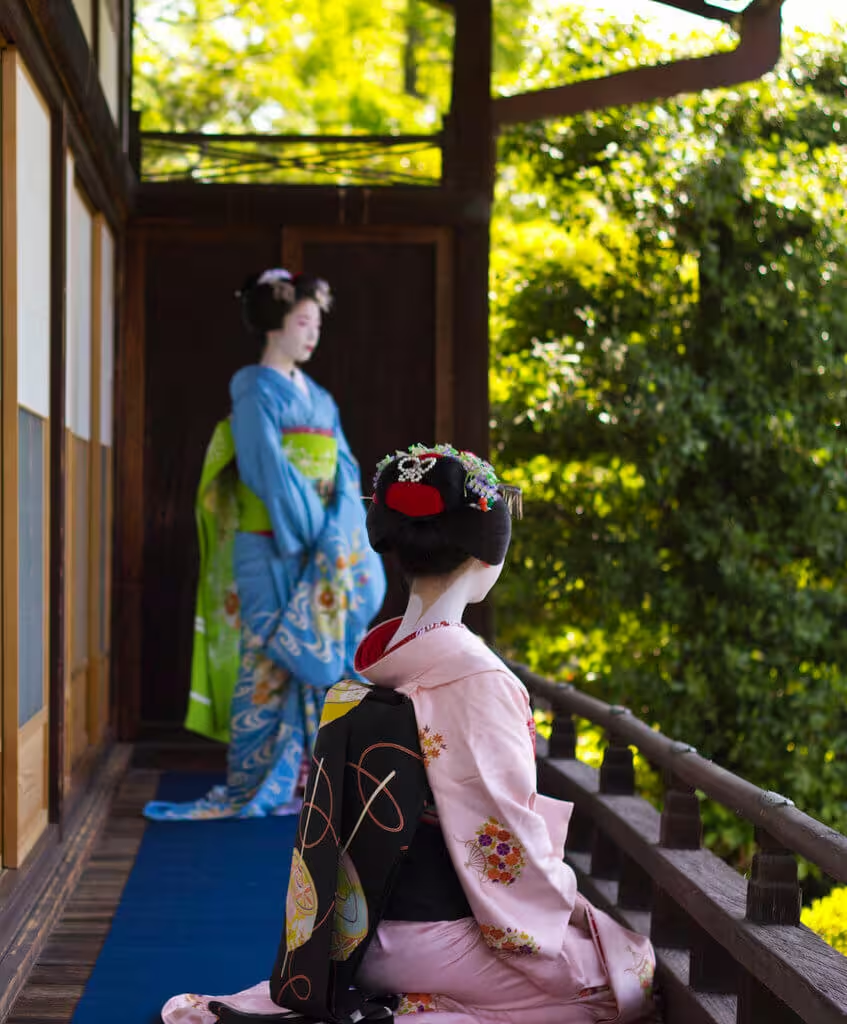
The untranslated original always holds more than the translation. In this case, what was lost was not a nuance. It was a person.
A Word That Crossed the Ocean Empty
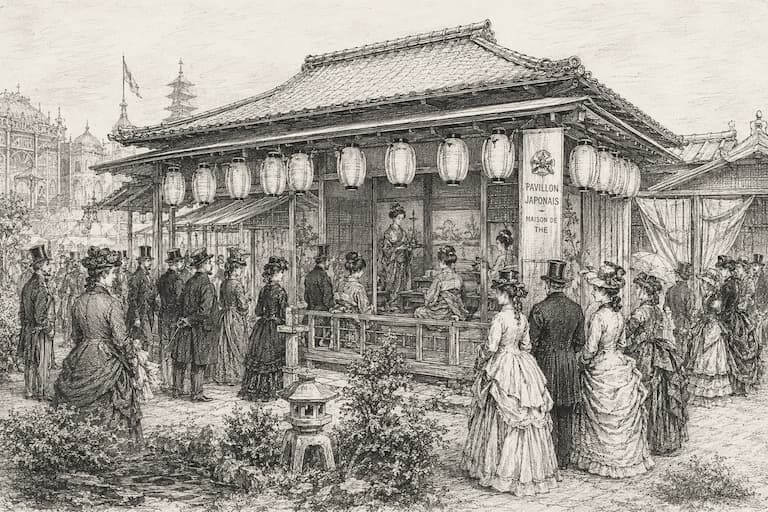
Paris, 1867. The Grand Hôtel. A Japanese woman named Kane — her professional name, Kaya — sits at a writing table. A photograph rests in front of her. She lifts her brush and writes on its reverse: a poem, in classical Japanese, addressed to a Japanese official she has come to know in the city. She and two colleagues, Sumi and Sato, are geisha from the Yanagibashi district of Edo, employed at a small teahouse within the Japanese pavilion of the Exposition Universelle. They crossed the Indian Ocean on a French mail steamer. They passed through Suez. They arrived at Marseille, then Paris. They are among the first Japanese women ever to stand on European soil.
The poem reads: "みもみぬもくるしき君のまかげえの いまはあたなるかたみとこそなる。" Whether I see you or not, the longing just tortures me. Now, the fading image of you has turned into a painful reminder — a ghost that only hurts.
Kane writes in a form that requires years of literary training to shape with this precision. She holds the photograph of herself, turns it over, and sets the brush down.
This is not a minor detail at the edge of the story. It is the entire story. At the same moment that Kane pressed ink to paper in the Grand Hôtel, the word attached to her profession was beginning its long movement across Europe — emptied of everything she carried, refilled with something the continent had already decided it wanted.
The circumstances of the three women's departure, their time in Paris, and their return to Japan are nearly unrecorded. Even in the memoir of Shimizu Usaburō — the merchant who brought them there — their names do not appear. They existed at the margin of a record written by men who considered them peripheral. One poem, on the back of one photograph, is the only direct evidence of who Kane was.
That poem is the untranslated original. Everything that followed is, at best, a very poor copy.
What a London Theatre Did to Japan in 1896
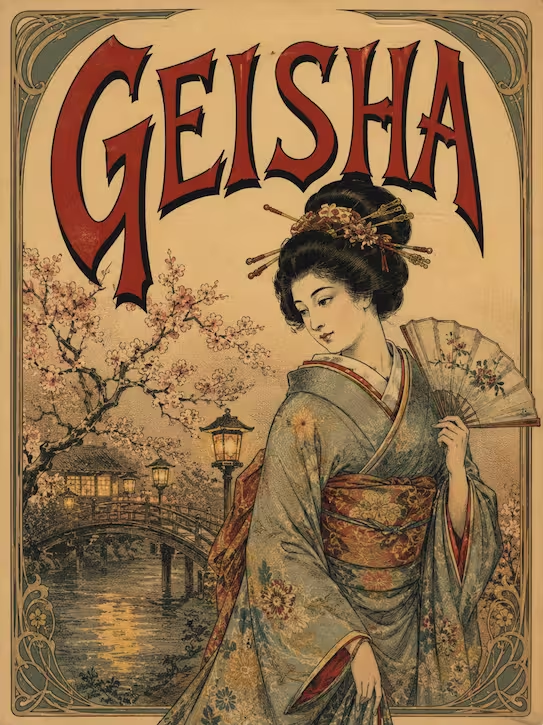
25 April 1896. Daly's Theatre, London. An operetta called The Geisha, composed by Sidney Jones, opens to a paying audience. Its heroine is a Japanese teahouse girl named O-Mimosa-San. The production runs for 760 consecutive performances. It transfers to Broadway for 161 nights. It crosses Europe. In Germany alone, it reaches an estimated 8,000 performances. In Britain, it continues in some form until 1934.
None of the people who wrote, staged, or performed this show had spent any time in Japan. The costumes come from a European imagination of what Japan looks like. O-Mimosa-San bears no resemblance to the geisha of Yanagibashi or Gion. The plot turns on comic romantic misunderstandings of British invention. Japan is the backdrop. It is not the subject.
Eight years after the operetta opens, Puccini's Madama Butterfly arrives on stage — and the image settles further. By the early twentieth century, European audiences hold a clear, confident picture: the geisha is decorative, exotic, sexually suggestive, belonging to a vaguely imagined East. That the actual geisha of Japan were professional artists — musicians and dancers embedded in a centuries-old system of training and cultural patronage — does not reach the theatre.
In 1908, the Finnish confectionery company Fazer releases a chocolate under the Geisha brand. The filling is named Mimosa — taken directly from the operetta's heroine. In 1911, an American canned fish company launches under the Geisha name, its founders noting that Fujiyama and Geisha are already widely recognised in the American market and will read immediately on a label. The word has become merchandise. The woman it was attached to has disappeared entirely.
What arrived in the West was not a translation. No translation was attempted. A story was told by people who had not heard the original, and for more than a century, that story was the only version most of the world knew.
What Japan Actually Thought About This
There is a persistent assumption that the Japanese government sent the geisha image abroad deliberately — that Fujiyama and Geisha were a planned export, a strategy conceived in Tokyo and released into the world. The historical record does not support this. It directly contradicts it.
Before the World's Columbian Exposition in Chicago in 1893, the Japanese government establishes an explicit policy: no Japanese customs, entertainments, or cultural performances are to be staged by parties outside direct government oversight. Japan is presenting itself to the world as a modern nation-state. The image of an exotic, decorative geisha — already moving through European opera and popular theatre — is the precise image a modernising government must refuse.
Private promoters find ways through anyway. At Chicago, Japanese officials intervene to block a commercial geisha performance organised without government approval. At the 1904 Saint Louis World's Fair, a private operator succeeds where Chicago had failed — thirty-four geisha perform miyako odori outside official channels. At the 1867 Paris Exposition, the three geisha present — Kane among them — are not a government deployment. They are employees of Shimizu Usaburō, a private merchant financing an exhibition of lacquerware, ceramics, silk, and tea. The teahouse draws curiosity. The goods sell poorly. Shimizu returns to Japan with a silver medal and a debt.
In Paris, in Chicago, in Saint Louis — across four decades — the sequence is the same. Western commercial interests identify geisha as a sellable image, and move to sell it. Japan resists, with varying force, and the image leaves anyway. What did not travel was the reality: the literary education, the years of training, the poem on the back of the photograph.
The Profession
Set aside the image for a moment. Set aside the white makeup, the trailing obi, the lantern-lit lane. What you are looking at, underneath all of that, is a professional artist who has trained for years — sometimes decades — in classical Japanese dance, music, and song. She performs at private gatherings called ozashiki, hosted inside teahouses for small groups of guests. She does not serve food. She does not exist as decoration. She dances. She plays the shamisen. She carries a conversation with the precision of someone who has studied how to be fully present in a room.
The ozashiki she attends is itself a cultural form — a centuries-old container for music, performance, and the kind of hospitality that requires training to give and attention to receive. When she walks through the door of the teahouse, the evening changes. That is her profession. That is what the word, emptied and exported, failed to carry.
This world has not disappeared. In Kyoto today, geiko and maiko still perform at ozashiki inside the city's ochaya — the same setting in which dance, music, conversation, and hospitality have long come together. Most ochaya traditionally do not accept first-time guests without an introduction, which is one reason this world can remain difficult for visitors to encounter on its own terms.
Geiko and Maiko at a Traditional Ochaya in Gion
A private evening at Ochaya Man in Gion Higashi, where a maiko performs traditional dance accompanied by a geiko on shamisen, followed by conversation, ozashiki-asobi and Japanese cuisine.
One Word, Many People
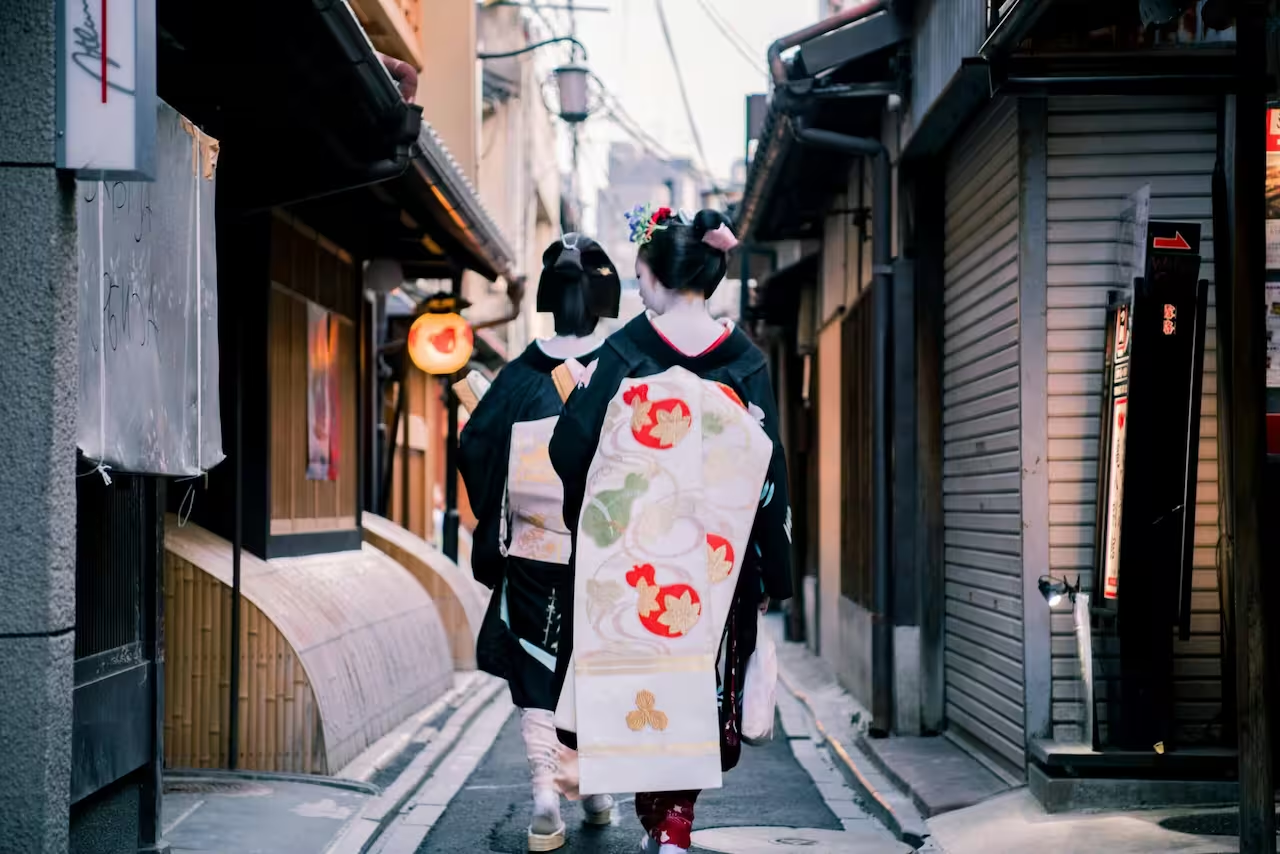
The single word geisha erases at least three meaningful distinctions. Understanding them is not a matter of precision for its own sake. It is the difference between seeing what is in front of you and seeing only what you were told to expect.
Geisha, Geiko, Geigi — the same profession, different cities
In Tokyo and the broader Kantō region, the word is geisha or geigi (芸妓, read "gay-gee"). In Kyoto, the same fully trained professional is called geiko (芸妓, read "gay-ko"). These are not different roles. They are the same role, described in different dialects. The character for "geisha" — 芸者 — means, literally, "a person of art."
The West received the Kantō pronunciation and applied it to everything. This matters because the most iconic image attached to the word — the elaborate white makeup, the long trailing obi sash, the seasonal flower hairpins, the tall lacquered wooden footwear — belongs not to the geisha or geiko, but to the maiko.
Maiko — the apprentice, not the archetype
A maiko (舞妓) is an apprentice geiko, specific to Kyoto's flower districts. She is not a fully trained professional. She is typically between fifteen and twenty years old, in the most intensive period of her training, and her entire appearance announces exactly where she stands. The collar of her kimono is embroidered in red. The darari obi — approximately five and a half metres long and weighing around six kilograms — trails nearly to the ground. Her flower hairpins change with every month: plum in February, cherry in April, iris in June, maple leaves in autumn. You can read the month from her hair. You can read her rank from her collar.
When she completes her training and moves to full geiko — a ceremony called erikae, the collar changing — the embroidered red is replaced with plain white. The darari obi becomes a standard tied obi. She becomes, visually, quieter. What has grown is not visible.
A trainee geisha in Tokyo's flower districts is called a hangyoku (半玉). The visual difference between trainee and fully trained professional is less immediately readable than in Kyoto — there is no equivalent of the maiko's darari obi. Tokyo's geisha tradition developed along separate lines, historically centred on districts such as Yanagibashi, Shinbashi, Akasaka, Kagurazaka, Mukōjima, and Asakusa. Each district holds its own dance school, its own character, its own social world.
Tachikāta and Jikata — the two disciplines within
Inside the profession, a further distinction exists that almost no account outside Japan has ever named. A tachikāta (立方) specialises in dance. She performs. A jikata (地方) specialises in music — she plays the shamisen, the hand drum, the flute, or sings, and in doing so provides the sound on which the tachikāta's dance depends. Without the jikata, the tachikāta cannot dance. Without the tachikāta, the jikata has no stage.
The jikata does not wear white makeup. She is, visually, the less conspicuous of the two. She is also, technically, the more demanding role to carry — requiring years of additional training across multiple instruments. In recent decades, jikata have become scarce across all five of Kyoto's flower districts. Their absence is considered one of the most serious pressures on the tradition's continuity.
The System, Not the Individual
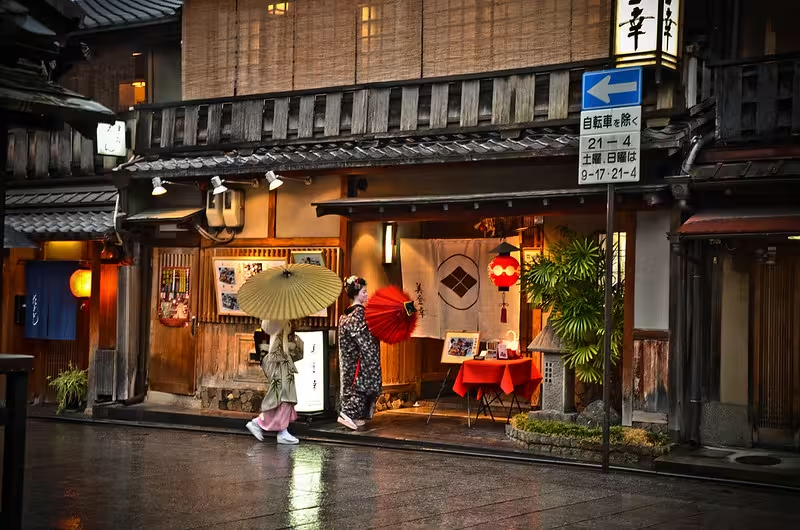
"geiko and maiko" by David Offf, CC BY 2.0
A maiko cannot exist without an okiya. The okiya cannot function without the teahouses that call for her. The teahouses call a specialist caterer. The maiko's hairpins are made by a craftsperson who works only in seasonal flower arrangements. Her kimono is woven in Nishijin. Her obi was dyed in Kyoto-style yuzen. The musician who plays when she dances trained for a decade in a school attached to the flower district.
Remove any one of these and the others weaken. This is not a way of speaking. It is how the system operates.
What you are looking at, when you look at a maiko on a Gion lane, is not a person in a costume. You are looking at the visible surface of a network — of weavers, dyers, caterers, musicians, craftspeople, teahouses, and training halls — that has held its shape across generations. The tradition is not preserved in a museum. It is alive in the relationships between these people, renewed each time the shamisen is tuned and the door of the ochaya slides open.
What Is Not a Costume
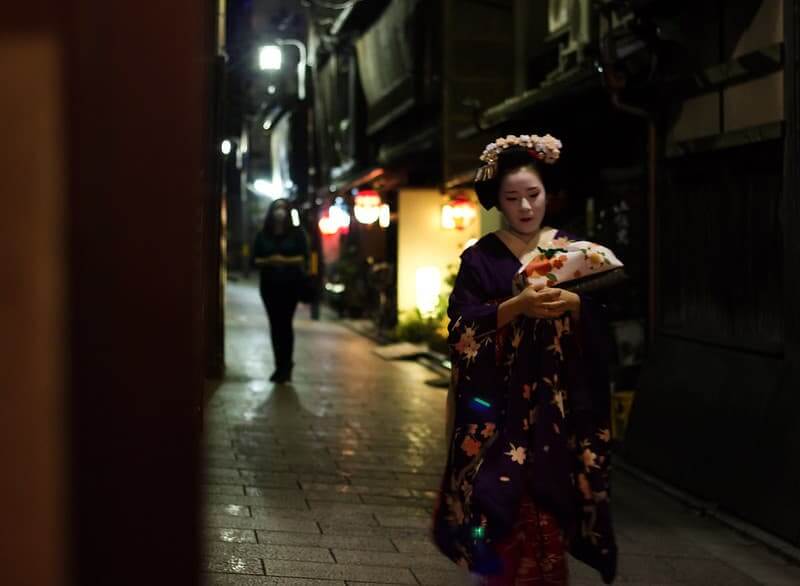
"Maiko in Gion alley" by Japanexperterna.se, CC BY-SA 2.0
The Western narrative about geisha carries an unspoken assumption: that women entered this world because they had no other choice. Poverty, family debt, circumstance — the implication is coercion. The reality is different. The women who become geiko and maiko choose this path. Some choose it young. Some choose it as adults, leaving other work behind. The choice is real. The profession is respected.
Tsune Kazu has been a geiko in Gion Higashi for sixty years. She did not enter the flower district with a particular ambition. Her older sister was already a geiko, and as a schoolgirl she visited the teahouse informally, helping where she could. After her sister married and left the profession, the house mother asked Tsune Kazu to stay. The mother said: stone on stone for three years. Tsune Kazu stayed.
She dances still. She has received the name of a dance lineage and the name of a long-uta song lineage. Her standard is her own: when she stands on stage in a way she would be ashamed of, she will stop. She has not stopped.
Dan Mitsu entered Gion Kōbu at thirty, with no prior apprenticeship as a maiko, after a decade in Tokyo in an unrelated field. She had attended the Miyako Odori every year since childhood, watching from the audience. Her eyes stayed on the jikata musicians rather than the dancers. She found a shamisen teacher in Tokyo and trained for years before approaching the flower district. Her sister — already a geiko — said: at that age? Then helped anyway.
Sato no Suke, a jikata in Kamishichiken, entered the flower district as an adult after working as a teahouse serving attendant. She watched the jikata at work. She saw someone who was invisible, indispensable, and technically exact. She asked the house mother. There were few jikata. The request was accepted.
The number of geiko in Kyoto's five flower districts has declined steadily across recent decades. Many young women enter as maiko and leave before making the transition to geiko — some because geiko life requires financial self-sufficiency the okiya no longer provides, and the economics press hard. Others leave because the glamour does not sustain the practice. Jikata are scarcer still.
A tradition is not a museum exhibit. It requires living practitioners who return to it, again and again, across decades. What Kane preserved in her poem in Paris in 1867 — the literary education, the deliberate art, the capacity to express longing in classical form — is what Tsune Kazu preserves in her dance, what Dan Mitsu preserves in her shamisen, what Sato no Suke preserves in the sound that makes the dancing possible.
It was never a costume. It was always a discipline. The discipline is still here.
If you are planning to encounter this world in person — to attend one of the five hanamachi performances, or to meet a geiko in Kyoto or Tokyo — the practicalities are gathered separately.
How to See Geiko and Maiko in Kyoto — A Visitor's Guide →Fewer things. Truer things.
- Sawa Mamoru, "Shimizu Usaburō — 1867-nen Pari Bankoku Haku wo Megutte," in Senshū Keizai Kenkyū, Vol. 29. Primary source on the three geisha and the poem by Kane.
- Ueda Takuji, "Kaigai ni okeru 'Geisha' no Imēji ni tsuite," Osaka University of Tourism Bulletin, Vol. 13 (March 2013), pp. 9–19. On The Geisha operetta (1896) and Japanese government opposition to geisha export. osaka-ue.ac.jp
- Ōokini Zaidan, official site for the five hanamachi: geiko training structure, maiko information, jikata and tachikāta roles. ookinizaidan.com
- Ōokini Zaidan — Interview series: published interviews with practitioners including geiko Tsune Kazu (Gion Higashi), jikata Dan Mitsu (Gion Kōbu), and jikata Sato no Suke (Kamishichiken). ookinizaidan.com/kagai/interview
- Tokyo Hanamachi Jōhōsha, "Nazenani Hanayanagikat," on Tokyo's geisha tradition and terminology. tokyo-geisha.com
This article contains affiliate links. If you book an experience through one of these links, Untranslated Japan may earn a small commission at no additional cost to you.