
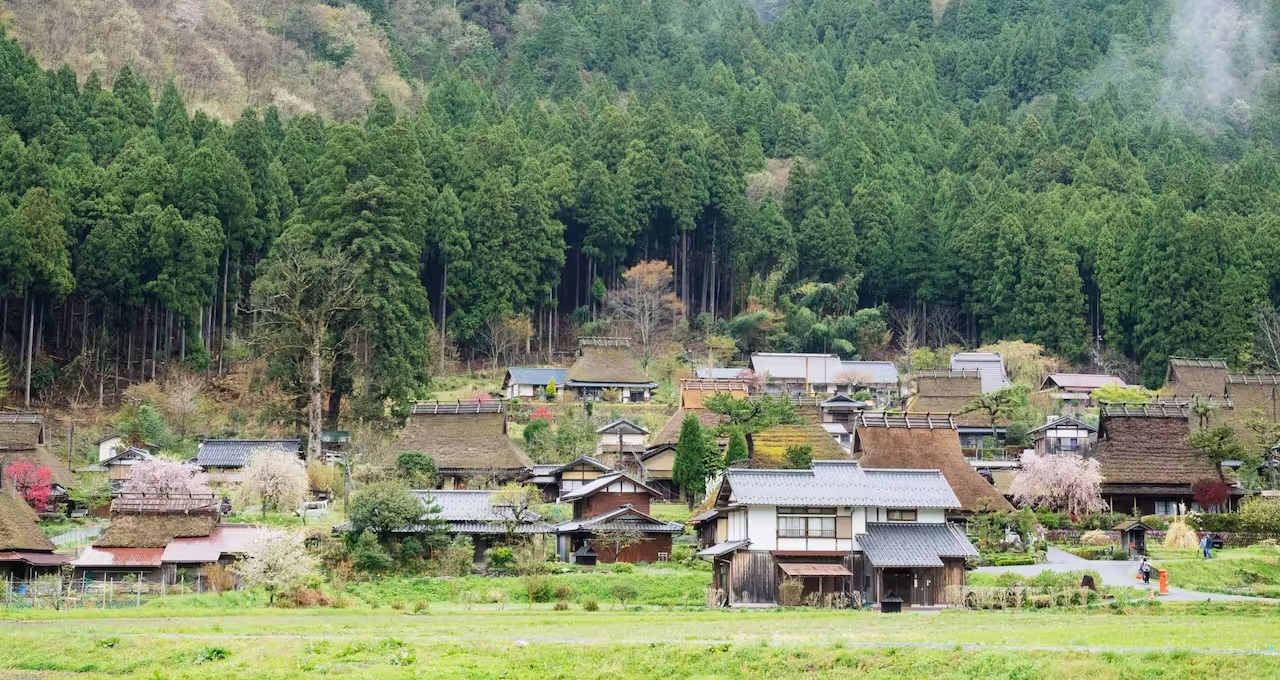
The countryside you want to visit is disappearing. Not dramatically — not all at once — but quietly, one closed shop at a time, one retired craftsman at a time, one abandoned farmhouse at a time. The question is not whether this is happening. The question is whether the way you travel makes it slower or faster.
Some of What You Came to See Is Already Gone
There is a village in Gunma Prefecture, about 100 kilometres west of Tokyo, called Nanmoku. Masayuki Kaneta, who is 85 years old, runs a confectionery there with his son. He told a journalist that within 150 metres of his shop there used to be forty other businesses. Today, most of the buildings on the main street are boarded up. Sixty-seven percent of Nanmoku's remaining population is over the age of 65. It is, by that measure, the oldest village in Japan. It is also one of twenty communities in Gunma alone that researchers say could disappear entirely by 2050.
Nanmoku is not exceptional. It is representative.
In the prefecture of Wakayama, more than one in five homes now stands empty. The same is true in Tokushima. Nationally, a government survey counted nine million abandoned homes — akiya in Japanese — and that figure continues to rise. These are not ruins. Most of them are structurally intact. They are simply no longer lived in, because the people who lived in them moved away, or grew old and died, and no one came after.
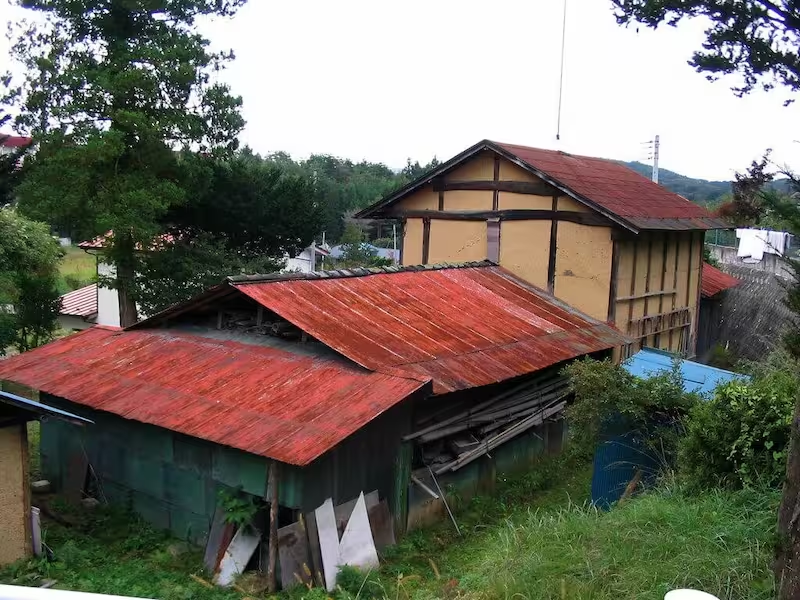
The houses are the visible part. What is less visible — what is harder to photograph — is what disappears before the houses do. The bus route that was discontinued because ridership fell below the threshold for subsidy. The hospital that closed because it could not recruit doctors to a town with a shrinking population. The school that merged with three others in the next district, requiring children to travel an hour each way. The sake brewery that made a single-origin rice wine for two hundred years, until the brewer's son chose a career in Osaka and there was no one left who knew the ratio.
In February 2024, the Sominsai festival of Oshu in Iwate Prefecture — a ritual with 1,200 years of continuous history — was held for the last time. It did not end because people lost interest. It ended because the small number of elderly households that had always funded and prepared the festival, performing the labour-intensive work of cutting wood for the ceremonial charms, could no longer sustain it alone. The tradition required bodies. The bodies were no longer there.
There is a tension worth sitting with before the rest of this article. If you are reading it, you already have an interest in rural Japan — in its landscapes, its crafts, its quieter rhythms, its distance from the version of Japan that has been packaged and presented for easy consumption. That interest is real and it is valuable. But interest expressed through the wrong kind of visit can be, at best, neutral in its effect on the places it touches. The question this article is asking is a specific one: not whether to go, but how.
The Logic of Emptying
Japan's rural depopulation is not a sudden event. It has been building since the postwar economic boom drew a generation from the countryside into the cities. What has changed is the velocity. In 2024, Japan recorded 686,061 births — the lowest figure since records began in 1899 — against 1.59 million deaths. The population shrank by nearly one million in a single year. And because this contraction is not evenly distributed, its consequences fall hardest on the places that were already losing people.
The mechanism is straightforward, and it is worth understanding clearly before moving to what can be done about it.
Young people leave rural areas for cities because cities offer more employment, more social connection, better access to education and healthcare. Their departure accelerates ageing in the communities they leave. An older population produces fewer children, reducing the long-term population base further. As the population contracts, the tax base shrinks. Municipalities lose the revenue to maintain infrastructure and services. Services deteriorate, which makes the area less attractive, which encourages more young people to leave. The spiral is self-reinforcing, and it is very difficult to break from the inside.
across Japan (akiya)
Wakayama & Tokushima
of 20+ Gunma villages
When the Craftsman Has No Apprentice
The first casualty of depopulation is not always the population itself. It is often the transmission of knowledge.
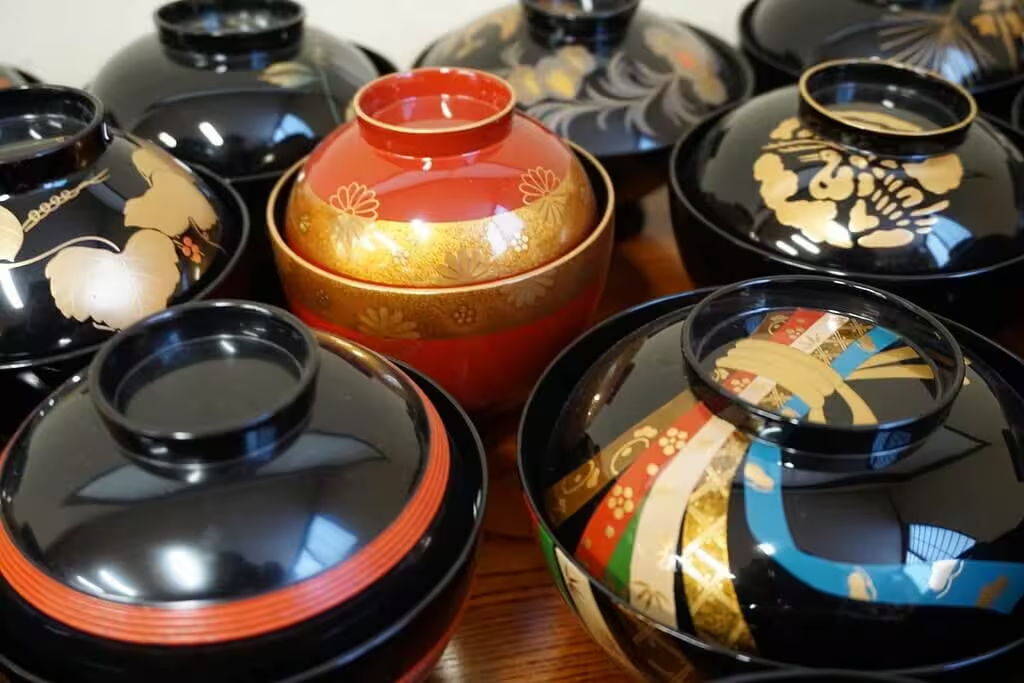
Traditional crafts in Japan — Wajima lacquerware in Ishikawa, Nanbu ironwork in Iwate, Bizen pottery in Okayama — are not produced in factories. They are produced by individual craftspeople who learned from a master, who learned from a master before that, in chains of direct transmission that in some cases stretch back several centuries. When a craftsman retires, someone must already have spent years learning the work. If no one has — because the young people of the region left, because the apprenticeship pays too little, because the community that would have produced the next generation no longer has the critical mass to sustain its own culture — the technique does not transfer to a museum. It simply ends.
This is not a metaphor. It is a description of what is happening. The 2024 earthquake that severely damaged the Noto Peninsula in Ishikawa — already one of Japan's most rapidly ageing regions — accelerated a process that was already advanced. Wajima lacquer masters, whose workshops were destroyed, faced a choice not only about whether to rebuild their buildings but whether there was a sufficient community remaining to rebuild their craft into.
The Akiya Economy — What 9 Million Empty Houses Actually Mean
An empty house is not just a real estate problem. It is a record of what came before it.
In the villages where akiya accumulate, the sequence tends to follow a recognisable pattern. The young leave first. Then the school enrolment falls below viability, and the school closes or merges. Then the doctor retires, and the medical clinic cannot recruit a replacement. Then the bus company reviews its routes and discontinues the least profitable one, which happens to be the one that connected this village to the town. Then the supermarket chain that opened a small branch here in the 1990s closes it, because the remaining population is too small and too old to be a viable market. Then the remaining residents, who can no longer access services without a car, and who are reaching the age where driving becomes difficult, face a choice about whether to stay.
The house does not become an akiya because the owner was careless. It becomes an akiya because the infrastructure that made it liveable was withdrawn, piece by piece, over twenty or thirty years, until staying became untenable for anyone without their own transport, their own resources, and a strong enough attachment to the place to absorb the increasing cost and difficulty of remaining.
What this means for the traveller is that when you arrive in a rural Japanese community, you are arriving in the middle of a process. Some communities are at the beginning of it; some are very far along. The presence of a functioning sake brewery, a family-run ryokan, a craftsman still accepting apprentices — these are not given. They are contingent. They are sustained by a combination of individual commitment, community support, and the modest but real economic signals that visitors send when they spend money in the right places.
37 Million Visitors. Nine Million Empty Homes. The Same Problem.
Japan welcomed 36.87 million international visitors in 2024 — a new record. In 2025, that number climbed further, past 42 million by most estimates. Foreign visitor spending exceeded eight trillion yen in 2024, surpassing all previous records. By every metric the tourism industry uses to measure success, Japan is performing exceptionally.
And yet nine million homes stand empty in its countryside.
These two facts are not unrelated. They are the same structural problem expressed in two different ways: a system that concentrates — concentrates visitors in certain places, concentrates economic benefit in certain corridors, concentrates attention on certain versions of Japan while leaving others entirely outside the flow.
The 73% Problem
Of all international visitors who stay overnight in Japan, 73% of those nights are spent in five prefectures: Tokyo, Osaka, Kyoto, Hokkaido, and Fukuoka. This concentration is not random. It is the product of how itineraries are constructed, how tours are packaged, how search algorithms and travel content surfaces destinations, and how infrastructure has been developed to serve the most visited places first.
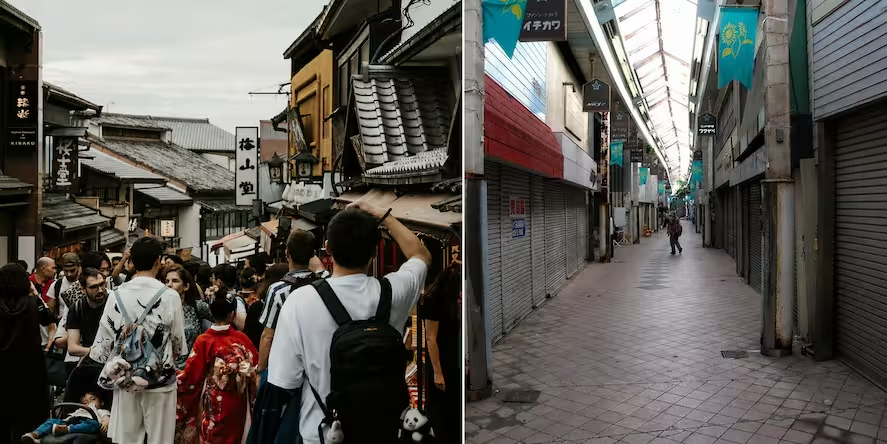
The result is a map of Japan where certain places absorb almost all the economic and social weight of international tourism, while most of the country receives almost none of it. Kyoto's buses are too crowded for residents to use during peak season. The village of Nanmoku has not seen a foreign tourist in years.
This is not a problem that more visitors will solve on its own. Japan's government has a target of 60 million international visitors by 2030. If that growth follows the same geographic distribution as today's tourism, the overcrowded places become more overcrowded, and the empty places remain empty. Volume is not the variable that matters. Distribution is.
What Overtourism Actually Costs — on Both Sides
In Kyoto, the effects of concentration are well documented. Residents report finding their commuter buses impassable during peak tourist season. The narrow lanes of Gion, never designed for the volume they now carry, have been partially closed to visitors. Housing costs have risen as short-term rental platforms converted residential stock into tourist accommodation. The city introduced Japan's highest lodging tax in an attempt to manage demand, and a further increase — to a maximum of 10,000 yen per person per night — has been proposed.
In rural Japan, the costs of the opposite condition are less reported but structurally just as serious. A ryokan that cannot attract enough guests to justify staying open closes. The closure removes the primary employer in a small community. It removes the accommodation option that would have drawn the next visitor. It removes the relationship between host and guest that, in rural Japan, has always been one of the primary mechanisms by which culture is transmitted to the outside world. The emptying of the countryside is, among other things, a silence imposed on the part of Japan that had the most to say.
When Tourism Money Doesn't Stay Local
There is a further complication that the visitor numbers alone do not capture. Visiting a rural area and benefiting a rural area are not the same thing.
A traveller who books through a large international platform, stays in a chain hotel, eats at a restaurant that sources its ingredients through a centralised supply chain, and purchases souvenirs from a national retail brand has spent money in the rural area. But much of that money — the platform commission, the hotel chain's margin, the supply chain's markup — flows back to corporate structures located elsewhere. The rural community captures a fraction of the transaction.
A traveller who books directly with a family-run ryokan, eats at a restaurant that names the farm where its vegetables came from, visits the workshop of the craftsman whose work they are considering buying, and pays for a guided experience run by a local cooperative — that traveller is making choices whose economic geography is fundamentally different. The money stays closer to where it is spent. That proximity is the mechanism through which tourism becomes a tool for rural survival, rather than simply a commercial transaction that passes through.
The Traveller as a Form of Intervention
This section is not going to ask you to travel sustainably. That phrase has been used so many times, in so many contexts, by so many airlines and hotel chains that it has been drained of specific meaning. What follows instead is a description of concrete choices — choices whose logic you can evaluate for yourself — and what each one actually does in economic and cultural terms.
None of these choices requires sacrifice. Several of them produce a noticeably better travel experience than the alternative. The point is not virtue. The point is understanding what your choices do.
Where the Money Actually Goes
The most consequential single decision a traveller makes is where to sleep. Accommodation is the largest single line item in most travel budgets, and it is the category where the difference between money that stays local and money that leaves is most pronounced.
- Family-run ryokan, booked directly or via a local platform
- Farm stay (nōka minshuku) — meals often included, ingredients from the host's land
- Converted akiya guesthouses — often run by Iターン settlers who chose to stay
- Temple lodgings (shukubō) along the Shikoku pilgrimage
- International hotel chains, even when located in rural areas
- Booking through large international platforms, where a significant commission share leaves the local economy
- All-inclusive tour packages where the accommodation margin is set centrally
- Short-term rentals operated by absent landlords as investment properties
The same logic applies to food. A restaurant that names its suppliers — that tells you the rice is from the farm two kilometres south of the village, that the miso was made in this building six months ago — is describing an economy that is geographically contained. That containment is not marketing. It is the operational reality of a food system that has not yet been rationalised into invisibility.
And to crafts. When you buy a piece of pottery directly from the person who made it, in or near the workshop where it was made, the full purchase price stays with the maker. When you buy what appears to be the same piece in a souvenir shop in Kyoto, a chain of intermediaries has already taken its share, and the maker — if they are still making — has received a fraction.
Finding Rural Experiences in Japan
Where possible, book experiences directly with the operator — by phone, email, or through their own website. Direct booking keeps the full fee with the host and often opens a conversation that a platform cannot. For those that require an English-language platform, Klook lists craft workshops, sake brewery visits, and cooking classes across rural Japan, with search available by region.
Search Rural Experiences on Klook → Viator and GetYourGuide also list rural Japan experiences — search by region and look for small-group or single-operator listings rather than packaged tours.The Value of the Off-Season
Japan's tourism peaks are well known and brutally concentrated. Cherry blossom season in April. Autumn foliage in November. The Golden Week holidays in early May. During these periods, the already-crowded places become almost impossible, while the rural areas — which also have cherry blossoms, also have autumn foliage — receive a fraction of the attention.
Visiting a rural ryokan in February — when the snow is on the ground and the thermal baths are at their most compelling — or in June, when the rice paddies have just been flooded and reflect the sky, or in October, before the foliage peaks draw the crowds — means visiting at a time when the inn genuinely needs your booking. The difference between a room occupied and a room empty is not trivial for a family-run property with eight rooms and no corporate cushion. An off-peak booking is a disproportionately meaningful act of support.
It is also, practically, a better time to be there. The landscape is less mediated by other visitors. The host has more time. The experience is closer to what the place actually is, rather than what it becomes when it is performing for a peak-season audience.
Staying Longer in Fewer Places
The standard international itinerary for Japan runs something like this: three nights in Tokyo, two in Kyoto, one in Osaka, perhaps a day trip to Nara. Seven or eight cities in two weeks, each seen from the surface, the famous sites checked, the train boarded to the next destination.
This is not wrong. It is a reasonable way to form an initial impression of a country. But it is a pattern that concentrates economic benefit in the same places that are already concentrated, and it produces a kind of cultural encounter that is, by definition, shallow — not because the traveller lacks depth, but because depth requires time, and there is none available.
Three nights in a single rural ryokan, in a village in Tohoku or a valley in Shikoku, produces something different. By the second morning, the innkeeper is beginning to speak with less formality. By the third, they might mention that their cousin makes pottery in the next town, and offer to call ahead. The surrounding area — which on day one seemed quiet, even featureless — begins to reveal its structure: the shrine festival scheduled for Thursday, the route along the river that no signage marks but that locals walk in autumn, the old farmhouse down the lane where someone has begun restoring the roof using traditional materials. None of this is accessible at one night's depth. All of it is available at three.
Finding Family-Run Ryokan Across Rural Japan
The best starting point is always the inn itself — a direct email or phone booking avoids platform commission and often results in a more personal arrival. Prefectural tourism boards maintain lists of registered ryokan and minshuku that are a more locally grounded source than international platforms. For those searching in English, Trip.com lists ryokan and traditional guesthouses across Tohoku, Shikoku, Kyushu, and the Japan Alps, including smaller properties. When searching on any booking platform, filtering by Property Type and selecting Guesthouse or Inn significantly narrows results toward family-run accommodation.
Search Rural Ryokan on Trip.com → When booking through any platform, look for properties with fewer than twenty rooms listed under a family name — these are the ones where your stay makes a direct difference to the people running it.What Held — And Why
Not every rural community in Japan is emptying. Some have found, or invented, or stumbled into, arrangements that work — that retain people, sustain culture, and remain economically viable without becoming theme parks of themselves. These places are worth looking at not as models to be replicated but as evidence that the spiral is not inevitable. What they share, as a group, is less a particular strategy than a particular logic.
The Kurokawa Model — Competing by Not Competing
Kurokawa Onsen, in the mountains of Kumamoto Prefecture, is a small hot spring village with around thirty ryokan. In the 1980s, the village's innkeepers made a decision that runs counter to most commercial logic: they agreed to share their guests.
The mechanism they invented is the nyūtō tegata — a single entry pass, sold at any participating inn, that allows the holder to bathe at three different establishments for one fee. The inns, which by every conventional measure are each other's direct competitors, effectively become each other's marketing infrastructure. A guest who arrives for one ryokan's baths encounters two others and returns. The town, experienced as a whole, is more than the sum of its individual properties.
What held in Kurokawa was not a particularly innovative tourism strategy. It was an older logic — the logic of the village economy, in which the survival of each member depends on the survival of the whole — applied to a modern commercial context. The innkeepers understood that their individual interests and the town's collective interest were the same interest, and they structured their business accordingly. Forty years later, Kurokawa is one of the most sought-after hot spring destinations in Japan, and its thirty ryokan are all still operating.
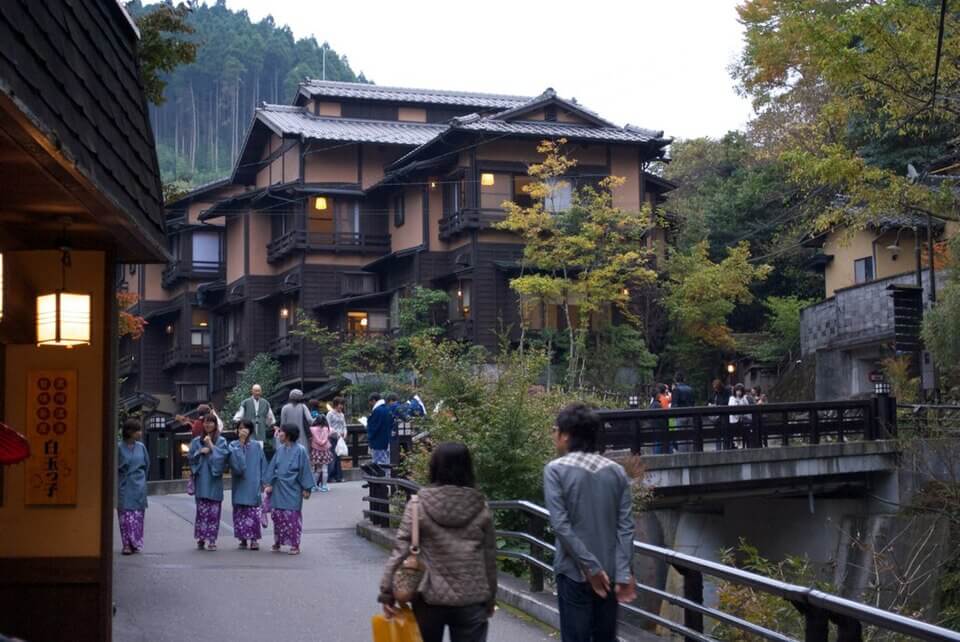
hiroooooki from Tokyo, Japan, CC BY 2.0, via Wikimedia Commons
The Iターン Generation — Choosing to Go Back
There is a growing cohort of people in Japan who are moving in the direction that demographic trends say they should not. The Iターン — literally the "I-turn," the trajectory of someone who was not born in a rural area but chose to move to one — and the Uターン, the person who left and came back, are not marginal figures. They are increasingly a structural feature of Japan's rural revival efforts.
Some are driven by cost — the collapsing price of akiya in depopulating areas has made it possible to acquire and restore a traditional farmhouse or a former workshop for a fraction of what equivalent space would cost in any city. Some are driven by craft — the potter who wanted access to a specific local clay body, the brewer who found a rice variety unavailable in Tokyo, the textile artist who needed the light and silence that only a certain kind of rural building provides. Some are driven by something less legible: a sense that the city's version of life had reached its useful limit for them, and that the countryside offered a different set of constraints that they preferred.
What these individuals do, collectively, is something that government policy struggles to achieve directly: they restore the demographic middle of communities that have become predominantly elderly. A 35-year-old who moves to a depopulating village and opens a small ceramic studio is not just a tourist attraction. They are, if they stay, a schoolparent, a festival participant, a neighbour who knows how to fix the irrigation channel because they asked the 80-year-old across the road to show them. They are the mechanism of continuity.
As a visitor, you are unlikely to become an Iターン. But you can encounter these people — at the converted akiya guesthouse where someone from Osaka decided to stay, at the workshop where a former graphic designer is now apprenticed to a lacquerware master, at the bakery in a former post office that a couple from Tokyo opened because they wanted to live near the mountains. These encounters are not incidental colour. They are evidence that the direction of travel can change, and that it sometimes does.
Finding Craft and Village Experiences
The most direct route to a craft workshop or farm experience is through Japan's official tourism platform, which links to regional booking sites where experiences can be reserved directly with local operators. For broader English-language search, Klook's filtering system works well for rural experiences — search by keyword such as "workshop" and narrow by prefecture to find small-group and hands-on options in specific regions.
Browse Regional Experiences on Japan Official Tourism → Search Workshops by Region on Klook →The structural tension that opened this article — between your interest in rural Japan and the forms that interest can take — does not resolve neatly. The countryside is not saved by any single visit, or ten visits, or a hundred. The forces driving depopulation are demographic, economic, and generational, and they are larger than tourism.
But the choice of how to visit is not nothing. It is the small-scale version of a decision that, aggregated across millions of travellers over years, determines which inns remain open, which craftspeople continue to find it viable to practice their work, which communities retain enough economic weight to maintain the conditions in which culture survives.
You stop. You look at the board outside the ryokan — the one that lists the name of the farmer who grew the rice, the name of the river the fish came from. You decide that three nights is not too long for a place this quiet. You set down your bag. These are not dramatic acts. They are, in their small and particular way, the right ones.
Frequently Asked
What is overtourism, and is Japan really experiencing it?
Overtourism refers to a condition in which visitor numbers in a specific location exceed the capacity of that location's infrastructure, environment, and community to absorb them without deterioration. Japan is experiencing it selectively and severely. In Kyoto, public transport has become effectively unusable for residents during peak tourist season. The narrow lanes of Gion have required access restrictions. Housing costs have risen as residential properties are converted to short-term tourist accommodation. Similar pressures are visible in parts of Tokyo, at Mount Fuji, and in Hokkaido's ski resorts. At the same time, most of Japan's rural and regional areas are experiencing the inverse condition: not too many visitors, but effectively none. The national headline figures — 37 million visitors in 2024, rising toward 60 million by 2030 — conceal a geographic distribution that concentrates almost all of that traffic in a handful of destinations while leaving the majority of the country untouched. The problem is not volume. It is distribution.
Does visiting rural Japan actually help local communities?
It can, and often does — but the mechanism matters. The economic benefit of a visit to a rural community depends on how much of the money spent during that visit actually stays in the community. Staying at a family-run ryokan and eating at a locally sourced restaurant delivers substantially more economic benefit to the local area than staying at a chain hotel and ordering from a national delivery app. Purchasing directly from a craftsperson, participating in a locally hosted experience, buying food from a market whose vendors are local producers — each of these choices creates a more geographically contained economic circuit than their alternatives. The visit itself is not sufficient. How the visit is conducted determines how much of its economic weight reaches the people and institutions that need it.
What is an akiya, and can foreign visitors buy or rent one?
An akiya is a vacant or abandoned property — a house, farmhouse, or commercial building that is no longer occupied. Japan has an estimated nine million of them, concentrated in rural and regional areas. Many are structurally sound; their vacancy reflects demographic change rather than physical deterioration. In recent years, local governments have established akiya banks — registries of vacant properties available for sale or rent — and some have made these accessible to foreign buyers and residents. The legal process for a foreign national to purchase property in Japan is relatively straightforward; Japan does not restrict foreign land ownership. The practical challenges include the cost of renovation, the complexity of navigating local bureaucracy in Japanese, and the commitment required to maintain a second home at a distance. For visitors who are drawn to the idea of a deeper relationship with a rural community, renting through a local akiya programme for an extended stay is a more accessible starting point than purchase, and is a meaningful form of economic participation.
How do I find accommodation that is genuinely local, not a chain?
The most reliable indicators are scale and ownership. A ryokan with fewer than twenty rooms, operated under a family name rather than a brand name, and located in a town rather than a city, is almost certainly family-run. Contacting the property directly — even in English, using a translation app for the response — establishes a direct relationship and avoids platform commission costs. Prefectural tourism boards in Japan maintain lists of registered traditional inns (ryokan and minshuku) which are a more locally grounded source than international booking platforms. For rural areas specifically, searching for nōka minshuku (farm stay accommodation) or shukubō (temple lodging) returns results that are, by definition, independently operated. Trip.com and Jalan (the Japanese domestic booking platform) tend to list smaller rural properties that do not appear on Booking.com or Expedia.
Is it possible to visit rural Japan responsibly without speaking Japanese?
Yes, with the acknowledgement that the experience will feel different from travel in Tokyo or Kyoto, where English is pervasive. In genuinely rural areas, menus, station signage, and day-to-day communication are often in Japanese only. Translation apps — Google Translate's camera function works reliably on menus and signs — cover most practical needs. Booking through platforms that offer English interfaces, and communicating with ryokan by email where staff can take time to reply with translation assistance, removes the most significant barriers before arrival. Once in a rural community, the communication gap is real but rarely an obstacle to meaningful encounter. A craftsman who does not share your language can still show you what he is making. An innkeeper who cannot explain the dish she has served can still indicate that it came from the field behind the building. The absence of a common language is not an absence of communication. In rural Japan, it is often the condition under which the most direct kind of contact happens.
The place you want to visit is still there. It is quieter than you expect, and more fragile than it appears, and more capable of receiving you well than its declining population suggests. It asks only one thing: that you arrive having thought about what your visit does, not only what it gives you.
This article contains affiliate links to Klook, Viator, and Trip.com. If you book through these links, Untranslated Japan may earn a commission at no additional cost to you. These platforms are included as English-language search tools for readers who cannot book directly. Where direct booking with the property or operator is possible, that is always the approach we recommend first. Untranslated Japan does not accept payment for editorial direction from any brand or platform.