

The doors open. You have not yet stood up. The sea is already there.
What a JR Pass Actually Opens
Every travel guide to Japan begins, eventually, with the same sentence: the country's rail network is one of the most extensive and punctual in the world. This is true. It is also, in a certain sense, the least interesting thing you can say about it.
What the guides say less often is what happens to a trip when the cost of stopping disappears. When you hold a JR Pass, every station between your origin and your destination becomes a genuine option. The two hours until the next train stops being a penalty. It becomes an afternoon. The town you had no reason to visit acquires one: you are already here, the doors are open, and the sea — or the mountain, or the castle wall — is directly in front of you.
The five stations in this guide were chosen on a single condition: step off the train, and you have arrived. No bus, no taxi, no further navigation. Just a platform, and what is already there.
What the Pass Covers — and What It Does Not
The Japan Rail Pass is issued jointly by the six companies of the JR Group and is valid on all JR railways across the country — shinkansen bullet trains, limited express trains, rapid trains, local trains, and BRT services. It also covers the Tokyo Monorail and, notably for this guide, the JR West Miyajima Ferry between Miyajima-guchi and Miyajima Island.
There is one significant exception. The pass does not cover standard reserved or unreserved seats on the Nozomi and Mizuho trains on the Tokaido, Sanyo, and Kyushu Shinkansen lines. If you need those specific trains, a separate ticket is available exclusively to JR Pass holders. For most journeys in this guide, the Hikari, Sakura, or Kodama services will take you where you need to go.
A note on IC cards: Suica and other transport cards work seamlessly in cities, but many of the stations featured here are on rural or coastal lines where IC card readers do not exist. The JR Pass handles entry and exit at these stations — but carry some cash for the towns themselves.
Two Types, Three Durations — How to Choose
The pass comes in two versions — Standard Car and Green Car — and three durations: seven days, fourteen days, and twenty-one days.
| Duration | Standard Car (Adult) | Green Car (Adult) |
|---|---|---|
| 7 days | ¥50,000 | ¥70,000 |
| 14 days | ¥80,000 | ¥110,000 |
| 21 days | ¥100,000 | ¥140,000 |
The question of which to choose is not primarily about price. It is about the kind of traveller you are. If you intend to stay in one region for several days — exploring a castle town on foot, lingering in a ryokan for two nights — a regional pass from the relevant JR company may serve you better than the national pass. If your journey moves through multiple regions, the national pass rewards the distance.
Where to Buy
The pass must be purchased before arriving in Japan, or through the official online reservation system. Purchasing online has a practical advantage beyond convenience: reserved seats on shinkansen and express trains can be booked in advance, without needing to queue at a station counter on arrival.
Japan Rail Pass — Standard & Green Car
Japan Experience has been selling the JR Pass for over forty years and offers the full range of durations alongside reserved seat booking. For travellers combining a pass with a ryokan stay or guided tour, the platform allows both to be handled in the same transaction.
Purchase via Japan Experience → Regional passes for Kyushu, Shikoku, and the San'in coast are also available for shorter or more focused itineraries.Shimonada
The Sea Before You Find Your Footing
The train slows. Through the window, the water has been there for some time — the Iyo-Nada, the inner sea of the Seto Inland Sea, flat and grey-blue under a high sky. What changes when the doors open at Shimonada is only this: the glass is gone.
There is nothing between you and the horizon. No road, no fence, no building. The platform ends where the sea begins, and the sea continues until it meets the sky somewhere you cannot quite locate. You step off the train and stand still for a moment that has nothing to do with jet lag.
Shimonada was once known as the station closest to the sea in Japan. Then came the national road, and the reclamation of the shoreline, and the station surrendered the record. It is now called, with a precision that borders on poetry, the station that was once closest to the sea in Japan. The superlative is in the past tense. The water has not moved.
The station has no staff. It has no ticket window, no waiting room with vending machines, no announcements. It has a small wooden shelter and a timetable. Between trains — and the gaps here can stretch to an hour or more — the platform is yours. The Blue Train photography poster that made this station famous was not staged. Someone simply stood here and pointed a camera at what was already in front of them.
The JR Yosan Line, which carries the train through this stretch of Ehime Prefecture, is among those that JR Shikoku has flagged as difficult to maintain at current ridership levels. The conversations about what comes next — reduced service, restructuring, something else — continue. The platform at Shimonada does not reflect any of this. It is, for now, exactly as it has always been.
The next train will come. Until it does, the sea asks nothing of you.
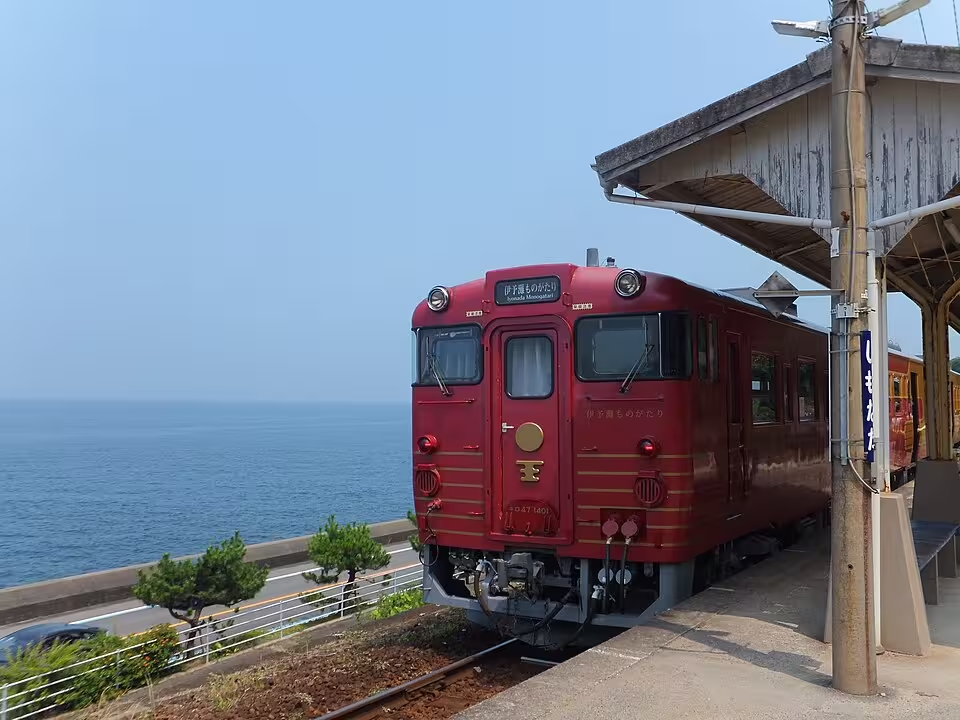
Sunport1216, CC BY-SA 4.0, via Wikimedia Commons
amaharashi
Where the Alps Come Down to the Water
Five minutes. That is the distance on foot from the platform at Amaharashi to the coast. Walk directly toward the water, and Toyama Bay opens in front of you. Look left along the shore. Then look up.
The Tateyama range rises directly from the water's edge — not in the background, not suggested by a distant outline, but present in a way that reorganises the proportions of everything else in the view. The highest peaks exceed three thousand metres. On a clear morning in winter or early spring, when snow still holds on the upper ridges, the weight of the mountains against the flat surface of the bay produces a stillness that is not quiet. It is the stillness of something very large, very close, doing nothing at all.
Amaharashi sits at the edge of a coastline that appears in the Man'yōshū, Japan's oldest anthology of poetry, compiled in the eighth century. Ōtomo no Yakamochi, who governed this province as a court official, wrote of the sea here and of the mountains behind it. What he described is what you see. The coastline has changed in the intervening thirteen hundred years in ways a geologist could map, but the relationship between the bay and the peaks — that particular compression of water and altitude — is structurally the same.
Amaharashi Station itself is a small unmanned stop on the JR Himi Line, a single-track coastal route that has been the subject of ongoing discussions between JR West, local governments, and Toyama Prefecture about its long-term future. BRT conversion — replacing the rail with buses on a dedicated lane — has been proposed. The outcome is not yet settled. The trains still run. The walk to the coast still takes five minutes.
20250215-IMG_2861.jpg "JR Stations Worth Stepping Off For")
くろふね, CC BY 4.0, via Wikimedia Commons
Mojiko
The Port That Time Renovated Instead of Replacing
The station at Mojiko was completed in 1914. It stands today as it did then: a wooden Renaissance-style building with high ceilings, arched windows, and a quality of light inside that belongs to a different pace of life. Walk out of the ticket gates and through the main entrance, and the Kanmon Strait is directly in front of you — the narrow water passage between the islands of Honshū and Kyūshū, five hundred metres across at its narrowest point.
Mojiko Station is a designated Important Cultural Property of Japan. This means something specific: it is not a reconstruction, not a replica built to suggest the past, but the original structure, maintained and restored. When you step off the train here, you are standing inside a building that has been in continuous use for over a century.
The Mojiko Retro District — as the surrounding waterfront is now called — collects the evidence of that outward orientation within walking distance of the station. The former Moji Customs building, the former Osaka Shōsen shipping company office, the old Mitsui Club where Albert Einstein stayed during his 1922 visit to Japan: these buildings survive intact or in restored form along a stretch of waterfront that was, in the Meiji and Taishō eras, one of the most active trade ports in Asia. Cotton, coal, and goods from the continent passed through here. The architecture that remains is the physical record of a moment when Japan was deciding, deliberately and with some urgency, what kind of country it intended to become.
The word "retro" does not quite fit. Retro implies nostalgia, a softening of the past into something palatable for a Sunday afternoon. What Mojiko holds is more specific than that: it is a particular decade in a particular port city, preserved not because it was charming but because the buildings were solid and the decision to keep them was made before anyone had considered demolishing them. The result is a place where the Meiji era is not curated. It is simply there.
From the waterfront, you can see across the strait to Shimonoseki, the city on the opposite shore. The ferry crossing takes minutes. But the view from Mojiko is enough on its own: the water, the bridge, the container ships moving through the gap, and behind you, a station that has been opening its doors since 1914.

Higashi-Hagi
The Town That Made Modern Japan
Getting Off a Train Called "The Story"
There is a tourist train on the JR San'in Main Line, running between Shin-Shimonoseki and Higashi-Hagi, called Marumaru no Hanashi— written in Japanese with two empty circles as placeholders: ○○のはなし.
The second part of the name is not arbitrary. Hagi, Nagato, Shimonoseki: the opening syllables of these three places —hanashi— combine to form the word hanashi, meaning story, conversation, the thing said.
The empty circles are where the content goes. They stand for everything this coastline holds and has not yet told you: the history of the men who walked these streets before Japan opened to the world, the culture they carried, the seafood landed that morning at the harbour, the sake that has been brewed the same way for generations. The circles also stand for the stories of the people who live here now — each life a hanashi of its own, most of them never written down.
The train does not deliver these stories to you. It moves you through the landscape that contains them. What you find along the way — what you stop for, what catches you off guard, what you carry home — becomes, in the end, your own hanashi of the journey.
What the Meiji Streets Still Hold
Higashi-Hagi is the easternmost of the two stations serving Hagi, the former castle town of the Chōshū domain — which is another way of saying: this is where modern Japan came from.
Yoshida Shōin was born here. Itō Hirobumi, Japan's first Prime Minister, grew up in a village a short distance from the old castle walls. Kidō Takayoshi — one of the three great figures of the Meiji Restoration — is buried nearby. The men who dismantled the feudal order and constructed the institutions of the modern Japanese state were disproportionately from this domain, on this stretch of coast, in this town that still looks, in its older districts, much as it did when they left it.
The bukeyashiki — samurai residential quarter — survives within walking distance of the station. White plaster walls, narrow lanes, the occasional gate still standing at the entrance to a property. These are not restored facades. They are the original structures, maintained by families who have been here for generations. The town is a UNESCO World Heritage component site as part of the Sites of Japan's Meiji Industrial Revolution, but the streets predate that designation by centuries.
Hagi is best visited with a night. The town changes after the day visitors have gone: the lanes empty, the light shifts, and the white walls take on a different quality in the evening. A ryokan here is not supplementary to the visit. It is part of what the place reveals.
.avif "JR Stations Worth Stepping Off For")
JR Sanyo Sanin Area Pass — via Japan Experience
If your journey follows the arc described in this guide — moving between Hiroshima, Miyajima, the San'in coast, and onward toward Kyoto or Fukuoka — the JR Sanyo Sanin Area Pass may serve you more precisely than the national JR Pass. Valid for seven consecutive days on JR West lines across the Chugoku and Kansai regions, it covers the Sanyo Shinkansen, the San'in Main Line, limited express services, and the JR West Miyajima Ferry. Higashi-Hagi, Amenohare, and Miyajima-guchi all fall within its scope. Unlike the national pass, this one also includes the Nozomi and Mizuho shinkansen on the Sanyo line — the fastest services between Hiroshima and Fukuoka — without a separate ticket.
View the Sanyo Sanin Area Pass → Covers Kyoto, Osaka, Himeji, Hiroshima, Miyajima, Tottori, Matsue, and Hakata (Fukuoka) — seven days, unlimited rides on JR West lines.Miyajima-guchi
The Ferry the JR Pass Also Covers
Why the Island Begins Before You Arrive
Most travellers know about the torii. The orange gate rising from the water at Miyajima — Itsukushima Shrine — appears in more photographs of Japan than almost anything else. What fewer travellers know is that the JR Pass, the same pass that carries them on the bullet train from Tokyo to Hiroshima, also covers the ferry crossing from the mainland to the island.
Take the JR San'yō Main Line to Miyajima-guchi Station. Walk to the pier — five minutes, directly from the platform. Board the JR West Miyajima Ferry. The crossing takes ten minutes. A separate Miyajima Visitor Tax of one hundred yen is payable on arrival; this is the only additional cost. The island, the shrine, the torii, and the deer that move between the two without any sense of boundary: all of this opens from a single pass.
The Torii at the Water's Edge
The torii at Itsukushima is often described as standing in the sea. This is not quite accurate — and the inaccuracy is worth knowing. The gate stands on the tidal flats at the edge of the island. At high tide, the water surrounds it completely, and the gate appears to float. At low tide, you can walk out to it across the exposed sand and place your hand on the lacquered wood.
These are two different experiences, and they belong to two different hours of the same day. The ferry schedule and the tide tables are worth consulting together before you arrive.
Itsukushima Shrine has stood on this site since the sixth century in some form, though the current structure dates largely to the twelfth century, when the Taira clan rebuilt it under the patronage of Taira no Kiyomori. The decision to build the shrine over the water — rather than on the higher ground of the island — was deliberate: the entire island was considered sacred, and human construction was not to disturb the ground. The tidal architecture is the consequence of a theological position.
The deer on the island are not tame, despite appearances. They have been here for as long as the records go, and they move through the shrine precinct with the confidence of animals that arrived before the buildings did.

For those travelling the Hiroshima corridor, Miyajima-guchi to Miyajima connects naturally with a broader journey that includes the Peace Memorial Museum in central Hiroshima — a twenty-minute train ride along the same JR San'yō Line. The two sites ask to be visited on the same day, in either order, with enough time between them to hold what each contains.
For a deeper reading of the Kansai and San'in regions connected by JR West lines, see our Kyoto cultural guide.
Before These Lines Close
In 2022, JR West published a list of lines and sections it described as operationally difficult to maintain at current service levels. JR Shikoku has made similar statements about portions of its network. These are not announcements of closures. They are the beginning of a public conversation about what happens to a rail network when the population it was built to serve has been declining for two decades.
Two of the stations in this guide sit on lines named in those conversations: Shimonada, on the JR Yosan Line coastal section in Shikoku; Amaharashi, on the JR Himi Line in Toyama. The trains still run on both. The schedules are thinner than they were twenty years ago. The gap between services — the two-hour wait that is either a penalty or an afternoon, depending on how you hold it — has in some cases grown.
A traveller who visited these stations ten years from now may find them unchanged. Or may find a bus stop where the platform was. There is no way to know. What is certain is that the platform exists now, and the train passes through now, and the sea at Shimonada and the mountains at Amaharashi are not going anywhere.
The Japanese writer and rail traveller quoted earlier in this piece — the one who began riding local lines after learning that certain routes had been flagged as at risk — described his motivation simply: he wanted to go while going was still possible. This is not grief. It is attention. Paying attention to something while it exists is not the same as mourning what it might become.
These are lines worth travelling. The time to travel them is now.
Staying Connected Between Stations
The Conversation You Didn't Plan For
The most useful thing a phone can do on a rural Japanese rail journey has nothing to do with maps or translation apps in the abstract. It has to do with this: an older woman in the waiting room at Amaharashi points at the mountains and says something. A fisherman on the Mojiko waterfront gestures toward the strait and begins to explain something about the current. The woman behind the counter at the small restaurant near Higashi-Hagi station notices you have been sitting there for forty-five minutes and asks — not in a way that suggests you should leave, but in a way that suggests she is curious — where you have come from.
In each of these moments, the language gap is real. It does not need to be absolute. Hold out the screen. Point at the text. The conversation begins from there, not perfectly, but genuinely — which is the only way any conversation worth having begins.
The rural sections of lines like the Yosan, Himi, and San'in can have weak or intermittent signal, particularly in mountain tunnels and remote coastal stretches. An eSIM from a local Japanese carrier tends to perform better than a pocket WiFi device in these conditions, drawing directly from tower networks rather than routing through a rental device. For a journey that moves through cities and countryside in alternation — which is precisely what a JR Pass trip tends to be — the eSIM is the more reliable companion.
eSIM & SIM Cards for Japan — via Japan Experience
Japan Experience offers both eSIM and physical SIM options for the duration of your trip. The eSIM activates before departure and connects directly to Japanese carrier networks on arrival — useful for rural lines where signal conditions vary by section.
View eSIM & SIM Options → Pocket WiFi rental is also available for travellers sharing connectivity across multiple devices.Frequently Asked Questions
Does the JR Pass cover all the lines and the ferry mentioned in this guide?
Yes — the JR Yosan Line (Shimonada), JR Himi Line (Amaharashi), JR Kagoshima Main Line (Mojiko), JR San'in Main Line (Higashi-Hagi), and JR San'yō Main Line (Miyajima-guchi) are all covered by the standard national JR Pass. The JR West Miyajima Ferry between Miyajima-guchi and Miyajima Island is also covered; only a separate Miyajima Visitor Tax of 100 yen is payable on arrival at the island. For the ○○のはなし tourist train to Higashi-Hagi, the JR Pass covers the base fare, but a reserved seat ticket may be required — check availability when booking, as seats on tourist trains can fill early.
Can I use an IC card like Suica on these rural lines?
Not reliably. Suica and other IC cards function well in urban rail networks and at major stations, but many of the stations featured here — Shimonada, Amaharashi, and smaller stops along the San'in coast — are unmanned or minimally staffed, with no IC card readers. Entry and exit with a JR Pass requires showing the pass at staffed gates, or in some cases simply boarding — local procedures vary. Carry cash for purchases in the towns themselves; rural areas frequently operate on a cash-first basis.
How long should I plan for each station?
Shimonada and Miyajima-guchi each warrant between one and three hours depending on tides and your pace — check the train schedule before stepping off so you know exactly when the next service departs. Amaharashi is worth a half day: the walk to the coast and time on the beach with the Tateyama backdrop does not feel rushed under two hours. Mojiko can absorb a full afternoon; the waterfront district is compact but dense. Higashi-Hagi is best with an overnight stay — the old districts change character entirely after the day visitors leave.
Are any of these lines at risk of closing?
Honestly, yes — for two of them. JR West has publicly identified the Himi Line (Amaharashi) as a line for which maintaining current rail service is financially difficult, and conversion to BRT has been discussed. JR Shikoku has similarly flagged portions of the Yosan Line coastal section (Shimonada) as operating below sustainable ridership. No closures have been announced, and both lines are running as of the date of this article. The most straightforward response to this information is to travel these lines now, while the option exists.
What is the best way to stay connected on rural JR lines?
An eSIM from a Japanese carrier is generally the most reliable option for travel that alternates between urban and rural areas. Pocket WiFi devices introduce an additional layer of hardware and can lose signal in tunnels or remote coastal sections. Physical SIM cards work well but require a compatible unlocked device. Japan Experience offers eSIM, SIM, and Pocket WiFi options bookable alongside the JR Pass — activating the eSIM before departure means you arrive with connectivity already in place.
The pass is a pass. What it opens is something else — the right to stop anywhere, at any moment, for any reason that presents itself through a window. The platform at Shimonada will still be there when the train leaves. The mountains behind Amaharashi will still be there when the last service of the day pulls away. The station at Mojiko was standing before anyone thought to photograph it.
Fewer stations. Truer ones.
Affiliate disclosure: Some links in this article are affiliate links. If you purchase a JR Pass, eSIM, SIM card, or tour package through Japan Experience via links on this page, Untranslated Japan may receive a commission at no additional cost to you. We only link to products and services we believe serve the kind of travel this site is about.