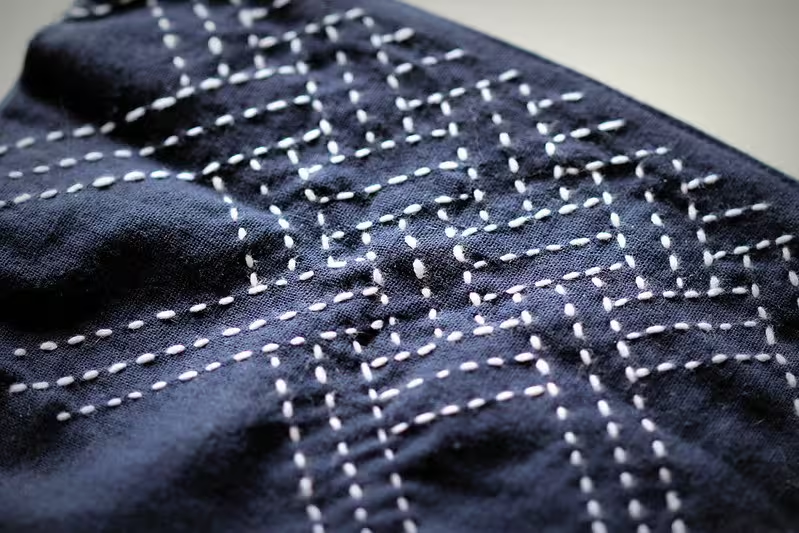
The needle enters the cloth and moves on. No pause. No announcement. Again, and again, across every surface — not because it is beautiful, but because the cold is coming and the cloth is thin. This is where sashiko begins. Not in beauty. In need.
The Stitch That Was Never Meant to Be Beautiful
In the northern provinces of Japan — in the deep winters of Aomori, Iwate, and Yamagata — cotton was something most families could not afford. The cloth they had was hemp: rough to the touch, loosely woven, cold air finding every gap. The winters in Tohoku are long and serious. The cloth was not enough.
So women stitched. They pushed thread through the gaps in the weave, layer by layer, until the fabric became dense enough to hold warmth. There was no name for what they were doing that needed to sound important. It was needle work. It was January.
The word itself asks for nothing: sashi, to pierce. Ko, small. Little stabs.
And yet. Look at a piece of old sashiko from Tohoku and something stops you. The white thread does not rise above the cloth. It does not sink into it. It simply rests there, even and steady, as if it could not imagine being anywhere else. The care put into each stitch — hundreds of them, across every surface — left a mark that cold weather never could.
The Logic of Reinforcement
Before the damage came, the needle was already there
There is an idea at the heart of sashiko that the West has not fully taken in. Every piece of cloth will wear out eventually. So it makes more sense to reinforce it before it weakens than to patch it after it tears.
Sashiko, in its original form, was not a response to damage. It was a preparation for damage. The cloth was stitched before it showed any weakness — a sleeve edge, a cuff, a knee, a shoulder — everywhere, not just at the places most likely to give way. When wear came, it came slowly and evenly. The garment stayed whole.
The stitching covers the whole surface not because it looks good, but because that is what holds the cloth together. The pattern you see is the result of one rule, followed without exception: stitch everywhere, leave no gap. The geometry took care of itself. The success of the stitch was measured by whether the cloth survived another winter.
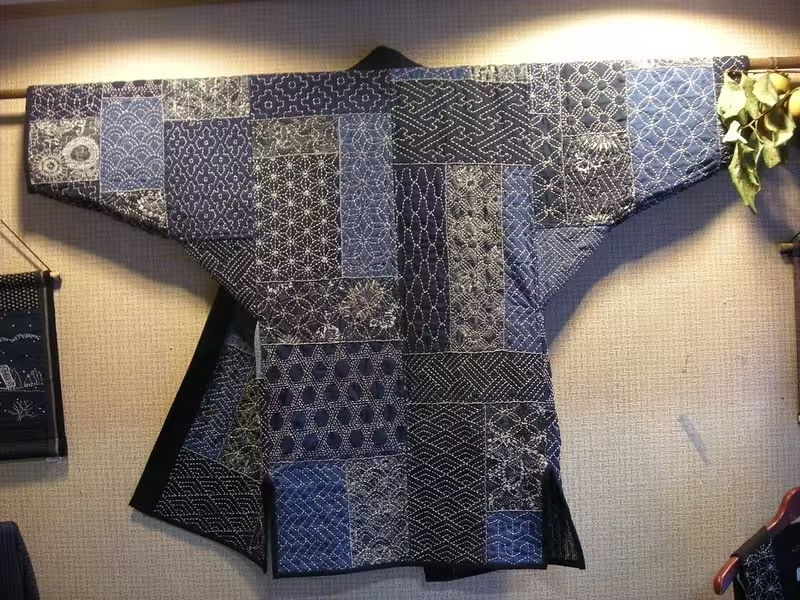
Sashiko shop - gorgeous jacket by jam_232, CC BY 2.0
From Survival to Ceremony
How function became form, and form became meaning
As sashiko moved from the farmhouse into town life, the logic behind it grew. The Edo-period firefighter's coat — the hikeshi hanten, a thick, heavily stitched jacket worn into burning buildings — is the most dramatic example. Before entering a fire, the coat was soaked in water. It was worn double-sided: the outer face plain, marked with the unit's crest; the inner face covered in bold pictorial designs. When the fire was out, the coat was turned inside out. The firefighters walked back through the crowd showing everything that had been hidden.
This is sashiko at its most complex: protective clothing and public statement in the same garment. The dense stitching held water in the cloth. The water held against the heat. And the design — only visible after the danger had passed — was the firefighter's way of saying: I went in. I came back. This is what I wore.
The geometric patterns of sashiko also carried meaning built up over centuries. The asanoha — a six-pointed shape based on the hemp leaf — was stitched into children's clothes as a wish for strong, straight growth, the way hemp grows fast and tall. The seigaiha — overlapping arcs that form a wave pattern — carried the sense of water's persistence, the way each wave follows the last without stopping. The shippō — interlocking circles named after the seven Buddhist treasures — expressed the way lives connect and hold each other. These meanings were not added to the patterns later. They were the reason the patterns were chosen in the first place.
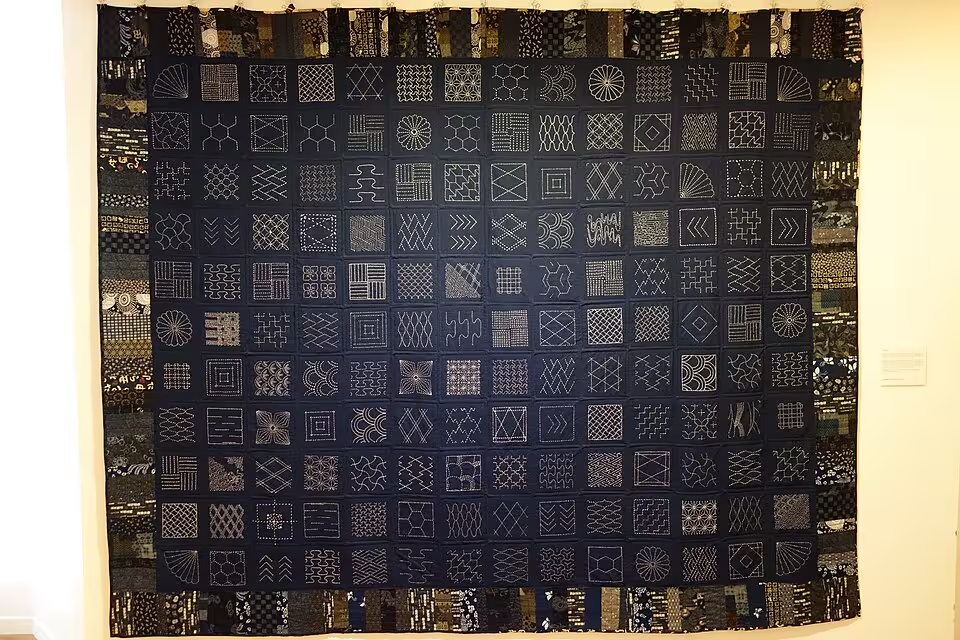
Daderot, CC0, via Wikimedia Commons
The Grammar of the Pattern
Look at a piece of sashiko long enough and you notice something about the geometry. It does not stop anywhere. There is no centre, no point where the eye is meant to rest. The pattern runs to every edge at the same density, as if the cloth is showing you a small section of something much larger continuing beyond it.
This is not an accident. When you stitch everywhere and leave no gap, the result is a surface with no beginning and no end. Your eye moves through it without finding a place to land — and this, strangely, is restful. The pattern does not ask anything of you. It simply continues.
Reading the Pattern
What the geometry carries that the eye alone cannot retrieve
The three major sashiko traditions of Tohoku each arrived at their own distinct look through different practical limits. In Aomori, farmers were banned from wearing cotton during the Edo period — only hemp was permitted. This produced kogin-zashi: white cotton thread pulled through open-weave hemp in carefully counted intervals, filling each gap in the cloth. The structure of the fabric determined the structure of the stitch. The pattern came from the material itself.
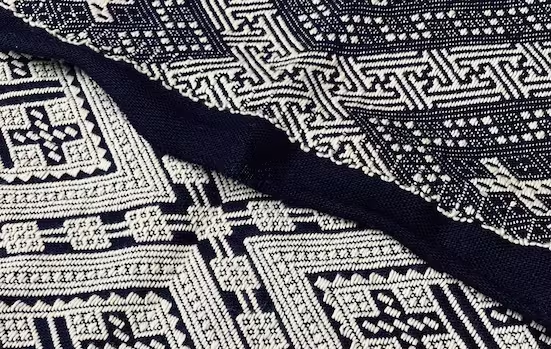
In Iwate, nanbu hishizashi — named after the Nanbu domain — grew along diagonal lines, using the diamond shape as its basic unit. Sharper, more angular than kogin, with a sense of forward movement. In Yamagata's Shōnai region, the same basic need — reinforce the cloth, cover the surface, keep the cold out — produced yet another visual language: quieter in colour, more measured in its repetition.
These are not decorative variations of one style. They are three separate answers to the same question, shaped by different weather, different materials, different rules. The patterns look different because the conditions were different. Not one national style spread across provinces — the same problem solved independently, in different places, by people who needed cloth to hold.
There is also a meaningful difference between moyōzashi — tracing a pre-drawn pattern in one continuous line — and hitomezashi — placing one stitch at a time across an open grid, building the pattern row by row. The first asks you to see the finished image before it exists and follow it. The second asks for something closer to patience: one row, then the next, each stitch the same distance from the last, the pattern arriving through repetition rather than planning. Both are sashiko. The needle is the same. The cloth is the same. What differs is the kind of attention each one requires.
Nihon Vogue Kogin Book — Japan, 1981
A Japanese-language reference book on kogin-zashi, published by Nihon Vogue in 1981. Pattern diagrams, stitch counts, and construction details — the kind of documentation that does not require fluent Japanese to follow. A smartphone camera held over the page will handle the rest. The untranslated original always holds more than the translation.
View on eBay → A vintage copy — stock is limited to what is available from the seller at the time of viewing.What the West Calls Visible Mending
Sometime in the last decade, sashiko arrived in the West as an answer to a problem that had just been given a name. Visible mending — the practice of repairing clothes not to hide the damage but to show it, to make the repair the most interesting thing about the garment — needed a technique, a vocabulary, an aesthetic. Sashiko offered all three.
The hashtag gathered millions of posts. Workshops opened. Kits appeared in craft shops. A practice that had been fading in Japan for most of the twentieth century — pushed aside by factory production, cheap imports, and the simple fact that new cloth was easier to buy than old cloth was to repair — was being learned by people who had never needed to stitch hemp against the cold. They came to it as a form of refusal: of waste, of speed, of the idea that it is easier to throw something away than to fix it.
There is a tension here worth looking at directly. The original sashiko was not trying to display a repair. The stitching went in before the damage arrived, and when damage did come, the garment was stitched again, and again. The boro textiles of the very poor — layers of worn cloth stitched together across generations, each layer added because the one before it had worn through — were not celebrated objects in Japan. They were evidence of poverty. The families who had used them were glad to put them away when they could.
Denim as the New Boro
Why the logic translates, even when the history does not
And yet something genuine is happening in the visible mending movement. The decision to keep a garment rather than discard it — to mark the damage honestly, to say this cloth has a history worth continuing — is not so far from what the women of Aomori were doing. The conditions are different. The abundance is different. But needle through cloth, again and again, with care: that part is the same.
Denim and sashiko are well suited to each other. Both were made to take hard use and show it. A worn seam, a blown knee, a fraying cuff — the same problem, new cloth. What sashiko brings is precision and patience. Pick up a jacket with fifty hours of stitching in it and you feel the difference — denser, stiffer, more solid than it was.
Within the sashiko community, there is a growing insistence that the cultural context matters — that unshin is worth understanding before you focus on the pattern. It is the difference between borrowing a form and entering a practice. Sashiko practitioners themselves are increasingly drawing that line.
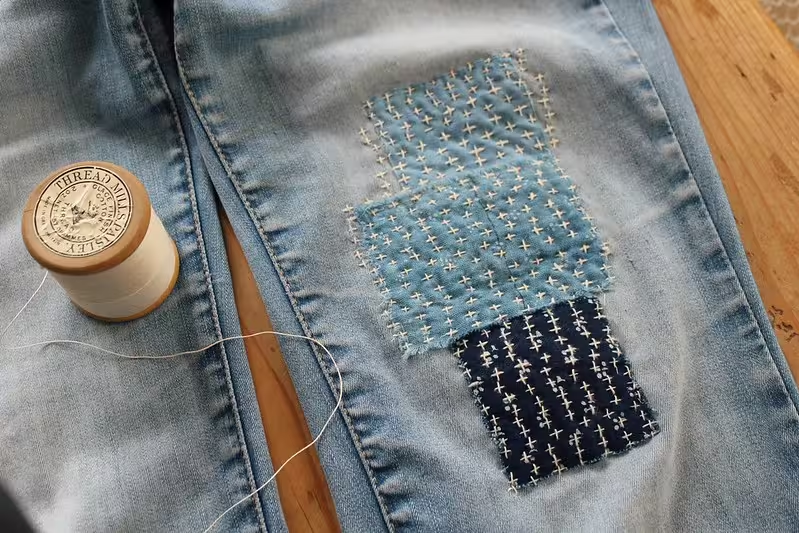
"sashiko stitch and patch" by Heather, CC BY 2.0
The Tools That Shape the Practice
The sashiko needle is longer than a standard sewing needle — roughly twice the length. This is not a small detail. The length is what makes unshin possible. Unshin is the rocking motion at the centre of sashiko technique: you rock the needle forward through the cloth in a gentle wave, gathering several stitches onto it before pulling the thread through. A short needle can only take one stitch at a time. A long needle can take four or five, in one fluid movement. The length determines the rhythm, and the rhythm is the practice.
Sashiko thread is also different from standard embroidery thread. It is spun more loosely, which means it does not compress when pulled through cloth — it stays on top of the surface, slightly raised, catching light at an angle the dyed cloth beneath it does not. This is why finished sashiko has that particular quality: the white thread sits above the indigo ground, visible and slightly three-dimensional. Use standard embroidery floss and the thread sinks into the weave and disappears. The thread is not interchangeable.
Where to Begin
A considered selection for those starting with intention
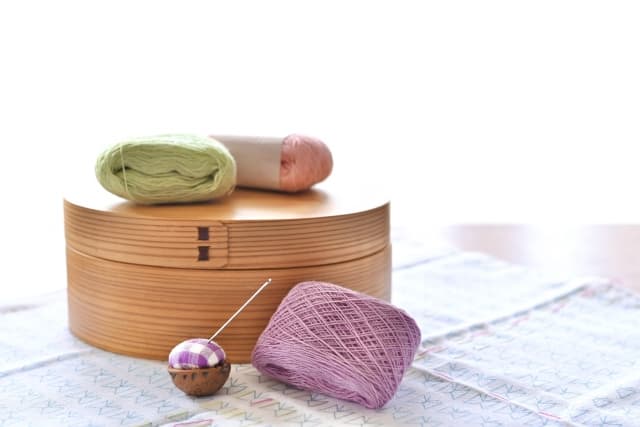
The yubinuki thimble — a small ring of coiled thread or metal worn around the middle finger at the base, not at the tip — is the third piece of the traditional toolkit. It sits where it does because the force of unshin comes from the side of the finger, not the tip. The thimble is placed where the needle actually makes contact.
Two Japanese thread producers have defined the market outside Japan: Yokota, whose Daruma thread is the most recognised internationally, and Olympus. Both produce thread in the traditional loose-spun weight, in a wide range of solid colours and, increasingly, in gradated colourways that shift tone slowly across a stitched surface. Either is a serious choice. The difference between them is one of colour preference, not quality.
For those beginning, a kit that includes pre-printed cloth — patterns already marked in water-soluble ink, ready to follow — removes the most technically demanding step and lets the needle work be the focus. This is not taking a shortcut. It is the right place to start.
STARTER SET Naska SASHIKO Kit
A complete Japanese kit dispatched from Japan, containing everything required to begin correctly: three pre-printed navy cotton hana fukin cloths (35 × 38 cm each) with water-soluble geometric patterns, four long sashiko needles (Daruma, Olympus, or Naska), 80m of 100% cotton sashiko thread, three palm thimbles, and an English-language instruction guide. The pre-printed pattern disappears on washing — no tracing required. Made in Japan.
View on eBay → Also available: Daruma thread sets for those building a colour collection.Sashiko in the Hand — Finished Works Worth Owning
A sashiko garment or bag carries something that a photograph cannot show you. Pick one up and you feel it: the slight resistance of cloth that has been stitched through and through, densely enough that the thread has become part of its structure.
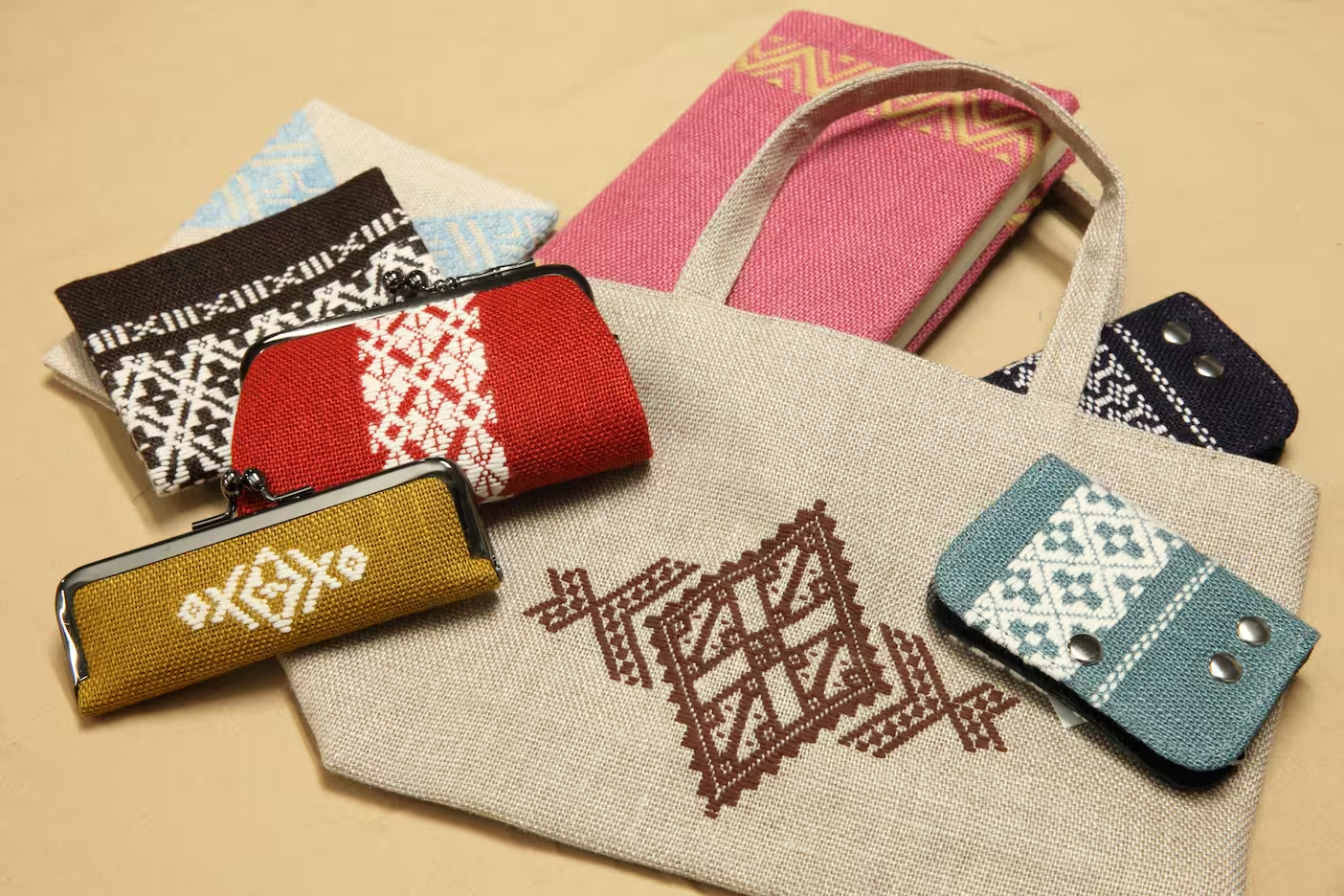
The signs of quality in a finished piece are readable once you know what to look for. The stitches should be consistent in length — not perfectly identical, because the hand is not a machine, but close enough that the surface looks deliberate rather than casual. The thread should sit on top of the cloth, not pulled tight into the weave. The pattern should reach every edge cleanly, without crowding or distortion at the corners. These details tell you whether the person who made it had fully learned the technique, or was still working it out.
How to Read a Piece
What to notice before you decide
The white thread on an indigo ground is the traditional combination, and it remains the most visually direct. But it is worth knowing that within Japan, this combination is sometimes seen as slightly old-fashioned — contemporary Japanese sashiko makers often work on grey, natural undyed, or coloured grounds. What looks like the authentic, original version to a Western buyer is, inside Japan, a marker of one particular historical moment. Neither is more correct than the other. They are different expressions of the same practice, separated by time.
For bags and accessories, the structural questions matter most: is the cloth stitched through two layers, or one? Has the lining been stitched through along with the outer fabric, or added separately after? A bag where the sashiko stitching passes through multiple layers will hold its shape more firmly — stiffer, more solid — than one where the stitching sits only on the outer surface. Both exist. One is a textile object built to last. The other is a fashion object that references textile tradition.
For garments — jackets, noragi field coats, vests — the key factor is the relationship between how densely the cloth is stitched and how heavy the cloth itself is. Very dense stitching on a thin cloth makes it stiff. Moderate stitching on heavier cloth lets it drape. There is no correct answer here, only what you prefer; but knowing what you are looking at means you can choose based on what the object actually is, not just how it appears in a photograph.
Handmade Sashiko Shoulder Pouch — Indigo Kasuri, Japan
A small crossbody pouch made in Japan from indigo kasuri cotton — a fabric woven with threads dyed before weaving, so the colour sits unevenly in the weave and gives the cloth its characteristic soft, blurred quality. The sashiko stitching passes through the patchworked outer surface, holding the layers together as it was always meant to. Adjustable strap, magnetic snap closure. 19 × 11 × 2 cm — the size of a phone and a few essentials. A daily-use object made with the full weight of the practice behind it.
View on eBay → Handmade and sold by an individual seller — one item available at the time of writing.Beginning Your Own Practice
There is a quality of light that works for sashiko, and it is not the bright overhead light of maximum efficiency. It is light coming from one side — morning or afternoon, not midday — the kind that throws small shadows across the cloth and makes the surface readable. You need to see the weave. You need to see where the needle has been and where it needs to go next.
Posture matters too, though no one tells you this until you have already settled into the wrong one. Sashiko is not embroidery held up in the air. The cloth rests on a firm surface, or on your thighs. The needle moves through from below as much as from above. Unshin only works when the cloth has something solid beneath it. Without resistance, each stitch becomes a separate act of pushing rather than part of a continuous rhythm.
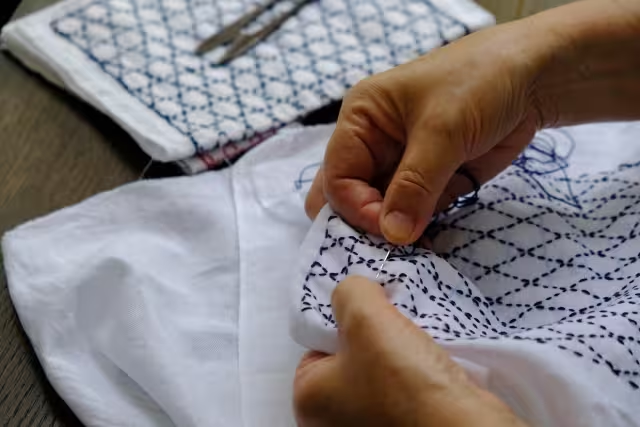
The first pattern most beginners attempt is moyōzashi — stitching continuously along a pre-drawn line, usually a wave or simple grid. This is the right place to start. A line pattern teaches you the rhythm before it asks you to think about geometry. You learn to keep the stitch length even, to rock rather than push, to let the needle find its angle through the weave. Everything you learn here carries into every other pattern you will ever try.
Two hours with a single pattern changes how you see cloth. Not as a surface, but as a structure — warp and weft and the spaces between them. The weave of the shirt you are wearing. The stitching on a bag you have carried for years without looking at. The way repair shows in any object that has lasted. Sashiko does not teach you to see this. It simply puts you in the conditions where seeing it becomes unavoidable.
Frequently Asked
What is the difference between sashiko and regular embroidery?
Embroidery is primarily decorative — it adds images or texture to a cloth that is already structurally complete without it. Sashiko began as structural work: the stitching reinforced the cloth, filled gaps in the loose weave, and extended the life of a garment. The patterns you see are a result of that structural logic — stitch evenly across the whole surface, leave no gap — not a decorative intention in themselves. The materials are also different: sashiko uses a loosely spun thread that rests on top of the cloth rather than sinking into it the way embroidery floss does. This is why finished sashiko has that slightly raised, textured quality — the white thread sits above the surface and catches light.
Do I need special thread to start sashiko, or can I use embroidery floss?
Sashiko thread is worth using from the beginning, and not just for reasons of tradition. Standard embroidery floss — six strands twisted tightly together — pulls tight when drawn through cloth, pressing flat into the weave and producing a sunken stitch rather than a raised one. Sashiko thread is spun more loosely, which means it stays on top of the cloth when you pull it through. This is both how the technique is meant to look and how it works structurally: the thread builds a second surface above the ground cloth, adding density and body. The two Japanese brands most widely available outside Japan are Daruma (made by Yokota) and Olympus. Both produce thread in the correct weight and twist.
What is the easiest sashiko pattern for a complete beginner?
A continuous line pattern — a wave, a simple diagonal, or a straight horizontal grid — is the right starting point, not because it looks impressive, but because it teaches the most important skill first: keeping the stitch length consistent while using the rocking needle motion known as unshin. Unshin is a gentle forward-and-back rock of the needle that lets you load several stitches onto it before pulling the thread through. Once this rhythm becomes natural, geometric patterns that require changes in direction become much easier to manage. Pre-printed cloth — available in starter kits from Olympus and other makers, with the pattern already marked in water-soluble ink — removes the marking step entirely, so you can focus on the needle work itself during your first few projects.
Is it culturally respectful for non-Japanese people to practise sashiko?
Jun Nitaya, one of the most prominent practitioners currently teaching sashiko internationally, takes a considered position on this: sashiko does not benefit from being defined narrowly by nationality. The practice began as a response to a basic human need — not enough cloth, too much cold — shared by people in many parts of the world. What matters, in his view, is the quality of attention you bring to it: learning what the patterns mean, understanding why the thread and needle are made the way they are, stitching with care rather than speed. These things are what respectful engagement looks like. The sashiko community itself is increasingly drawing this distinction — between taking only the visual surface of a practice and entering it fully.
How long does it take to complete a sashiko project?
A small hana fukin — a practice cloth roughly 35 by 38 centimetres, traditionally used as a dish cloth or hand towel and the most common first project — takes most beginners between four and eight hours across several sessions. A tote bag panel of similar size takes a little longer because the cloth is thicker. A full garment — a jacket or noragi field coat — is a project of several months for an experienced practitioner. The time is not separate from the practice. It is part of what the finished object carries. Sashiko does not reward speed, and the piece you complete holds the record of the hours you spent on it in a way that is physical, not just symbolic.
The needle enters the cloth, draws the thread through, and moves on. Again and again, across every surface. Nobody planned for it to look this way. But care, applied without exception, leaves a mark. Fewer things. Truer things.
Affiliate disclosure: This article contains links to eBay through the eBay Partner Network. If you make a purchase through these links, Untranslated Japan may earn a small commission at no additional cost to you. All product recommendations reflect genuine editorial judgment.