

Somewhere in Japan right now, someone is pressing an ink stamp onto a piece of paper. Not because the software failed. Not because there was no other option. Because that is how it is done — and because somewhere in the doing, something is confirmed that a click cannot confirm.
The World Sped Up.
Something Got Lost.
You wake up. Before your eyes fully adjust, your phone has already summarised your emails, scheduled your week, and generated a draft reply to a message you haven't read yet.
By the time you sit down to work, an AI has already done half of it.
This is not a complaint. The tools are extraordinary. But somewhere between the first notification and the third automated response, a small feeling arrives — quiet, easy to dismiss — that something has been subtracted.
Not time. Not efficiency. Something harder to name.
The promise of digital technology was always the same word: frictionless. Remove the steps. Reduce the effort. Eliminate the wait. In the logic of Silicon Valley, friction is a problem to be solved. The fewer clicks between you and the outcome, the better the product.
For decades, this felt like progress. It still is progress — in many real, measurable ways.
But there is a question that the frictionless world has not fully answered.
What happens to the person who never has to stop?
Japan noticed something that much of the modern world has only recently begun to feel. Not because Japan resisted technology — it did not — but because Japan held onto a different idea about what technology is for.
And that idea left a trail of paper.
Japan Kept the Friction
The Country That Built Robots and Kept the Paper Forms
Japan runs the railway that changed what a train could be. Its factories run with a precision that engineers from other countries still travel to study. Its semiconductor industry supplies components to machines that power the global internet. Its robots perform surgery, assemble cars, and sort parcels at speeds a human hand cannot match.
Japan also asks you to fill in a form. By hand. In triplicate.
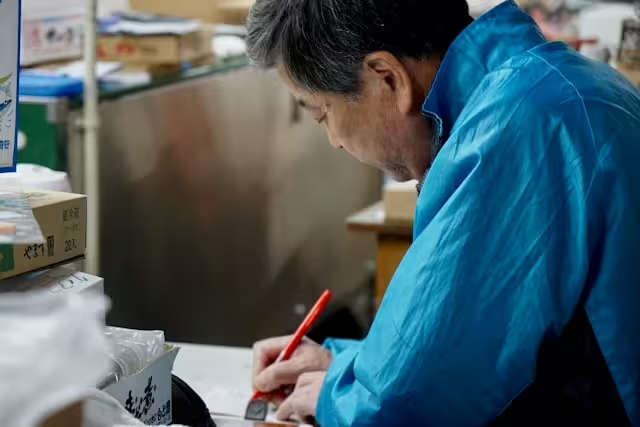
Administrative procedures that could run entirely online still require physical documents in many Japanese offices. Civic registration, business filings, school enrolments — these often involve paper, a counter, a person sitting across from you, and an ink stamp pressed slowly and deliberately into a small red pad. In residential neighbourhoods, the kairan-ban — a paper notice that moves from household to household down the street, each resident reading it and signing before passing it on — still carries local announcements that could travel just as easily by group chat.
From outside, this looks like contradiction. From inside, it is something more precise than that.
The Friction Is the Point
In English, the word friction is almost always negative. Friction slows you down. Friction creates resistance. Friction is what you design around.
Japanese culture holds a different relationship with resistance. Not always, and not in every context — but in the places where it matters most, the difficulty of a thing is understood to be part of its value.
Consider the preparation of dashi — the clear broth that sits beneath almost every great Japanese dish. You could open a packet. The packet is good. But the traditional method asks you to bring cold water slowly to temperature, lower the kombu by hand, watch the surface for the first trembling before the boil, then remove it at exactly the right moment before the bitterness comes. The whole process takes focus. It requires you to be present for each step.
Nothing about this is efficient. Everything about it is intentional.
The same logic runs through the tea ceremony, through the sharpening of a knife, through the seasonal re-papering of a shōji screen — the sliding door made of wooden lattice and translucent paper that diffuses light softly across a Japanese room. When the paper tears or yellows, it is removed and replaced — not the frame, just the paper. The screen continues. You could replace the whole thing. Nobody does.
Repetition, in this tradition, is not monotony. Repetition is how the hands learn to be steady. It is how attention becomes a habit.
A Society Where the Most Important Things Go Unsaid
A manager in a Japanese company wants to propose a new project. He does not send a company-wide email. He does not call a meeting. He visits each relevant person individually — one conversation at a time, over several days — listening, adjusting, reading how each person receives the idea. By the time the formal meeting happens, every person in the room already knows what is being proposed. The decision has already been shaped by the people who will carry it out. The meeting is not where the decision is made. It is where the decision is confirmed.
This process has a name: nemawashi — literally, the careful wrapping of roots before a tree is transplanted. You prepare the ground before you make the move.
Or consider a simpler moment. A junior employee stays late at the office. His manager notices, says nothing, but the next morning places a can of coffee on his desk without comment. Nothing is said. Nothing needs to be said. This is kuuki wo yomu — reading the air — the ability to sense what someone needs before they ask for it.
These are not customs layered on top of a system. They are how the system works.
A digital process cannot do either of these things. It can send a notification. It can log an approval. It cannot read a pause, or leave a coffee, or sense that a room has shifted before anyone has spoken. The moment you fully automate a Japanese institution, you remove the layer where most of the actual decisions are made.
The paper form, the stamped document, the in-person counter — these are not obstacles to a more efficient future. They are what keeps the human layer in place.
Paper as the Trace of Trust
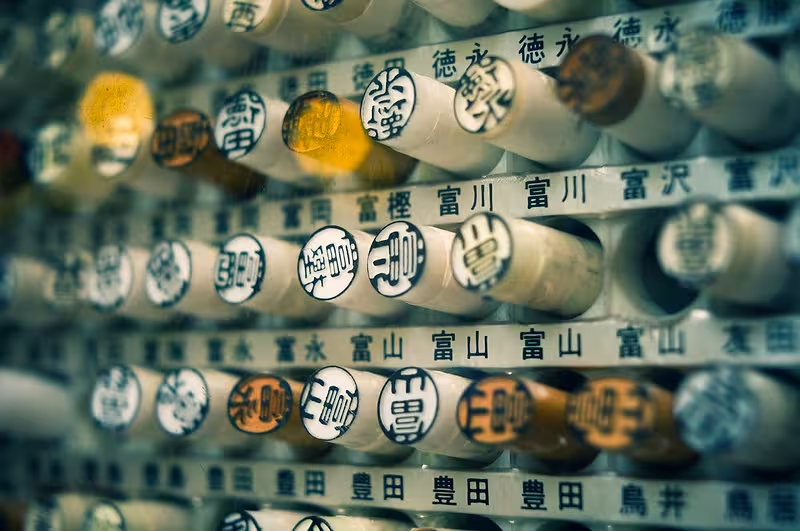
The hanko — known more formally as inkan, a small cylindrical seal typically carved from wood or stone, pressed into red ink and applied to a document — is one of the most misunderstood objects in Japanese culture. Western observers often read it as a quaint alternative to a signature. It is not quite that.
Imagine a single purchase order moving through a mid-sized Japanese company. It begins on someone's desk. That person reads it, presses their seal into the bottom corner, and passes it to their supervisor. The supervisor reads it, presses their seal beside the first, and passes it upward. By the time it reaches the department head, the paper carries four or five small red circles in a row — each one placed by a different hand, in a different office, on a different day. You can see, at a glance, who read this document, in what order, and whose authority stands behind it.
A digital approval chain records the same information. But it does not look like anything. The hanko makes the chain of human responsibility visible — physical, countable, impossible to alter after the fact.
How deeply this is embedded became clear during the pandemic. When offices closed and workers moved home, nearly sixty percent of remote workers in Japan had to return to the office at least once — not for a meeting, not for an emergency — but to press a seal onto a piece of paper. The hanko could not be done from home. The document was waiting.
The Japanese government has spent the last five years trying to phase it out. The private sector has largely continued anyway.
This same instinct runs through Japanese architecture. The Ise Grand Shrine has been rebuilt every twenty years for over thirteen centuries — dismantled and reconstructed using identical techniques, the same proportions, the same wood joints. The building is always new. The knowledge never breaks. What is being preserved is not the object. It is the understanding of how to make it.
Paper works the same way. The document is not the point. The act of passing it, reading it, pressing a mark into it — that is where the trust lives. Remove the paper and you keep the record. You lose the ritual that gave the record its weight.
Japan did not fail to modernise. Japan modernised in a way that kept the human layer intact. Not everywhere, not always successfully — but structurally, persistently, and with a logic that is only now becoming easier to see from the outside.
Now the Rest of the World Is Remembering
Meanwhile, on the other side of the world, something quietly reversed.
In New York, London, and Sydney, people who had grown up entirely digital began buying film cameras. Record stores reopened. Repair cafés — where you bring a broken toaster or a torn jacket rather than replacing it — filled up on weekends. Paper notebook sales climbed in markets that had declared paper finished. Not because the internet stopped working. Because something about the internet, at full speed, had started to feel like too much.
This feeling has a name: frictionless fatigue.
Then AI arrived, and the speed increased again. Suddenly the machine was not just fast — it was finishing your sentences, writing your emails, making your decisions. The feeling that something had been subtracted became harder to ignore.
When everything is instant, nothing requires your attention. When nothing requires your attention, you stop feeling the texture of your own time passing. Tasks complete themselves.
And yet the hand wants to touch something that resists it.
Japan never fully lost this. Paper was never simply administrative habit in Japan — it was material culture, craft tradition, and daily practice all at once. The physical page was something worthy of care. That instinct, it turns out, was worth keeping.
The irony is precise: the country that the rest of the world spent two decades gently pitying for its attachment to paper turns out to have been holding onto something that the rest of the world is now trying to find its way back to.
Not because analog is superior to digital. Not because efficiency is wrong. But because a life conducted entirely at the speed of a machine is a different kind of life — and many people, having lived it, have started to want something slower alongside it.
Japan kept the slower thing. It simply never called it a choice.
The Practice Needs an Object
An idea stays an idea until your hands get involved.
The analog turn — the desire to slow down, to write by hand, to own and use a physical thing — is not a feeling that resolves itself. It requires an object. Something with weight. Something that pushes back.
Japan has been making those objects for a long time.
The Notebook
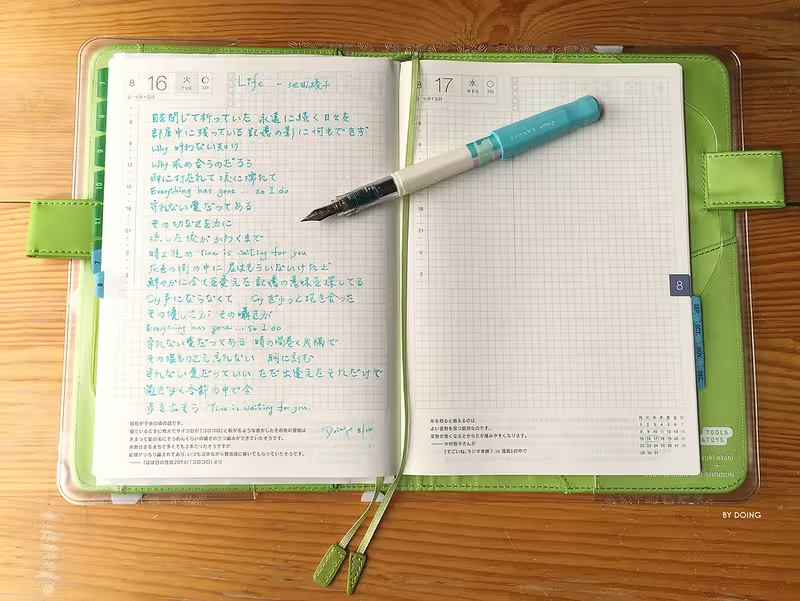
The Hobonichi Techo began as a single idea: one page per day, no more. Open it and you find a date at the top, a faint grid, and the rest of the page waiting. No categories. No prompts. No system telling you how to use it.
People who use it for years describe a feeling that is difficult to explain at first. The notebook does not organise your day. It does not ask anything of you. It simply holds whatever you bring to it — a schedule, a worry, a sketch, a sentence you heard and didn't want to lose. One long-time user put it this way: the Hobonichi feels less like a planner and more like a small letter you are writing to your future self. Open an old one, and the person you were on an ordinary Tuesday in March comes back to you in your own handwriting.
The paper is Tomoe River — a Japanese paper stock so thin it verges on translucent, yet it accepts fountain pen ink without bleed, without feather. Users describe the sensation as writing on the surface of still water: the pen moves, the ink settles, the resistance is just enough to feel like something. The notebook opens flat, 180 degrees, because the pages are sewn together with thread rather than glued — so nothing fights you when you write.
At the bottom of each page sits a short quotation — selected from the archives of Hobonichi's own publication, chosen carefully for the specific day it appears. On busy days you don't notice it. On slower days, you stop. Sometimes it says exactly what you needed to hear without knowing you needed it.
The lineup has grown well beyond one page per day. The Weeks offers a weekly spread for those who want overview rather than depth. The 5-Year Techo dedicates a page to each date of the year, divided into five horizontal sections — one per year. Open it on any day and you can see exactly what you were doing on the same date last year, and the year before that, going back five years. Some entries will make you smile. Some will surprise you. All of them are yours.
Hobonichi Techo — Original, Cousin, Weeks, or 5-Year
The A6 Original is the classic starting point — pocket-sized, one page per day. The A5 Cousin suits those who write at length. The Weeks offers a compact weekly format. The 5-Year Techo is for those who want to watch the same date accumulate across years. All use Tomoe River paper. Ships internationally from the Hobonichi online store; also available via Amazon Japan and select international stockists.
View at Hobonichi Store → New covers and collaborations are released each autumn for the following year. The selection process is part of the ritual for many users.The Fountain Pen
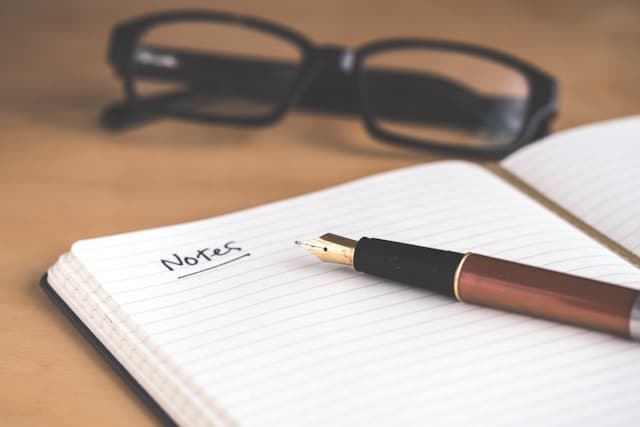
It is late. The house is quiet. You sit down with a fountain pen and a page, and something shifts — not immediately, but within the first few lines.
The nib moves across the paper and makes a sound. Faint, dry, a little like a whisper. You press slightly harder on a downstroke and the line thickens. You ease off and it narrows back to almost nothing. You are not thinking about this. Your hand is doing it on its own, adjusting without being told. The sound continues — steady, rhythmic — and somewhere in the rhythm, the noise of the day begins to recede.
This is what a fountain pen does that nothing else quite replicates. It slows the hand just enough to slow the mind. The slight resistance of the nib against the page — not too smooth, not laboured, but present — keeps you exactly where you are. You cannot rush it. The pen will not let you.
And because your hand is actually doing something, what you feel finds its way into the line. A tired evening looks different from a clear morning. The ink carries more than the words. You cannot write with a fountain pen and remain entirely elsewhere.
Japanese fountain pens — particularly those made by Sailor and Platinum — were refined for a specific reason. Written Japanese demands something that the Latin alphabet does not: the tome, the moment a stroke stops completely before changing direction, and the hane, the small upward flick at the end. These require a nib that holds just enough resistance to let the hand stop exactly where it intends, rather than sliding past. The result is a nib calibrated for precision at slow speed — finer, more responsive, built for the kind of writing where a single character can require a dozen directional changes within a square centimetre. When you use one to write in English, you are borrowing a tool made for a harder task. It shows.
Platinum Century 3776
One of Japan's most respected everyday fountain pens. Known for exceptional ink retention — it can sit unused for months and restart without hesitation. The nib is precise, responsive, and calibrated for the kind of control this article has been describing.
View on Amazon → Entry point: the Pilot Kakuno is a fraction of the price and a genuine introduction to Japanese nib quality.The Letter
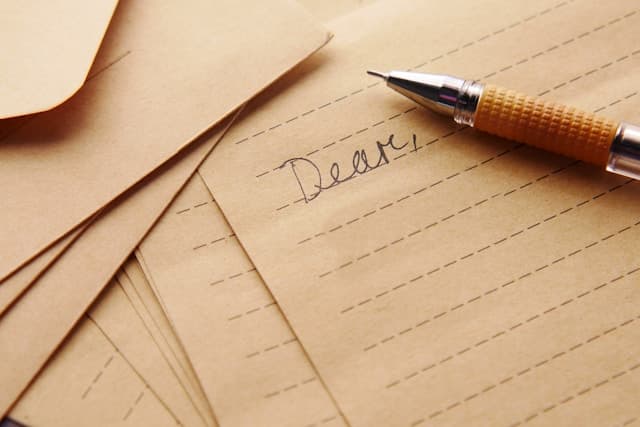
When you receive a handwritten letter, you feel something before you read a single word.
You feel the weight of the envelope. You notice the paper — whether it is thin and ordinary, or whether it has a texture that tells you someone chose it carefully. You see the handwriting on the front, your name written by a hand you know. By the time you open it, you already understand that someone really cares about you. None of this was typed. None of it could be.
Japan has a long tradition of treating the letter as an object in itself — not just a vehicle for words, but something the recipient will hold, feel, and keep. The paper matters. The envelope matters. The way the letter is folded matters. These are not just decorative concerns, but the message before the message.
Mino washi — handmade paper from Gifu Prefecture, produced using techniques registered by UNESCO — has been used for correspondence in Japan for centuries. It is made from the long fibres of the kozo plant, which interlock in a way that gives the sheet a softness and a slight translucency unlike anything produced by machine. To write on it is to feel that the paper is receiving the words, not just recording them. To receive a letter written on it is to hold something that took time — in the making, and in the writing.
The act of choosing this paper, and writing on it by hand, says something that a typed message cannot. It says: I sat down and thought about you before I wrote a word. I chose this paper because something about it felt like you. I practised on another sheet first — so that when the pen touched this one, the words came out clean. I hope you can feel, holding it, that someone thought you were worth the extra care.
That is not nostalgia. That is attention. And attention, given freely, is the rarest thing anyone can receive.
Japanese Letter Set — Mino Washi by Akira Kusaka / Cozyca Products
A letter set made from Mino washi — traditional Japanese handmade paper from Gifu Prefecture. Illustrated by artist Akira Kusaka, the set includes twelve letter sheets and four envelopes, all made in Japan. The paper has a soft texture and slight translucency that is immediately apparent when you hold it. Available via Etsy with international shipping.
View on Etsy → For those who want to explore further: search "Cozyca Products" on Etsy for the full range of washi letter sets, each illustrated by a different Japanese artist.Handmade Birthday Card — Origami Kimono, Yuzen Washi Paper
A handmade greeting card featuring an origami figure crafted from Yuzen washi — a Japanese paper dyed with traditional patterns originally developed for kimono fabric. Each card is made by hand, arrives with a matching envelope, and is blank inside for your own message. The kind of card that is kept long after the birthday has passed. Available via Etsy with international shipping.
View on Etsy → The same seller offers cards for other occasions — anniversaries, thank-you notes, and general greetings — all made from Japanese washi and origami paper.Questions
Is Japan's paper culture really a cultural choice, or just slow modernisation?
Both things are true, and separating them is part of the point. Japan has modernised with extraordinary speed in areas where modernisation aligned with its values — precision manufacturing, transportation systems, consumer electronics. The persistence of paper and analog process in institutional life reflects something more structural: a preference for human-mediated accountability, a cultural relationship with physical objects as carriers of meaning, and institutional inertia built around systems that work. Calling it purely "slow" misses the fact that these systems are often extremely reliable and that the choice to maintain them is sometimes deliberate.
What is the Hobonichi Techo and why does it have such a dedicated following?
The Hobonichi Techo is a Japanese planner published annually by the company Hobonichi, founded by writer and entrepreneur Shigesato Itoi. It uses Tomoe River paper — exceptionally thin, fountain-pen friendly — and is structured around one page per day, with minimal pre-printed guidance. Its following is partly about the paper quality and partly about the philosophy: the notebook does not impose a system. Users develop their own. The annual ritual of choosing a new Techo, transitioning from the old one, and starting fresh on January 1st has become a practice in itself for many people around the world.
How does the hanko ink stamp system actually work?
A hanko — or inkan in more formal contexts — is a cylindrical seal, typically made from wood, stone, or resin, with the owner's name carved into the base in a formal script. Pressed into red ink and applied to a document, it functions as a legally recognised signature in Japan. In institutional settings, documents often require multiple inkan — from the person initiating a request, their supervisor, department head, and so on — creating a visible chain of approval. This physical approval trail is called a ringi document. The system is currently being reduced in some government and corporate contexts as part of digital reform, but it remains deeply embedded in Japanese institutional practice.
Are younger Japanese people rejecting analog culture?
It is more complicated than a generational rejection. Younger Japanese people use smartphones and digital tools as fluently as anyone. But survey data and sales figures suggest that interest in handwriting, stationery, and physical media among younger Japanese consumers remains strong — stronger, in some categories, than in comparable Western markets. The Hobonichi Techo's largest demographic is not older users. Japanese stationery culture — pens, inks, notebooks, washi tape — has an active and young collector community both domestically and internationally. The relationship with analog objects in Japan is not simply traditional habit. It coexists with digital life rather than opposing it.
How can I bring Japanese analog culture into my own daily life?
The honest answer is: start with one object. Not a system, not a routine overhaul — one object that asks something of you. A notebook that requires you to decide what to put on the page. A pen whose response to pressure makes you slow down. A sheet of paper that is too good to waste on careless writing. The philosophy behind Japanese analog culture is not about accumulating objects; it is about choosing objects that make the act of using them a form of attention. One object, used every day, is enough to begin understanding what Japan never fully let go of.
The rest of the world built tools to move faster. Japan quietly kept the tools that make you stop. Now, in an age where a machine can finish your sentence before you have fully formed the thought, the slower instrument has started to look like something rarer than efficiency.
It looks like a decision about what kind of attention a life deserves.