

Japan's extraordinary longevity has attracted decades of research, journalism, and wellness marketing. The ingredients have been catalogued. The superfoods have been identified. And yet something deeper has gone mostly unexamined: not what Japanese people eat, but why they never stopped eating this way.
The Palate That Dashi Built
Few foods are treated with as much respect in Japan as a bowl of freshly cooked rice. For many Japanese people, it is a meal in itself. The aroma rising from the bowl. The slight sweetness that appears as you chew. The texture of each grain. None of this requires sauce, seasoning, or accompaniment.
The ability to enjoy something so simple is not accidental. And the answer, in large part, is dashi (a clear cooking stock made from dried kelp and smoked bonito flakes, and the flavour foundation of Japanese cooking).
You steep dried kombu (thick sheets of kelp harvested from cold northern waters) in cold water, bring it slowly toward a simmer, add handfuls of katsuobushi (bonito shaved so thin it trembles) and remove from the heat. What remains is almost transparent. Pale gold. And yet the flavour arrives at the back of the mouth and stays, carrying a depth that fat never needed to provide.
Japan is a soft-water country. Its groundwater carries very little mineral content, which means the delicate compounds in kombu dissolve cleanly and fully. This is not a cultural decision; it is simply the nature of the water, and it made a particular kind of flavour possible, one that hard water cannot replicate.
Over centuries, cooking inside this flavour produced a palate trained to find satisfaction in the ingredient itself, before anything was added to it. A piece of daikon simmered in dashi and a little shoyu (soy sauce) tastes complete, not plain, not lacking, but finished. To someone raised on stronger flavours, this reads as restraint. To someone raised on dashi, it reads as precision.
A food culture maintained by willpower is fragile. A food culture maintained by taste — by the genuine, trained enjoyment of the food itself — is something much harder to dislodge. Japanese people did not keep eating simply-seasoned fish and rice and vegetables because they knew it was good for them. They kept eating it because, to a palate built on dashi, it tasted right.
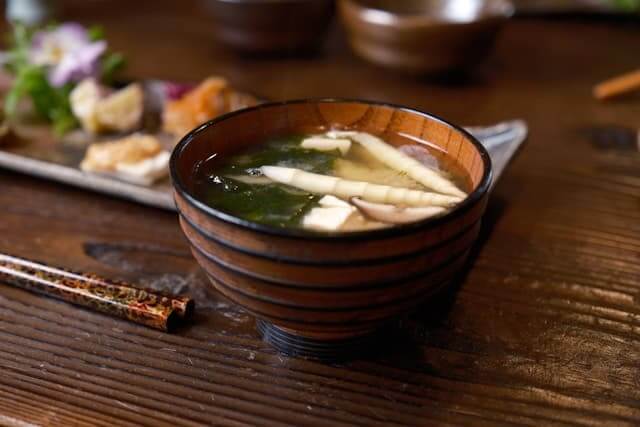
Photo by Seiya Maeda on Unsplash
What School Lunch Actually Teaches
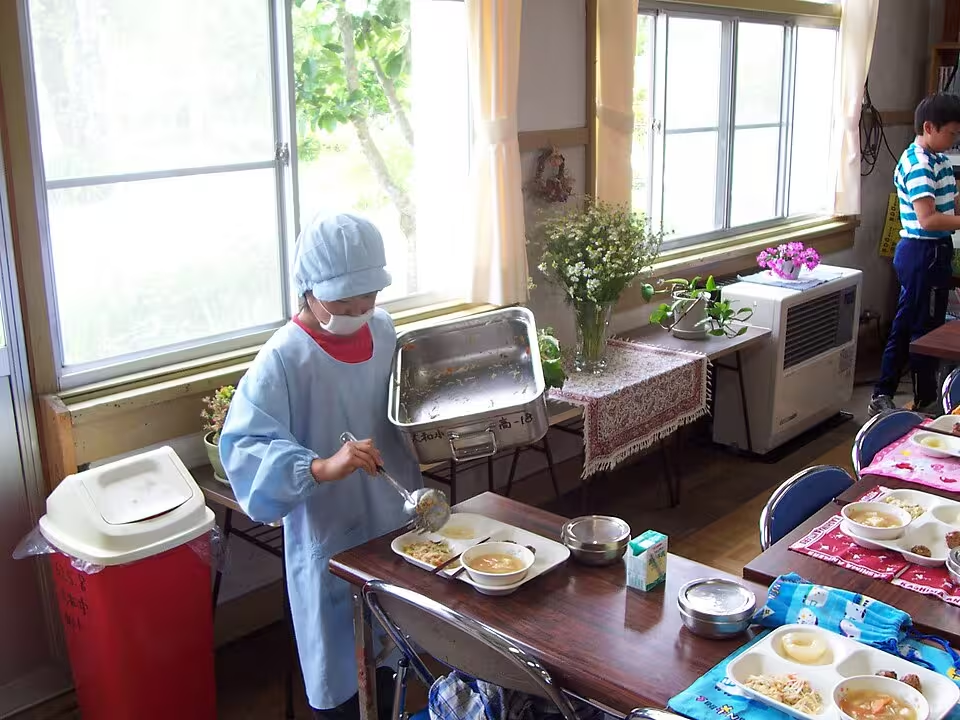
In almost every public primary and middle school in Japan, lunch is not brought from home. It is made in the school kitchen, or at a nearby preparation centre, and it arrives hot, every day, without exception.
The menu is designed by a qualified nutritionist. It is calculated to provide the required nutrients for a growing child, constructed so that the flavours are mild enough to be approachable and varied enough to be interesting. And the structure, almost always, is the same: rice or bread, a bowl of soup (usually miso), and two or three small dishes that might include grilled fish, simmered vegetables, tofu, or a light salad.
In other words: ichiju-sansai. One soup, three sides. The traditional grammar of the Japanese meal, served to children five days a week, for nine years.
Over the course of a Japanese child's compulsory education, this amounts to approximately two thousand meals. Two thousand times, the body receives protein from fish, plant protein from tofu, fermented probiotics from miso, complex carbohydrate from rice, and fibre from simmered vegetables, without calculation, without decision, simply because that is what lunch looks like.
Kyushoku (the Japanese school lunch system) is one of the least-discussed mechanisms of Japanese food culture, and arguably one of the most consequential. It does not teach children that healthy food is good for them. Through repetition, it teaches them what good food tastes like.
Built on dashi and mild seasoning, the menu trains children to find satisfaction in subtle flavour. Not because they are told to. Because, eaten day after day among friends, it simply begins to taste right.
Children look forward to lunch. They serve each other. They eat together. The experience is social before it is educational. And that may be the system's greatest strength: the lesson arrives before anyone realises they are being taught.
fo.ol from Helsinki, Finland, CC BY-SA 2.0, via Wikimedia Commons
.jpg)
How Travel Reinforces Tradition
Japanese people love domestic travel. And more often than not, food is one of the main reasons.
Cross from one prefecture into the next, and the food changes. Akita has kiritanpo, rice pounded smooth, pressed around cedar skewers, grilled over charcoal, then simmered in a broth made from local hinai-jidori chicken. Kyoto has obanzai, small dishes of simmered, pickled, and dressed vegetables shaped by centuries of refinement. Okinawa has gōyā chanpurū, a stir-fry of bitter melon, tofu, and egg that carries the flavour of a culture at a very different edge of the archipelago.
This is kyōdo ryōri, regional cooking rooted in place. Japan has hundreds of these dishes. Sometimes the ingredients change. Sometimes the seasoning changes. Sometimes the preservation methods change. But almost every region offers something that cannot quite be found anywhere else.
Travel turns traditional food into something people actively seek out. The regional dish becomes the reason to go. The memory of eating it becomes part of the memory of the trip itself. Traditional food is experienced not as obligation, but as discovery.
There is another effect that is easy to miss. A child who spent years eating kyushoku at school encounters many of the same flavour principles again while travelling. The dashi. The grilled fish. The miso soup. The balance of small dishes. The lesson is no longer taking place in a classroom. It is taking place during holidays, family outings, and moments people genuinely enjoy.
The palate continues to develop.
What once felt ordinary begins to feel comforting. And in time, comforting food can become something more than comfort. It becomes something worth seeking out.
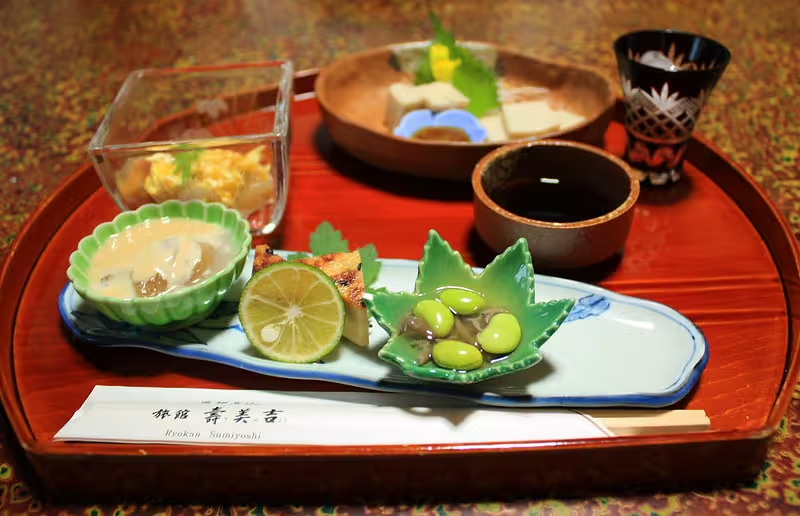
At a ryokan, this process reaches its most concentrated form. The evening meal may showcase the ingredients of the region, while breakfast arrives before the light has fully settled into the room: miso soup, grilled fish, pickled vegetables, rice, and tea. The meal is not designed to impress through excess. Yet many travellers remember it long after they return home.
The structure is familiar. The experience is special.
Through travel, traditional Japanese food becomes attached not only to habit, but also to pleasure, family, and memory. The palate formed in childhood is reinforced throughout adulthood, one trip at a time.
"Dinner at Sumiyoshi ryokan" by A S, CC BY 2.0
Eat Inside the Culture
If you have the opportunity to sit at a table where regional Japanese food is being prepared, by the people who grew up making it, take it. ByFood connects travellers with cooking classes, market tours, and food experiences led by local specialists across Japan.
Explore food experiences in Japan at ByFood →Sleep Where the Food Is
The most direct encounter with regional Japanese cuisine is often not at a restaurant. It is in the dining room of a small inn, where the kitchen uses local produce, the menu changes with the season, and dinner is the reason the guests came. Rakuten Travel lists ryokan and traditional inns across Japan, searchable by region and season.
Find a stay where the food is the destination at Rakuten Travel →Why Fermented Foods Never Disappeared
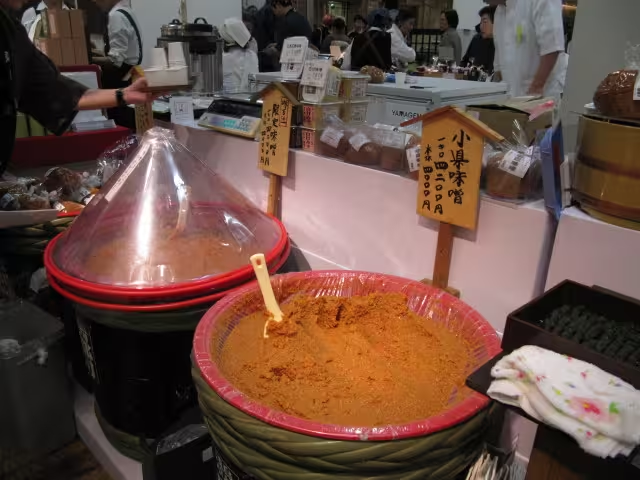
Miso (a fermented paste made from soybeans, salt, and a cultivated mould called koji) does not arrive quickly. A pale shiro miso, fermented for only a few weeks, carries a gentle sweetness that dissolves almost without resistance into broth. A dark hatcho miso, left for years in cedar barrels beneath heavy stone weights, is something else entirely: dense, sharp, almost bitter, with a depth that seems to come from somewhere beneath the taste itself.
Neither was created with health in mind. Both began as practical ways of preserving food. That got them onto the table. What kept them there was something else.
The answer lies in how well they fit the Japanese table.
Dashi provides subtlety. It carries the flavour of kelp, bonito, dried sardines, or mushrooms with remarkable restraint. But subtlety alone can become monotonous. Fermented foods supplied what dashi did not: concentrated umami, salt, aroma, and depth.
A bowl of miso soup begins with dashi, but it is miso that gives it body. A piece of grilled fish is transformed by a few drops of shoyu. A meal of rice and vegetables becomes more satisfying with the sharpness of tsukemono. Even natto, with its pungent smell and sticky threads, brings a richness that plain soybeans never could.
Together, they created a style of eating that remained simple without becoming bland.
That combination proved remarkably durable. The more attuned Japanese palates became to the subtle flavours of dashi, the more naturally fermented foods found their place beside it. They were not separate traditions. They depended on one another.
Over time, miso, shoyu, tsukemono, and natto became part of everyday life: present at breakfast, lunch, and dinner, built into meals so thoroughly that their absence would feel unusual.
Consider the bowl of miso soup that appears on the Japanese breakfast table. It is not chosen for its health benefits. It is not prepared as a ritual. It is simply breakfast, as ordinary and unconsidered as the morning itself.
That is how fermented foods became part of the system. Long before anyone spoke about probiotics, gut health, or the microbiome, people were already eating them every day. Science arrived later, and found benefits that tradition had never set out to pursue.
Fooding Around, Crystal, pelican, Kari Sullivan, CC BY 2.0, via Wikimedia Commons

The Calendar Written in Food
Sometime in late February, the air still carries winter but the bamboo shoots are already moving toward the surface. Japanese people who grew up eating them know the window without consulting anything. A few days, at most. Simmer them with dashi and a little shoyu, or cook them into rice. Wait a week, and they turn woody and the moment is gone.
The seasons in Japan do not simply change the weather. They change the table. And because the table changes, the year has a texture, a sequence of arrivals and endings that runs through the kitchen before it reaches anywhere else.
Pacific saury (sanma, a slender, silver-skinned fish) appears in the fish market in September, its fat at its peak, the skin splitting over charcoal with a smoke that rises straight in still autumn air. Winter brings the communal nabe, a hot pot set over a low flame at the centre of the table, the broth deepening as the meal lengthens, everyone reaching in.
Seasonal ingredients are one way the calendar reaches the table. Festivals and rituals are another.
Osechi (lacquered boxes filled with preserved and symbolic foods, prepared for New Year) are opened on the first of January in nearly every household in the country. Each item carries a meaning: black soybeans for health, herring roe for fertility, kombu rolled and tied for joy. The food is not incidental to the occasion. It is the occasion.
Mochitsuki (the pounding of glutinous rice into mochi, a dense and chewy rice cake) takes place before New Year in communities across Japan. It is physical, communal, loud: one person strikes the rice with a heavy wooden mallet while another turns and folds the mass between blows. The rhythm is the point as much as the result. Children participate. Neighbours gather. The act of making the food is the event.
Setsubun, the seasonal turning point marked each February, when roasted soybeans are scattered to drive out misfortune. Obon, the midsummer festival of ancestral return, when families gather and prepare the foods that belong to that gathering. The autumn harvest. Each brings its own dishes, its own rituals, and its own moment when the table returns to flavours that have been part of Japanese life for generations.
Every season brings its own foods. Every celebration brings its own meal. And almost without noticing, people find themselves returning to traditional Japanese food again and again throughout the year.
A food culture sustained only by individual choice is fragile. One generation makes different choices, and the culture shifts. But a food culture woven into seasonal rhythm, community ritual, and the emotional memory of repeated occasions has something to return to, even when ordinary daily life drifts away from it.
The calendar keeps pulling people back to the same flavours, ingredients, and food traditions that have shaped Japanese life for generations. Not through obligation. Through the kind of hunger that is really memory.
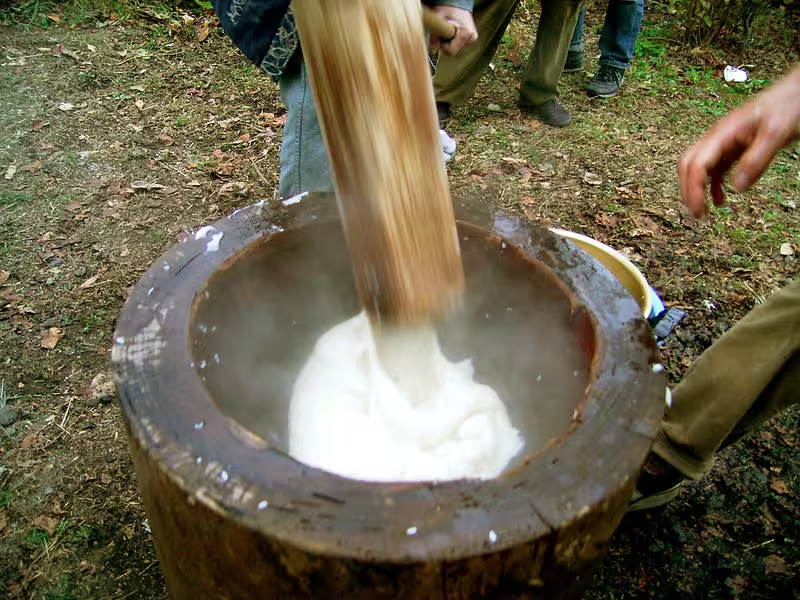
"Mochitsuki 餅つき" by norimutsu nogami, CC BY-ND 2.0
The System Is the Answer
Taken separately, none of these things seems remarkable. A bowl of miso soup. A school lunch. A regional dish eaten on a family holiday. A food that appears for only a few weeks each year and then disappears.
But together, they form something powerful: a system of return.
None of it was designed with longevity in mind. Yet together, these forces shaped the Japanese palate, reinforced it through childhood and adulthood, and returned people to the same foods again and again across the course of a lifetime.
Each emerged from geography, from practical necessity, from the human need to mark time with ceremony. And yet together, they do something no single policy or health campaign has managed: they make the food culture the path of least resistance.
The choice was made long before the individual arrives at the meal.
Japan's food culture is not maintained by a population of exceptionally health-conscious individuals. It is maintained by a society that continually brings people back to the same flavours, the same meal structures, and the same food traditions throughout their lives.
Children encounter them at school. Families encounter them while travelling. Communities encounter them through seasonal rituals and celebrations. The return happens so often that it rarely feels like a return at all.
That may be the most important reason Japanese food culture has endured.
The answer to Japanese longevity was never a single ingredient. It was never a single habit.
It was a system, assembled over centuries, piece by piece, until it became ordinary enough to disappear into everyday life.
Questions
What is kyushoku, and why does it matter?
Kyushoku is the Japanese school lunch system. In almost all public primary and middle schools in Japan, a hot, nutritionist-designed meal is provided every school day. The structure is almost always based on ichiju-sansai — one soup and three sides — meaning children encounter the traditional grammar of the Japanese meal, repeatedly and consistently, from the age of six through to fifteen. Over nine years of compulsory education, this amounts to approximately two thousand meals. The significance is not nutritional instruction, but sensory training: children learn what a balanced, flavourful, traditional Japanese meal tastes like through direct experience, in a social setting they look forward to.
What is ichiju-sansai?
Ichiju-sansai means one soup, three sides. It is the traditional structural principle of a Japanese meal: a bowl of rice, a bowl of soup — almost always miso — and three small accompanying dishes that typically include a source of animal protein such as grilled fish, a plant protein such as tofu, a simmered or pickled vegetable, and often a small portion of tsukemono. The principle is variety rather than volume. In a single meal built this way, the body receives a wide range of nutrients — lean protein, fermented probiotics, complex carbohydrate, fibre, and minerals — without planning or calculation. The structure does the work.
What is kyōdo ryōri?
Kyōdo ryōri means regional home cooking — food that is specific to a particular place, made from local ingredients using methods that developed in response to that region's geography, climate, and history. Japan's prefectural boundaries often correspond to distinct food cultures: the dashi base shifts, the dominant protein changes, the preservation methods differ. Kyōdo ryōri is one of the primary reasons Japanese domestic travel is organised around food — and one of the mechanisms by which traditional Japanese food culture is repeatedly rediscovered by each generation, not as a duty, but as a reason to travel.
Do younger Japanese people still eat traditional food?
The picture is mixed. Urban younger generations eat a more varied diet that includes substantial amounts of convenience food, fast food, and processed ingredients. The rate of traditional home cooking has declined. At the same time, the structural mechanisms described in this article — school lunch, seasonal eating, annual rituals, domestic travel — continue to create repeated encounters with traditional Japanese food across every generation. There is also growing interest among younger Japanese people in fermentation, regional cuisine, and seasonal eating, partly as cultural identity and partly in response to health awareness. The drift is real; so is the pull back.
How can I bring some of this structure into my own eating?
Begin with structure rather than specific ingredients. The most transferable principle from the traditional Japanese diet is variety in small portions across a single meal — several different foods encountered together, rather than a large serving of one thing. From there: add miso soup made from a good-quality paste, include fish two or three times a week, and incorporate one fermented food daily, whether miso, pickles, or natto if you can find it. Seasonal eating — choosing produce that is at its natural peak in your local climate — is the next step. The specific Japanese ingredients matter less than the underlying habit: fewer large things, more small different things, and the willingness to let the season decide.
Disclosure: This article contains affiliate links. If you book an experience through ByFood or a stay through Rakuten Travel using a link on this page, Untranslated Japan may earn a small commission at no additional cost to you. We only link to services we believe are consistent with the values of this site.