

The language you are born into is not just a tool for speaking. It is the first map you are given of the world.
A Language That Stops at the Border
There are approximately 7,000 languages spoken in the world today. Japanese is among the twenty most widely spoken by total number of speakers. By almost every other measure, it is profoundly alone.
Around 120 million people speak Japanese. Nearly all of them live in Japan. Unlike Spanish, which crossed an ocean and took root across two continents, or Arabic, which spread along trade routes and through faith, Japanese stayed where it began. Step off a plane almost anywhere outside Japan, and the language simply stops working. Not partially. Completely.
This is not a minor inconvenience. It shapes everything that follows.
Growing up in Japan, you encounter this fact early and often: in foreign films watched with subtitles or in dubbed translation, in the particular anxiety of a school English class, in the knowledge that travel abroad requires a different version of yourself. Your language, and by extension your way of thinking, your jokes, your sense of what is obvious and what requires explanation, belongs here. Out there, you will need to translate everything, including yourself.
This produces something observable in Japanese culture: a simultaneous fascination with and wariness of the world beyond the islands. Foreign things are eagerly consumed, carefully studied, enthusiastically adapted. But the engagement tends to happen on Japanese terms, in Japanese, within Japan.
The world is larger than your language.
You are not at the centre of the conversation.
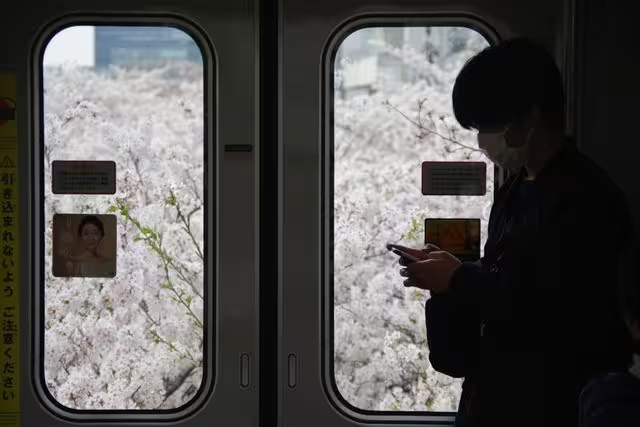
The Language That Reads the Room
Languages are not only systems for conveying information. They shape how people pay attention to the world. And Japanese does this in ways that are worth examining closely.
In Japanese, the subject of a sentence is routinely dropped when context makes it clear. Verbs come at the end, which means the direction of a sentence only resolves in its final moments. Levels of politeness are encoded directly into verb forms, so that every time you speak, you are making a calculation about social position, relationship, and context. None of this is conscious after childhood. It becomes the texture of thought itself.
One result is a particular sensitivity to what is not said. In Japanese communication, the spoken word carries only part of the meaning. The rest lives in tone, timing, silence, and the shared understanding of what the situation implies. The word for this attentiveness is kuuki wo yomu — reading the air. It is not a special skill. It is considered a basic social competency.
This habit of locating meaning beyond the literal words appears everywhere, including in some of the most ordinary moments of daily life.
Consider the word itadakimasu, spoken before every meal. English translations offer approximations: "let's eat," "thank you for the food." But itadakimasu is a formal verb of receiving, directed simultaneously at the person who cooked, the animal or plant whose life was taken, and the broader web of effort and nature that made the meal possible. It is a ritual compressed into a single word. The moment you translate it, it becomes something else entirely. Japanese speakers know this. They have always known it. The untranslatable is not an exception encountered in books. It is embedded in daily life.
This awareness shapes how Japanese speakers approach communication with the outside world. The assumption is not that language will carry meaning cleanly from one person to another. The assumption is that something will always be lost, and that the gap requires effort, patience, and attentiveness to bridge.
The contrast with English-speaking cultures is structural rather than personal. English is the closest thing the modern world has to a universal operating language. Airports, universities, scientific journals, international business, the architecture of the internet: English is the default. For a native English speaker, the world tends to come to them. When communication fails, the instinct is often to repeat more clearly or more slowly, rather than to consider that the entire frame of reference might need rethinking.
Neither orientation is superior. But they teach people different expectations about what it means to understand, and to be understood.
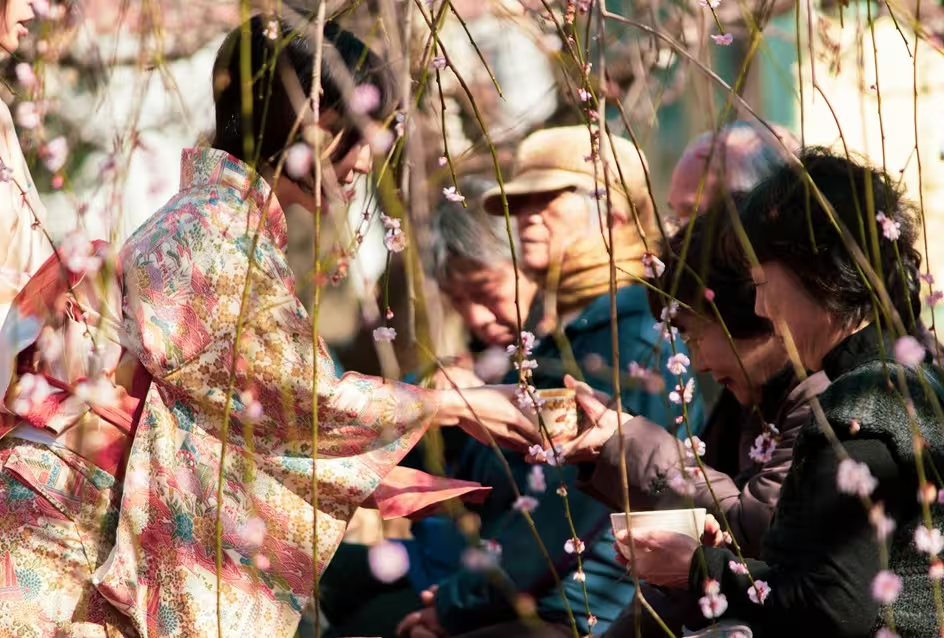
This Is What It Built
A society whose language remains largely within its borders often develops depth in different places. Language is not the only reason. Geography, history, and long periods of cultural continuity matter too. But language shapes what a society pays attention to. And over time, attention accumulates.
The Artisan Standard
Japan's artisan culture is one expression of this. The concept of shokunin (a word that translates loosely as craftsperson, but carries a weight the English cannot hold) describes someone who dedicates a working life to the refinement of a single skill. A knife forger in Sakai who has spent forty years perfecting the geometry of a single blade. A lacquerware maker in Wajima who applies layer after layer of urushi over weeks, letting each one cure before the next begins. The goal is not novelty. It is excellence pursued with such patience and care that it begins to resemble devotion.
The Everyday Standard
The same orientation appears in places that have nothing to do with traditional craft. A ramen shop in a Tokyo backstreet whose owner spent three years developing a single broth: the ratio of chicken carcass to pork bone, the exact temperature at which the fat emulsifies into a glossy, almost luminous surface, the twelve-hour reduction that produces a depth no shortcut reaches. A fruit farmer in Shizuoka who grows muskmelons in a greenhouse, each one supported in a handmade net so its weight is distributed evenly, each one inspected daily, each one brought to market at the precise moment of peak ripeness: the skin a perfectly symmetrical lattice, the flesh sweetened by months of controlled attention.
The same impulse appears in places that outsiders often treat as entirely modern. In the workshop of a figure sculptor adjusting the curve of a sleeve by fractions of a millimetre. In an animator drawing the same movement hundreds of times until it feels alive. In fans who spend decades exploring the details of a fictional world with the seriousness others reserve for history or religion. The subject changes. The habit of attention does not.
The Seven-Minute Turnaround
Or consider the cleaning crew at a major Shinkansen station. When a Shinkansen pulls in, the turnaround time before the next departure is seven minutes. In those seven minutes, a team of attendants moves through the carriages with a silent, balletic precision that has been studied by logistics researchers and business schools internationally. Every seat is rotated to face the direction of travel. Every tray table is wiped. Every headrest cover is replaced. The floor is swept, the toilets are cleaned. When the work is complete, the team lines the platform and bows as passengers board. The company that runs this service, Tessei, has described its mission not as cleaning but as omotenashi: the art of hospitality so complete that the recipient should not have to think about it at all.

The shokunin in a traditional workshop and the Tessei attendant on a platform appear to have nothing in common. One works with centuries of accumulated technique. The other works a shift. But the ramen shop owner, the melon farmer, and the cleaning crew operate from the same place: this thing I do, however ordinary it appears, is worth doing as well as it can possibly be done.
Many societies have artisans. Japan is not unique in valuing skill. What feels unusual is the breadth of that impulse. Japan did not produce a class of dedicated specialists alongside a general population of average workers. It produced a culture in which the specialist impulse runs through almost everything, including the work that other societies treat as interchangeable.
This, at least in part, is what grows when a society learns that words are never enough.
Arrival of AI
For most of the modern era, Japan's language barrier functioned in two directions at once. It kept Japanese culture from reaching the world efficiently. It also kept the world from entering Japan at full speed. The wall was a constraint. It was also, whether intentionally or not, a form of protection.
That wall is coming down.
AI translation has advanced faster than almost anyone predicted. Real-time voice translation now handles ordinary conversation with reasonable accuracy. Written Japanese, long considered one of the most difficult translation challenges due to its three interwoven scripts and its dependence on context, is now rendered into English at a quality that would have seemed implausible a decade ago. The friction is not gone, but it is diminishing rapidly, and the direction of travel is clear.
For Japanese creators, artisans, and businesses, doors that were once closed are beginning to open. The knife forger in Sakai who spent forty years achieving a standard that nobody outside Japan could easily read about can now reach buyers in London and São Paulo directly. The small ryokan in a mountain village whose website existed only in Japanese is, effectively, legible to the world. Knowledge that lived inside the language: recipes, techniques, local histories, specialist vocabularies. All of it is becoming accessible in ways it never was before.
But the same opening works in reverse. The buffer that language once provided is disappearing. External ideas, tastes, and commercial pressures now move into Japanese cultural space with unprecedented speed. The shokunin working in a centuries-old tradition now faces customers whose expectations were shaped somewhere else. The neighbourhood coffee shop serves local customers who arrive with tastes formed by global trends. The regional festival exists not only for the people who attend, but for an audience watching from elsewhere.
Whether this accelerates homogenisation or simply amplifies visibility is a question no one can answer yet.
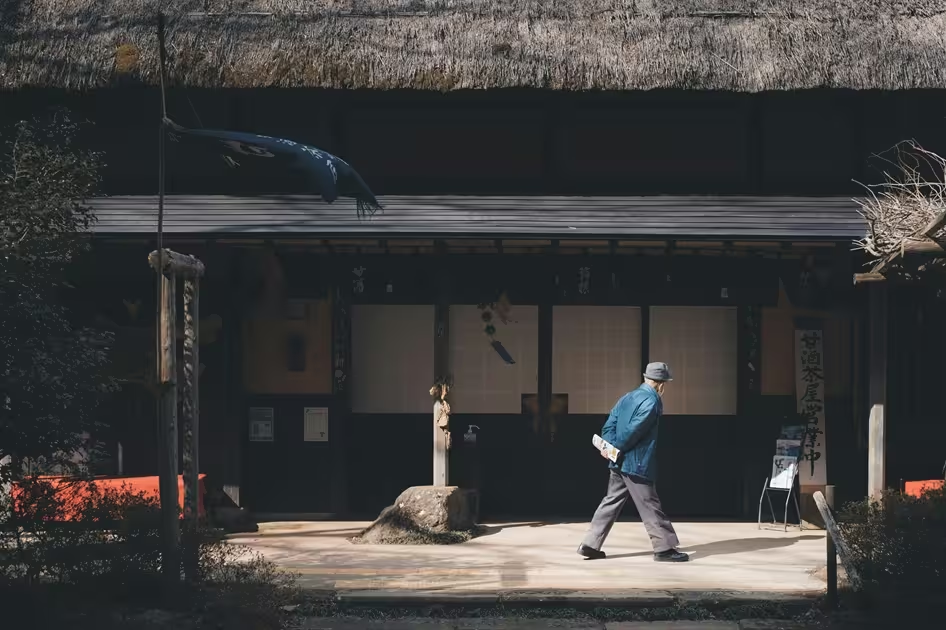
Practised, or Lost
But there is a deeper question than what crosses the border.
AI does not only translate words. It reinforces values already spreading across the modern world: that understanding should be fast, that answers should be immediate, that anything worth knowing can be summarised. These values are useful. They are also, if left unchecked, corrosive to a particular kind of culture.
A culture that waits for the other person to finish speaking. That finds meaning in work that looks inefficient from the outside. That does the unnoticed task with the same care as the visible one. That registers a small shift in the season before anyone names it. That prepares for a guest's comfort without expecting to be seen doing so.
None of these things survive automatically. They are practised or they are lost.
The question for Japan, and perhaps for anyone shaped by a culture of careful attention, is simple:
Can a culture built on slow attention survive in a world that increasingly rewards speed?
Questions
Is Japanese really one of the hardest languages to learn?
For native English speakers, yes. The United States Foreign Service Institute categorises Japanese as a Category IV language, its highest difficulty rating, estimating around 2,200 classroom hours to reach professional working proficiency. The reasons are structural: three interwoven writing systems (hiragana, katakana, and kanji), grammatical logic that differs fundamentally from European languages, and a system of speech levels that requires understanding social context in order to speak correctly. The difficulty is not incidental. It reflects how different the underlying architecture of the language is from anything an English speaker has encountered before.
What does "high context culture" mean, and is Japan really high context?
The anthropologist Edward T. Hall introduced the distinction between high-context and low-context cultures in his 1976 book Beyond Culture. In low-context communication, meaning is carried primarily by explicit language: what is said is what is meant. In high-context communication, meaning depends heavily on shared understanding, relationship, nonverbal signals, and what is deliberately left unsaid. Japan is consistently placed at the high-context end of this spectrum. The concept of kuuki wo yomu, reading the air, captures this orientation precisely. It is worth noting that the high/low distinction is a model, not a precise measurement, and individuals within any culture vary considerably.
Can AI translation fully capture Japanese nuance?
Not fully, and probably not soon. Current AI translation handles straightforward Japanese text with impressive accuracy and continues to improve. Where it struggles is precisely where Japanese is most itself: honorific levels that shift meaning depending on social relationship, contextual omissions that a human reader fills in automatically, idiomatic expressions rooted in cultural experience, and the particular weight that certain words carry from centuries of use. Translation technology transfers the informational content of Japanese. The cultural and emotional resonance embedded in the language requires something more than pattern recognition to move intact.
Why do Japanese people sometimes seem reluctant to speak English even when they have studied it?
Several factors converge here. Japan's English education has historically emphasised reading and grammar over spoken communication, so many Japanese people have considerable passive knowledge of English but limited practice using it in real conversation. There is also a cultural dimension: making errors in public carries a social cost in a culture that prizes precision and consideration for others. Speaking imperfect English risks causing misunderstanding, which is its own form of impoliteness. The reluctance is less about ability than about a particular relationship to correctness and to the responsibility of communication.
What is lost when Japanese is translated into English?
The losses are layered. At the most basic level, concepts disappear: words like ma, wabi, mono no aware, and itadakimasu have no direct English equivalents, and any translation is an approximation that selects one dimension of meaning while discarding others. Beyond vocabulary, grammatical ambiguity is often lost. Japanese sentences can sustain multiple interpretations simultaneously in ways that English structure tends to force into resolution. Most significantly, the register system is lost. Japanese encodes the speaker's relationship to the listener directly into verb forms; English has no equivalent, so translated Japanese tends to flatten social complexity that was doing real work in the original.
This article does not contain affiliate links.