Japan is already living in a future that many other countries are only beginning to approach.
As of October 2024, 29.3 percent of its population was aged 65 or older. That is more than one person in four, and the highest share in the world.
Those numbers are often presented as a problem. Japan's ageing population is discussed in terms of labour shortages, pensions, healthcare costs, shrinking communities, and the pressure placed on younger generations.
All of that is real. But a society this old also makes something easier to see: what growing older looks like when it is part of everyday life, rather than something pushed to the margins.
So when nearly three in ten people are already over 65, does growing older still mean gradually stepping away from work, family, community, and public life?
Growing Older Does Not Mean Stepping Away from Life
I grew up in rural Japan, in a place where many families around us farmed. So from childhood, I was used to seeing people in their seventies still out in the fields working.
There was nothing unusual about it. If you walked through the countryside, you would see older men and women tending vegetables, checking crops, carrying tools, or moving slowly between the house and the fields. They were well past what most people would think of as retirement age, but they were still working because the work was still there.
My own parents were much the same. When they were already past seventy-three, I remember suggesting that perhaps it was time to retire. They were not very enthusiastic about the idea. One of the things they worried about was losing the everyday connection they had with the people they worked with.
Later, when I lived in Tokyo, the surroundings were completely different, but older people were just as visible.
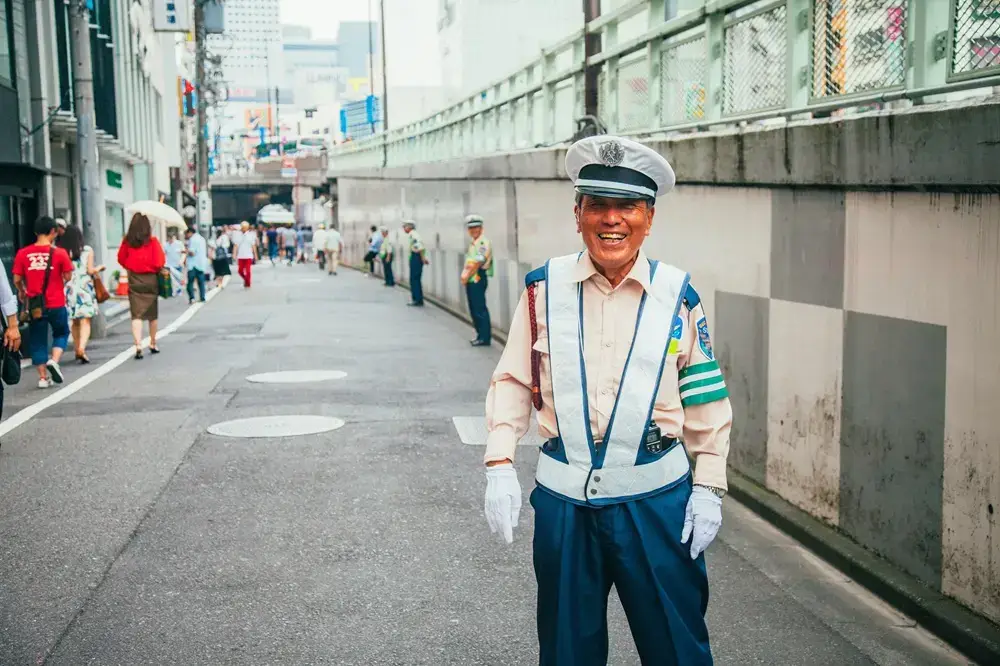
I often saw them helping children cross the road on their way to school, working at bicycle parking areas, guiding visitors at public facilities, or taking part in local volunteer activities.
The work itself was rarely dramatic. A person might spend the morning watching over a school crossing, keeping rows of bicycles in order, giving directions, or helping maintain a public space. But those small roles placed older people right in the middle of ordinary neighbourhood life.
At the time, I did not think of any of this as unusual. Older people were simply there, doing things, being seen, part of the rhythm of the place around them.
Looking back, I realize it wasn't only that older people stayed active. There were still places for them to take part: at work, in the family, and in the community.
A Life Built Around Roles and Responsibilities
In Japan, there are several different ways for people to remain involved as they grow older. Some are formal, created through employment law or local programmes. Others are much less visible: a family business that has no fixed retirement age, a neighbourhood task that still needs doing, or a family that relies on a grandparent for part of its daily routine.
The workplace is one of the clearest examples. Japanese employers that set a retirement age below 65 are required to provide a way for employees to remain employed until 65, whether by raising the retirement age, abolishing it, or offering continued employment. Since 2021, employers have also been asked to make efforts to secure opportunities to work up to age 70.
That does not mean everyone wants to keep the same job for another decade. In practice, retirement can mean returning to the same company on a different contract, working fewer hours, or taking on different responsibilities. Structurally, there is a bridge between full-time work and simply stopping.
For people who have already left a company, Japan has another unusually visible bridge: the Silver Human Resources Centers. These public-interest organisations operate locally and connect older people with short-term, light, or community-based work, such as managing bicycle parking or maintaining public spaces. Officially, they are intended to support social participation and a sense of purpose while contributing to the local community.
Local communities create another layer. Japan's community-care policy also creates opportunities for healthier older residents to support everyday life in their own communities. In practice, that can mean neighbourhood activities, safety patrols, local clean-ups, volunteer groups, or helping with events and services that would otherwise be difficult to maintain.
Then there are the roles that no law created.
Many grandparents help with school pick-ups, meals, childcare, or caring for another family member. In farming families and small family businesses, work often has no clear retirement day at all. This was the world I knew as a child. The amount of work may gradually shrink, and the younger generation may take over the heavier tasks, but a person can still have something that is theirs to do.
I do not think all of this comes from a uniquely Japanese belief that older people should stay useful. Economic necessity, labour shortages, and family circumstances all matter. And responsibility can become a burden as easily as it can provide structure.
These different layers often overlap: employment policy, local organisations, neighbourhood life, family, and work without a fixed retirement age can all leave room for participation to continue in smaller forms.
Over time, those roles can become part of the structure of a day. And that makes the next question harder: what happens when they are no longer there?
What Happens When Social Roles Are Lost?
Retirement is the clearest example of what can happen when a role ends. A job gives a person more than work to do. It sets the rhythm of the day: when to get up, where to go, who to see, and what other people expect.
This is one reason I think back to my parents' reluctance to retire. They were less worried about having less work than about losing the everyday connection with the people they had worked beside for years.
The same kind of change can happen outside work. Children grow up, a caregiving role ends, a spouse dies, poor health makes a familiar activity harder to continue, or a family business passes to the next generation. The circumstances are different, but a role can take part of a person's routine and social life with it when it goes.
Research in Japan supports the importance of those connections. Longitudinal studies of older adults have found that participation in community groups, hobbies, sports, and work is associated with a lower risk of functional decline. Other studies have found links between social participation and lower levels of loneliness or future social isolation. These findings show association rather than simple cause, but they suggest that everyday participation matters.
Of course, losing a role does not always mean losing connection or meaning. Retirement can make room for a hobby, volunteering, study, travel, or more time with family. Some people feel relieved when a long responsibility ends.
The harder transition may come when several roles disappear and nothing takes their place. What is lost then is not only a way to fill the day, but regular contact with people and places that once gave the day its shape.
When those external roles begin to fall away, what still gives a person a reason to get up and take part in the day?
Beyond the Ikigai Venn Diagram
If you have come across ikigai in English, there is a good chance you have seen it as a Venn diagram.
Four circles overlap: what you love, what you are good at, what the world needs, and what you can be paid for. At the centre sits ikigai, as though the word describes the perfect point where passion, talent, usefulness, and career all meet.
It's an appealing idea, but the famous diagram was created outside Japan as a way of organising the concept. It is not a traditional Japanese definition of ikigai.
To me, ikigai seems to have grown much larger in translation.
In Japanese, ikigai can carry the sense of something that makes life feel worth living. The word combines iki, from living, with gai, a sense of worth or value. But even researchers in Japan note that there is no single English expression that captures it exactly. Depending on the context, it can suggest purpose, meaning, motivation, or a source of everyday satisfaction.
A person's ikigai might be their grandchildren. It might be gardening, painting, meeting the same friends each week, taking a morning walk, following a favourite television series, or looking forward to what will bloom next month. It can involve responsibility, but it does not have to. Nobody else needs to consider it useful.
In the previous section, I wrote about what can happen when an external role disappears. But losing a role does not necessarily mean losing everything that makes the next day matter.
Research on older adults in Japan also suggests that ikigai is connected with several aspects of wellbeing. A nationwide longitudinal study of Japanese adults aged 65 and over, for example, found associations with lower risks of later functional disability and dementia, as well as greater life satisfaction and participation in activities such as hobby groups.
For me, the more useful insight is simpler. When one role ends, a person does not necessarily need another grand role to replace it. Meaning can remain in much smaller things.
And once we bring ikigai back down to the scale of ordinary life, another question follows naturally: how long can we keep living that life for ourselves?
Life Expectancy Is Not the Only Number That Matters
Japan is famous for how long its people live. But in Japanese public health, there is another number that has become just as important: kenkō jumyō, or healthy life expectancy.
Life expectancy asks how long a person can expect to live. Japan's most commonly used measure of healthy life expectancy asks how long they can expect to live without health problems limiting their everyday activities.
In 2022, life expectancy in Japan was 81.05 years for men and 87.09 for women. Healthy life expectancy was 72.57 years for men and 75.45 for women. That leaves a gap of 8.49 years for men and 11.63 years for women between the two measures.
That gap should not be read as years spent bedridden or dependent on care. The measure is based on whether health problems limit daily life.
The gap does point to a different way of thinking about longevity: less about how long people live, and more about how long they can continue doing the ordinary things that make up their own lives.
That can mean cooking for yourself, going out when you choose, meeting people, or continuing the activities that give shape and meaning to your day.
Healthy life expectancy is not a uniquely Japanese idea. The World Health Organization also uses healthy life expectancy, known as HALE, to account for both how long people live and the health they experience during those years. Japan, however, has made its own measure of healthy life expectancy a prominent part of national health policy.
Under Health Japan 21 (the third term), which began in 2024, extending healthy life expectancy is a central national health goal. The aim is for healthy life expectancy to increase faster than overall life expectancy, not just for it to rise, narrowing the gap between the two.
To me, that changes the question in an important way. Instead of asking only, “How many years can we add to life?”, it asks something closer to: “How long can we continue living our own lives?”
What Japan Reveals About Aging Well
The more I think about ageing, the less I see it as something an individual can manage alone. Health, independence, and the roles we hold all change over time.
For me, ageing well means being able to keep finding meaning and enjoyment as those changes happen, in a society that gives people the support and room to remain part of everyday life.
Japan does not have a perfect answer to ageing. But living in such an old society has made this relationship easier for me to see. Ageing well depends not only on how we adapt to growing older, but also on whether the society around us adapts with us.
Frequently Asked Questions
How does Japan support older people beyond healthcare and pensions?
Japan uses several systems to help older people remain involved in work and community life. Employers must secure employment opportunities until age 65 and are expected to make efforts to provide opportunities up to age 70. Silver Human Resources Centers offer short-term, light, and community-based work, while community-care policies also encourage social participation and local roles for older residents.
What does ikigai mean in Japanese?
There is no single English translation for ikigai. It can suggest meaning, purpose, motivation, or something that makes life feel worth living, and it can be rooted in very ordinary sources of satisfaction. The well-known four-circle Venn diagram was created outside Japan and is not a traditional Japanese definition of ikigai.
What is the difference between life expectancy and healthy life expectancy (kenkō jumyō)?
Life expectancy measures how long a person can expect to live. Japan's commonly used measure of healthy life expectancy estimates how long people can expect to live without health problems limiting their everyday activities. In 2022, the gap between the two measures was 8.49 years for men and 11.63 years for women. That gap should not be read as the number of years someone is bedridden or dependent on care.
What happens when older adults lose their social roles?
Losing a role can change more than how a person spends their time. Retirement, bereavement, changes in family responsibilities, or declining mobility can also reduce regular contact with people and places that once gave structure to the day. Japanese longitudinal studies have found associations between social participation and lower risks of functional decline or future social isolation, although this does not prove that losing a role directly causes poorer health.
What can other ageing societies learn from Japan?
Japan does not offer a perfect model for ageing. One useful lesson is that ageing well is not only an individual challenge. Health and independence matter, but so do the social structures that allow people to remain involved as their roles and circumstances change. The broader question is whether a society continues to leave room for people to participate in everyday life as they grow older.
References
Cabinet Office, Government of Japan. Annual Report on the Ageing Society 2025: Current Status and Future Outlook.
Ministry of Health, Labour and Welfare. Employment Measures for Older People: Securing Employment to Age 65 and Opportunities to Age 70.
Ministry of Health, Labour and Welfare / Miyagi Labour Bureau. Purpose of Silver Human Resources Centers.
Ministry of Health, Labour and Welfare. Community-Based Integrated Care System.
The Government of Japan. Ikigai: The Japanese Secret to a Joyful Life. 2022.
Regional Differences in Ikigai (Reason(s) for Living) in Elderly People. Japanese Journal of Geriatrics, 2003.
Okuzono, S. S., et al. Ikigai and Subsequent Health and Wellbeing Among Japanese Older Adults: Longitudinal Outcome-Wide Analysis. The Lancet Regional Health – Western Pacific, 2022.
Kanamori, S., et al. Social Participation and the Prevention of Functional Disability in Older Japanese: The JAGES Cohort Study. PLOS ONE, 2014.
Ejiri, M., et al. Social Participation Reduces Isolation Among Japanese Older People in Urban Area: A 3-Year Longitudinal Study. PLOS ONE, 2019.
World Health Organization. Healthy Life Expectancy (HALE).
Ministry of Health, Labour and Welfare. Life Expectancy and Healthy Life Expectancy.
Ministry of Health, Labour and Welfare. Health Japan 21 (Third Term).