
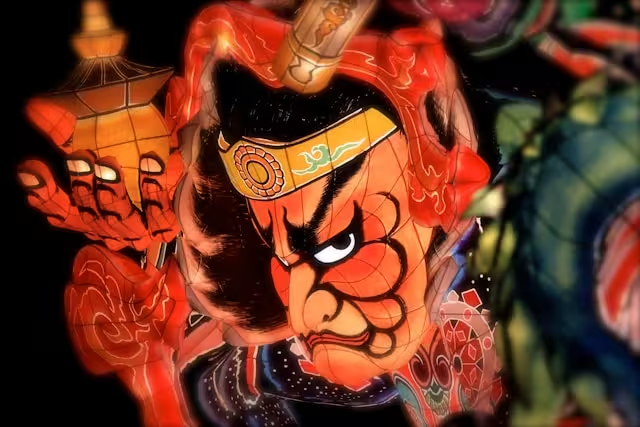
In early August, the streets of Aomori city fill with a sound that has no equivalent elsewhere in Japan. It is not music, exactly. It is not celebration. It rises from somewhere older than either of those words — a low drumbeat that you feel in the chest before you hear it with the ears, then voices shouting in unison, then the slow emergence of a warrior's face, ten feet high, made of wire and paper and light, moving through the dark as if it knows exactly where it is going.
Five Months of Winter
Snow arrives in Aomori in November and does not leave until April. Not the gentle snowfall of seasonal greeting cards — the kind that accumulates in meters, that buries roads, that requires a different relationship with time entirely. The Tsugaru region on the Sea of Japan side receives some of the heaviest snowfall of any populated area on earth. By January, the weight of it changes how a person moves, how a person plans, how a person thinks about the months ahead.
Apple farmers begin pruning in January. They are standing in snow that reaches their knees, cutting branches from trees that will not bear fruit for another nine months. Every cut is a calculation — this branch takes too much light from that one, this angle will hold the weight of August apples better than that one. The work is patient and completely invisible. By the time the fruit appears, it has already been shaped by decisions made in January. In the snow. By someone who could not yet see what they were making.
This is the rhythm that underlies everything in Aomori. Not the rhythm of seasons turning pleasantly from one to the next, but the rhythm of a long, demanding pressure followed by a brief, ferocious release. The winter is not a pause between summers. It is the condition that makes summer what it is. Remove it, and the summer would mean nothing at all.
The Ou Mountain Range runs through the centre of the prefecture, dividing it into two distinct climates. On the Pacific side, the Kennan region receives cool, damp winds from the east in summer — the yamase — that can bring crop-damaging cold even in July. On the Tsugaru side, those same mountains block the winds and allow brief, intense heat. The same prefecture, two different experiences of summer. Both shaped by the same understanding: that warmth is temporary and preparation is the only rational response to that fact.
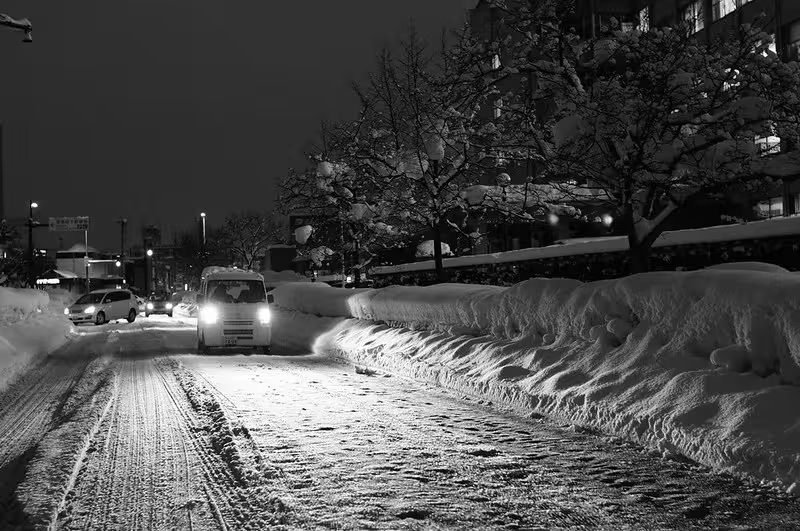
"DSC_0070-aomori-streets" by Konstantin Leonov is licensed under CC BY 2.0 
 .
.
That long winter transforms more than the rhythm of daily life. It reshapes the landscape too. In Oirase Gorge, a forested ravine in southern Aomori, waterfalls and streams freeze into icefalls and icicles, turning a landscape known for rushing water into something almost still.
Seeing it at the deepest point of winter, however, is not always straightforward for an overseas visitor. Exploring the gorge independently generally means dealing with snow-covered roads — not something every traveller will want to attempt.
Explore Frozen Oirase Gorge with a Private Guide
This private winter experience takes you through Oirase Gorge by vehicle with a local guide, stopping to see its frozen waterfalls and ice formations. Choose a daytime visit to see the frozen landscape in natural light, or a night departure when the icefalls are illuminated against the dark forest. Local Aomori sake is served along the way.
View the experience at Wabunka →A Week That Holds a Year
The Aomori Nebuta Festival runs from the second of August to the seventh. Six days during which more than three million people come to watch warriors made of wire and washi paper parade through a coastal city at night, lit from within, accompanied by taiko drums and flutes and the sound of ten thousand voices shouting rassera, rassera into the summer dark.
To call this a celebration is accurate but insufficient. The word implies that the thing being celebrated is something pleasant that has arrived. What Nebuta expresses is closer to the opposite — an awareness that what has arrived will not stay. The festival falls in the narrow window between the end of the rainy season and the beginning of harvest preparation. Before it and after it, there is work. The festival is the hinge between two kinds of pressure, and its intensity is borrowed from both of them.
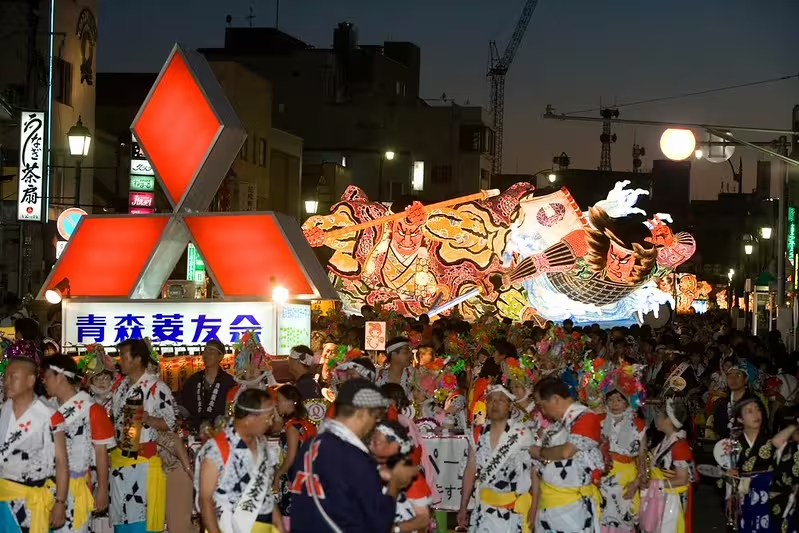
"NEBUTA" by Yuichi Kosio is licensed under CC BY 2.0 .
The most widely cited theory of Nebuta's origin traces it to nemuri nagashi — the floating away of sleep. Farmers in the height of summer, working long hours in heat they were unaccustomed to after months of cold, would grow dangerously drowsy. The festival, on this account, was a ritual for driving the drowsiness out — lighting lanterns, making noise, moving the body until the heaviness lifted and there was enough alertness left to finish the season's work. The name itself preserves this: nebutai in Tsugaru dialect means sleepy, and the word shifted over generations into the name of the festival. This theory is contested among folklorists, but it contains something true regardless of its historical accuracy: the festival's energy is not the energy of ease. It is the energy of people who cannot afford to stop.
The haneto — the dancers who run alongside the floats — wear specific costumes and jump in a specific way, heels lifting high off the ground, arms swinging outward, the whole body bouncing in a rhythm that becomes exhausting within minutes and is sustained for hours. Anyone can join. You put on the costume and you enter the procession and there is no distinction between participant and spectator, between resident and visitor, between the person who has danced every year since childhood and the person who arrived this afternoon. The festival absorbs everyone into the same motion.
Hirosaki, sixty kilometres to the southwest, holds its own version at the same time. The Hirosaki Neputa floats are fan-shaped rather than figural, and they carry two faces — the kagamie, painted on the front, shows a warrior at the moment of charge, eyes forward, expression fierce. The miokuri, painted on the back, shows a woman looking backward, expression quiet, watching something disappear. The float moves forward through the streets and the front face leads, but the back face trails behind, looking at what has been left. Each float is built once. The painting that covered it — a year of work by a single artist — is not made to last.
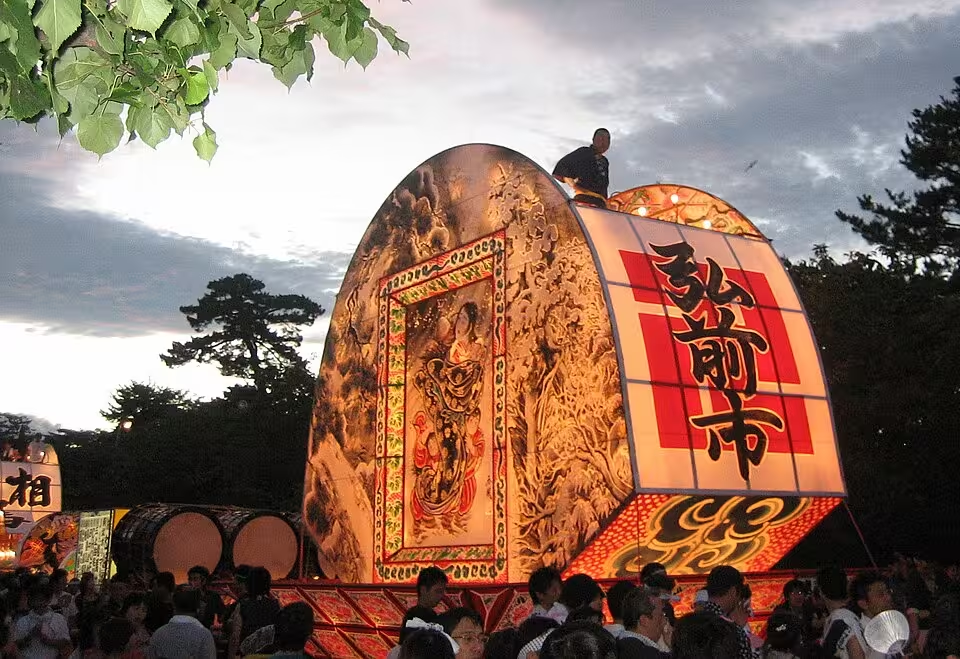
"Ōgi Neputa 3" by Ben Garney is licensed under CC BY 2.0 .
See Nebuta Through the Eyes of a Master Artist
This private experience is led by nebuta artist Hiroo Takenami, who explains how the enormous illuminated figures are designed, built, and brought to life. Depending on the season, you may visit the production site while a full-scale float is taking shape or try the same techniques on a smaller lantern of your own. The experience also includes a private visit to the Nebuta Museum Wa Rasse.
View the experience at Wabunka →At the Edge of the Living
At the northern tip of the Shimokita Peninsula, three hours from Aomori city by road, there is a place called Osorezan. The name means fear mountain, though no single mountain carries the name — it refers instead to a lake surrounded by eight peaks, on whose shore stands a Buddhist temple that has been a sacred site since the ninth century. The lake is called Usoriyama-ko. Highly acidic, the water is unnervingly clear and supports almost no life. The ground around it vents sulfurous gas through cracks in the volcanic rock, and the smell reaches you before anything else does.
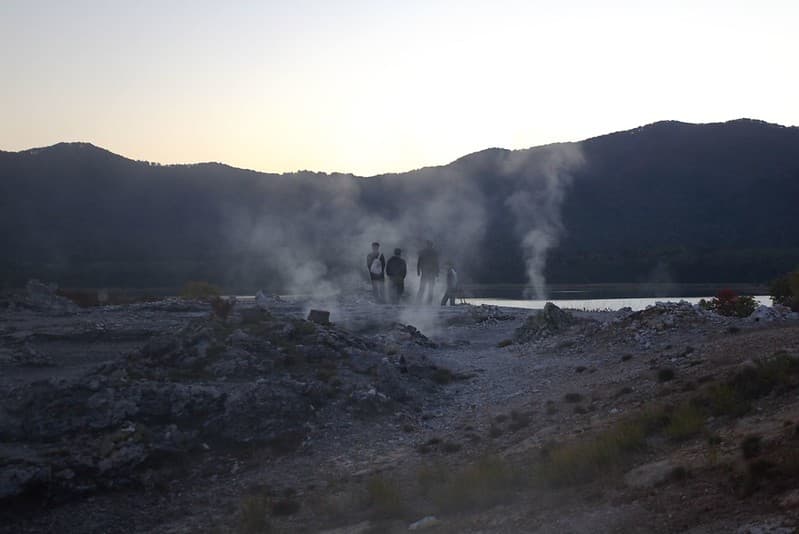
"Osorezan #1" by tsuda is licensed under CC BY-SA 2.0  .
.
The people of this region have said for generations that the dead go to Osorezan. Not as metaphor — as a statement about geography. If you die here, this is where you end up. Jizo statues line the paths through the volcanic terrain, placed by the living for the dead, small cairns of stones piled beside them, pinwheels turning in the wind. The landscape does what landscape rarely does: it makes an abstract belief into something you can walk through.
Twice a year, in summer and in autumn, the temple holds a great festival. And it is at these gatherings that the itako come.
An itako is a female medium — a woman trained, through years of apprenticeship under a master, to call the dead and speak in their voices. She is a practitioner, not simply a vessel. The craft is learned methodically, over several years, and passed from teacher to student through direct transmission. What she carries is not a gift but a skill.
Historically, itako were almost always blind. The connection was not incidental. In a region where measles periodically took the sight of children, communities needed a way to integrate those children into the fabric of daily life. For blind girls, the path to the itako apprenticeship was one of the few routes to economic independence and social standing available. The community's need for mediation between the living and the dead, and the need to care for its most vulnerable members, produced the same solution. This is how cultures under pressure think: not abstractly, but in structures that solve multiple problems at once.
What an itako actually does, in practice, is listen. A person comes with grief — a parent lost, a child gone, a death that came too quickly to allow for proper farewell. The itako performs the kuchiyose, the calling, and then she speaks in the voice of the dead person. What she says, according to those who have documented the practice, is almost always reassuring. She tells the grieving that the dead are at peace. That they were grateful for their life. That the living should not worry. Whether or not the dead are truly speaking through her, the effect is consistent: people leave with something they did not have before. Not certainty. Not proof. Something closer to permission — to continue.
The tradition is nearly gone. The number of historically trained itako in Aomori can now be counted on one hand. The last blind itako still practicing is in her nineties. The apprenticeship system that produced them has not functioned for decades. What remains is a cultural memory of a practice that lasted, in organized form, for at least two and a half centuries — a memory of the particular kind of work that communities do when they accept, rather than deny, that death is part of the landscape.
The festival fires of Nebuta drive away the sleep of summer. The mediums at Osorezan bridge the silence after death. The same prefecture holds both — the maximum of noise and the maximum of stillness, separated by three hours of road.
What Extremes Leave Behind
The winter ends. The festival ends. The person who sat with the itako goes home. What remains is not absence — it is object, habit, taste, the specific weight of a lacquered bowl in the hand.
Tsugaru-nuri
The lacquer that teaches time
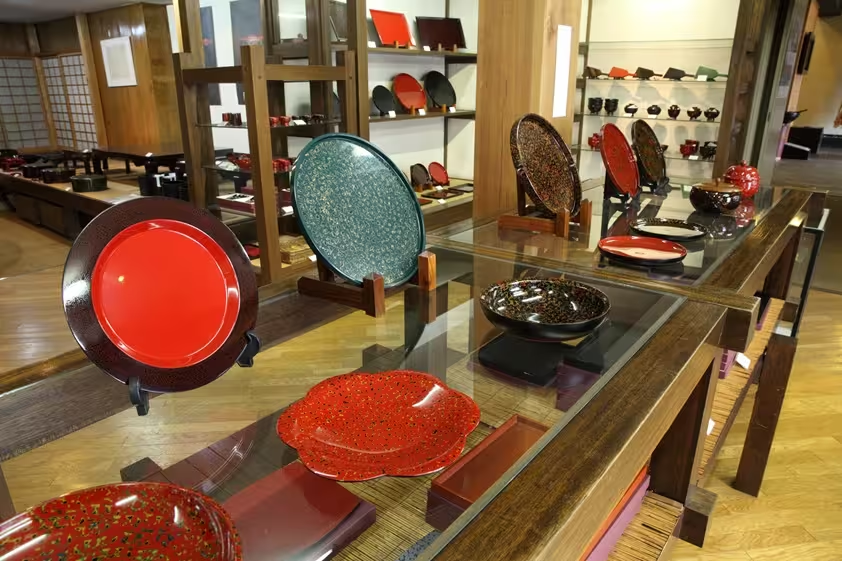
Tsugaru lacquerware — Tsugaru-nuri — is made by applying coat after coat of lacquer to a wooden base, allowing each layer to dry before the next is added. The most complex style, kara-nuri, involves applying lacquer in multiple colours, allowing it to dry, then adding more layers in different colours, then grinding the surface back to reveal a cross-section of everything that was applied — a depth of colour that shifts as the light changes, as if the object is still in the process of becoming. A single piece may take several months. Some take longer.
There is no way to accelerate this. Lacquer dries according to its own conditions — humidity, temperature, time. The craftsperson cannot negotiate with it. What this kind of work requires, and what the winters of Aomori produced in abundance, is the capacity to apply effort and then wait. To do the next step not when you want to but when the material is ready. This is a specific kind of patience, different from passive waiting. It is active attention to something that is changing on its own schedule.
Kogin-zashi
The stitch born from necessity
Kogin-zashi, a regional form of sashiko, is a running-stitch embroidery developed in the Tsugaru region during the Edo period. At that time, feudal regulations prohibited peasants from wearing cotton. The winters were too cold to survive in linen alone. So farm women began stitching white cotton thread into their linen work garments — kogin — in dense, counted patterns. The stitching reinforced the loose weave, trapped air between the layers, and provided insulation. It also, eventually, became beautiful.
This sequence matters. The beauty was not the intention. The intention was to stay warm inside a set of restrictions that offered no comfortable solution. The women counted warp threads and placed stitches, one beside the other, across the width of the cloth, developing geometric patterns — cat's eyes, stone steps, fish scales — that reflected the shapes of the natural world around them. The long months of snow, when outdoor work was impossible, gave them time to refine what had begun as a practical response to cold and regulation. By the time the restrictions eased, the craft had developed its own internal logic, its own standards, its own vocabulary of form. Necessity had become language.

Mccunicano, CC BY-SA 4.0 , via Wikimedia Commons
Cider
The fruit that could not be wasted
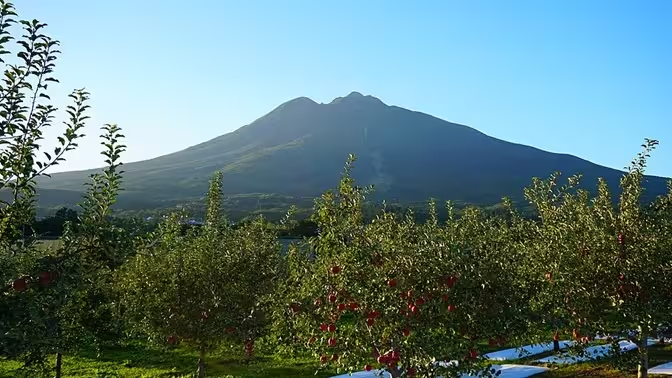
Aomori produces more apples than any other prefecture in Japan — roughly sixty percent of the national harvest. The cold winters, the mineral soil, the sharp temperature difference between day and night in autumn: the same conditions that make the land difficult to farm produce fruit with a density of sweetness and texture that milder climates cannot replicate. Cider has been made in Hirosaki since the late nineteenth century, and Japan's first commercially produced cider was released from a Hirosaki factory in 1956. The tradition is long.
What a fourth-generation Hirosaki farmer named Moriyama did in 2017 was find a new use within it. In the production of premium apples, farmers practice tekika — the deliberate thinning of fruit while it is still small, removing the majority of young apples so that the remaining ones receive more light, more nutrition, more space to develop. The discarded fruit was, for most of Aomori's agricultural history, simply waste.
Moriyama began making cider from these thinned-out apples — fruit that would otherwise have no value — after five years of development. The cider is drier than conventional apple cider, lighter, with an acidity that reflects the immaturity of the fruit. It tastes like the beginning of an apple rather than its end. Nothing was wasted because, in a climate this demanding, waste was not something the land could afford.
掬茶, CC BY-SA 4.0 , via Wikimedia Commons
Fermentation
Preservation as inheritance
The winters required food that would last. Before refrigeration, before supply chains that stretched across seasons, the months between November and April had to be met with what had been put away in October. Aomori's fermentation culture — pickled vegetables, miso, the dense soy-paste-based soup stock that anchors much of the region's winter cooking — grew from this necessity. The flavours that resulted were not designed for flavour. They were designed for survival, and the depth they achieved was a consequence of the conditions under which they were made: cold cellars, long slow fermentation, the particular microorganisms of a specific place.
People in Aomori did not develop a fermentation culture because they were interested in fermentation. They developed it because five months of winter had to be survived, and survived well enough to begin the work again in spring. The taste is the residue of that necessity. When you eat it now, you are eating a solution to a problem that the season posed, refined over generations until the solution became the point.
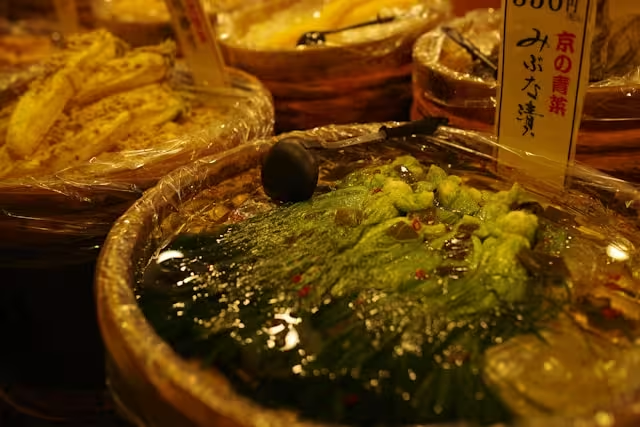
Photo by Rich Soul on Unsplash
Aomori makes visible what other parts of Japan have quietly absorbed.
Much of what the world recognises as Japanese culture — the patience in craft, the precision in food, the willingness to sit with grief rather than escape it — did not emerge from comfort. It emerged from pressure. From seasons that demanded a response. From the understanding, learned over generations, that the conditions of a place are not problems to be solved but materials to be worked with.
The logic did not begin or end in Aomori. Constraint, held long enough, becomes form.
The extremes do not disappear. They leave traces. You can hold those traces in your hands.
Questions About Aomori
When is the best time to visit Aomori?
The answer depends on what you are looking for. The Nebuta Festival runs from August 2nd to 7th in Aomori city, with Hirosaki's Neputa Festival running simultaneously from August 1st to 7th. This is the single most concentrated period for cultural experience. Spring — late April to early May — brings the cherry blossoms to Hirosaki Castle, one of the most spectacular displays in Japan. Winter, from December through February, is demanding but reveals the conditions that shaped everything else: the deep snow of Tsugaru, the silence, the particular quality of light through a grey sky. Each season makes a different argument for the place.
What is the difference between Nebuta and Neputa?
Both festivals take place in Aomori Prefecture in early August, but they are distinct traditions. Aomori city's Nebuta uses human-shaped floats — warriors, gods, figures from history and legend — and the energy is forward-driving, aggressive, the chant rassera pushing outward. Hirosaki's Neputa uses fan-shaped floats with two painted faces: the front face, kagamie, depicts a warrior charging forward; the back face, miokuri, depicts a woman looking backward at what is being left behind. The emotional register is different — Hirosaki's festival carries an undertone of departure and elegy that Aomori city's version does not. A third variation, the Goshogawara Tachineputa, uses floats twenty-three metres tall — the scale of a seven-storey building — that were lost for eighty years before being revived in 1993.
Can visitors participate in Nebuta as haneto dancers?
Yes. The haneto costume — a specific yukata, a woven straw hat, and cloth sandals — can be rented from multiple locations near the festival grounds. Once dressed, you introduce yourself to one of the nebuta groups before the parade begins and join the procession. There is no audition, no prior skill required, no separation between experienced participants and first-timers. The dance itself — a repeated jumping movement, heels lifting, arms swinging outward — can be learned by watching for a few minutes. Rental and dressing services are available from late July through the festival period; the Nebuta Museum Wa Rasse and several hotels near Aomori Station offer these services.
What is the Sannai Maruyama site and is it worth visiting?
Sannai Maruyama is a Jōmon period settlement on the outskirts of Aomori city, occupied continuously from approximately 5,500 years ago to 4,000 years ago. It is one of the largest and longest-occupied Jōmon sites ever excavated in Japan. The site reveals that the people of this region were not nomadic foragers but settled community builders — they constructed large wooden buildings, maintained chestnut orchards, and developed trade networks that reached across Honshu. The adjacent museum holds thousands of recovered objects, including the woven baskets that are direct ancestors of the basketwork still practiced in the region today. It is not a dramatic site in the way of a castle or a temple. It is better understood as evidence — of how long this land has been shaped by the people living in it, and how long those people have been finding solutions to the same seasonal pressures.
What food is Aomori known for?
Aomori's food culture is shaped by the same logic as everything else in the prefecture: what the land and sea provide, and what winter demands. Apples are unavoidable — Aomori produces roughly sixty percent of Japan's crop — and they appear in forms beyond fresh fruit: apple juice, apple cider, apple vinegar, apple-based confectionery. Seafood from the cold northern waters — scallops from Mutsu Bay, sea urchin from the Shimokita Peninsula, and Oma tuna, caught by hand-line and considered among the finest in Japan — is central to the coastal diet. Inland, the traditions are of preservation: pickled vegetables, miso-based soups, and senbei-jiru, a soup made with broken rice crackers that is specific to the Hachinohe region and reflects the same instinct toward using everything, wasting nothing, that characterises the region's approach to its materials.


This article contains affiliate links. If you book or purchase through these links, Untranslated Japan may earn a small commission at no additional cost to you. We include only products and services we have researched and consider genuinely useful to readers.