
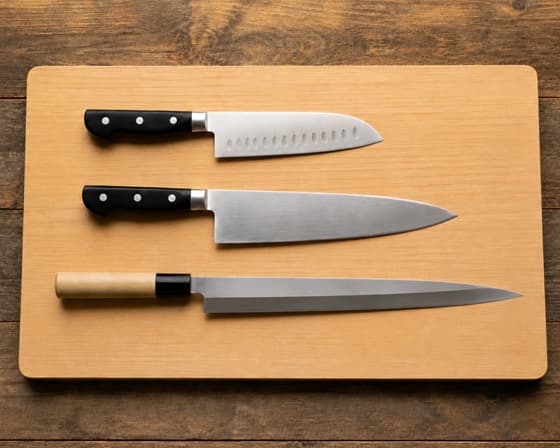
Every knife here was chosen for one reason: it does what it is supposed to do, and it does it with the discipline that Sakai's blade-making tradition demands.
These recommendations cover three essential knife types — the Santoku, the Yanagiba, and the Gyuto. Within each type, we have identified three options at different price points: entry level, standard, and high end.
The selection is not a ranking of cutting performance alone. We balanced sharpness against steel character, edge retention against maintenance demands, and craftsmanship against everyday usefulness. The goal is to help you find a knife that fits your kitchen as well as it fits your hand.
All knives are available through Hocho Knife, a specialist retailer with a deep inventory of Sakai-made blades. If you want to understand the background — the history of Sakai, the logic of steel types, what each blade geometry is designed for — the full guide covers that in detail.
Santoku
The most practical first Japanese knife for a home kitchen.
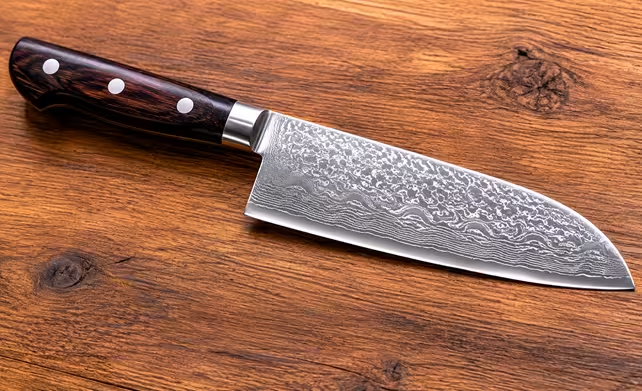
The Santoku is compact, versatile, and forgiving of different cutting styles. Its name is commonly understood as referring to three uses — meat, fish, and vegetables — and in daily cooking it earns that description. It does not require the technique of a specialist knife. It belongs naturally in the rhythm of an ordinary meal.
The design has a specific origin. During Japan's postwar economic growth, many households moved into smaller apartment blocks with narrower kitchens. Keeping a separate knife for each task was no longer practical. The Santoku was the answer — bringing together the broad flat edge of the nakiri for leafy vegetables and the pointed tip of the gyuto, which handles meat and fish more cleanly, consolidated into a single shape. Today it is one of the few Japanese knife names recognised worldwide without translation.
Its blade length — typically 160mm to 180mm — is also worth understanding before you buy. For slicing large cuts of meat in a single clean motion, or drawing through a whole fish fillet for sashimi, the Santoku is shorter than ideal. Those tasks are better suited to a Gyuto or Yanagiba. What the Santoku does exceptionally well is the daily work of a home kitchen: breaking down vegetables, portioning fish fillets, trimming boneless meat. For peeling fruit, the broad blade can feel slightly unwieldy — a paring knife handles that more naturally. Within its range, though, very little stops it.
- Everyday home cooking
- Vegetables, fish, boneless meat
- Cooks new to Japanese knives
- Those who want one versatile blade
- Cutting through bones
- Breaking down whole fish
- Heavy butchery
- Those who prefer a large, heavy chef's knife
Sakai Takayuki 33-Layer Damascus Santoku — 180mm
A VG-10 stainless steel core offers reliable sharpness and rust resistance — a sensible combination for someone building their first relationship with a Japanese edge. The 33-layer hammered tsuchime finish reduces food sticking to the blade. It is made in Sakai, maintained without specialist knowledge, and sharp enough to change how you approach a vegetable.
View at Hocho Knife →Sakai Takayuki Aogami Super Kurouchi Santoku — 160mm
Aogami Super — Blue Super Steel — holds its edge significantly longer than most other materials at this price point. The kurouchi finish, left dark from the forge, offers a degree of surface protection and a directness of appearance that suits the steel beneath it. At 160mm it is more compact than most Santoku knives — easier to manoeuvre in a smaller kitchen, and well-suited to those who prefer a lighter blade. This is a knife for someone ready to commit to a carbon steel maintenance routine: hand wash, dry immediately, and the edge rewards you.
View at Hocho Knife →Sakai Takayuki 33-Layer Damascus Gingami No.3 Santoku — 180mm
Gingami No.3 is a silver paper steel that achieves the sharpness associated with high-carbon blades while remaining fully stainless. It is rare in this application — most knives at this price point use carbon steel to achieve comparable edge quality. For those who want the precision of a high-end edge without the maintenance demands of carbon steel, this is the honest choice.
View at Hocho Knife →Gyuto
A Japanese interpretation of the chef's knife — lighter, thinner, more precise.
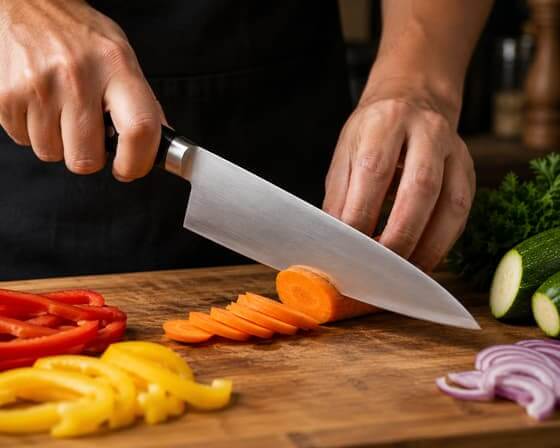
The Gyuto covers a similar range of tasks to a Western chef's knife — meat, fish, vegetables, longer slicing motions — but it typically carries a thinner blade and a more refined edge geometry. For cooks already comfortable in the kitchen, it often becomes the blade they reach for most. Its appeal is in the balance: versatile enough for daily use, refined enough to feel like a deliberate choice.
One difference from the Santoku is worth understanding before you choose between them. The Gyuto's blade curves upward toward the tip. This shape was designed for a pulling cut — drawing the blade toward the body in a single motion, common in Western professional kitchens — rather than the straight downward push used with most Japanese knives. Cooks who learned on a Santoku or nakiri may find this curve unfamiliar at first. The adjustment is not difficult, but it is real. Using the part of the blade closest to the handle, where the edge runs flatter, eases the transition.
The narrower blade width is one of the Gyuto's practical advantages. Less surface area means less resistance through food — useful when slicing thin cuts of meat, breaking down a fish fillet, or peeling fruit and vegetables where a broader blade creates thumb strain. The length matters too. For home use, 210mm covers most tasks comfortably. Those with smaller hands, or cooking in a compact kitchen, often find 180mm more manageable. Professional cooks tend to work with 240mm and above, where the longer blade earns its place in a full service environment.
- Confident home cooks and professionals
- Meat, fish, and vegetables
- Longer slicing motions
- Those familiar with chef's knives seeking a refinement
- Cutting through bones or frozen food
- Those who prefer a short, compact knife
- Users who want minimal maintenance
Sakai Takayuki 33-Layer Damascus Gyuto — 210mm
The 210mm length covers the full range of daily kitchen tasks without feeling unwieldy. The VG-10 stainless core gives reliable sharpness without the attention carbon steel demands, and the hammered tsuchime finish reduces drag through food. For someone upgrading from a mass-market chef's knife, this is where the difference becomes apparent — not in any single cut, but in what the kitchen feels like after a month of use.
View at Hocho Knife →Sakai Takayuki SPG2 Damascus Kengata Gyuto — 190mm
SPG2 — Super Gold 2 — is a powder stainless steel engineered for edge retention at a level not usually achievable in stainless construction. The kengata tip, angled like a sword point, allows for precise detail work that a standard rounded tip cannot. At 190mm it sits between the compactness of a Santoku and the length of a full chef's knife — a deliberate choice for those who want the Gyuto's refined edge geometry with a blade that is easier to control in a home kitchen, or for those with smaller hands. A knife for those who want the benefits of high-performance steel without accepting the rust risk of carbon.
View at Hocho Knife →Satoshi Nakagawa Aogami No.2 Kurouchi Gyuto — 240mm
Satoshi Nakagawa trained for sixteen years under Kenichi Shiraki, one of Sakai's most respected master smiths. This 240mm Gyuto is produced using water quenching — a technique that requires precise timing and carries a real risk of blade fracture, but results in exceptional hardness in the finished steel. The Blue Steel No.2 edge, the kurouchi surface, and the urushi-lacquered handle are all the work of someone who has spent their working life inside this discipline. For the serious cook who wants to own that.
View at Hocho Knife →These recommendations balance cutting performance with steel character, maintenance demands, craftsmanship, and everyday usefulness. They are not a strict ranking. The right knife is the one that fits how you actually cook.
Yanagiba
For sashimi, precision, and the discipline of a single cut.
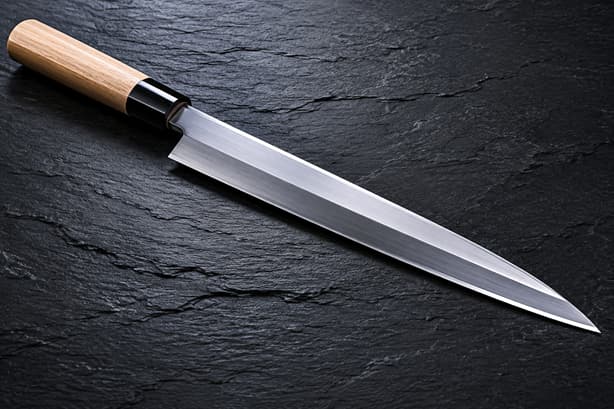
The Yanagiba — also known in Japan as the sashimi knife — is used primarily for slicing raw fish. Its long, narrow blade passes through the ingredient without sawing, without a second pass. The surface of a well-cut piece of sashimi is clean and undisturbed. The edges hold. The flesh is not compressed.
The name comes from the blade's shape: long, straight, and tapering toward the tip like the leaf of a willow tree — yanagi in Japanese. That shape is not decorative. It determines how the knife moves. The cutting motion is a single draw toward the body, the blade held at a shallow angle, the weight of the knife doing most of the work. A well-executed pull through a piece of fish requires almost no force. The cut arrives before the cook has thought about it.
One practical point worth knowing before you buy: the Yanagiba is designed for slicing fish that has already been filleted, not for breaking it down. That earlier work — removing the head, cutting along the spine, separating the flesh from the bone — belongs to the deba, a thick, single-bevel knife built for heavier contact. If you intend to prepare whole fish from start to finish, you will need both. The Yanagiba enters only when the hard work is done, and the fish is ready to become food.
Sashimi knives come in three tip shapes — the standard pointed tip, the rounded sakimaru, and the angular kiritsuke. The functional difference between them is small. Most experienced users choose based on personal preference, or on the shape their teacher used. For a first Yanagiba, the standard pointed tip is the most widely available and the most straightforward to learn on. The sakimaru tip — seen on the Genbu recommended below — is a traditional shape associated with Japanese sword geometry, chosen as much for its character as for its cutting behaviour.
Many traditional Yanagiba knives are single-bevel and made for right-handed use. Always confirm the orientation before purchasing.
- Sashimi and sushi preparation
- Clean slicing of fish fillets
- Presentation-focused cooking
- Experienced users interested in specialist technique
- Vegetables and general daily cooking
- Cutting through bones
- Users who want one knife for every task
- Beginners not yet ready for a specialist blade
Goh Umanosuke Yoshihiro White 2 Steel Yanagiba — 270mm
White Steel No.2 is the high-purity carbon steel used by professionals who want surgical sharpness and a clean, immediate response at the cutting edge. This Jousaku-series knife offers that steel in an accessible form — the weight, balance, and cutting feel of a Sakai-made Yanagiba, without the price of a master smith's commission. As with all carbon steel blades, it must be washed and dried immediately after use, and kept away from moisture between sessions. For a first Yanagiba, this is the honest starting point.
View at Hocho Knife →Goh Umanosuke Yoshihiro Aogasumi Blue 2 Steel Yanagiba — 270mm
Blue Steel No.2 holds its edge longer than White Steel under repeated use — the carbon content and heat treatment result in a blade that sustains its sharpness through a full service of sashimi without the same frequency of touch-up. The aogasumi finish — a pale blue haze left from the polishing process — reflects the quality of the smith's heat treatment. Like all carbon steel blades, it requires careful drying after each use and occasional oiling if left unused for any length of time. A knife for those who have moved past the entry point and want an edge that grows with their skill.
View at Hocho Knife →Sakai Takayuki 45-Layer Damascus Urushi Yanagiba 'Genbu' — 300mm
The Genbu combines three separate crafts: a 45-layer Damascus blade in Gingami No.3 stainless steel, a sakimaru tip — the upswept point associated with traditional sword geometry — and an urushi lacquered handle and scabbard. The Gingami No.3 core means the cutting performance is uncompromised despite the stainless construction. This is a knife that will outlast the person who buys it, and knows it.
View at Hocho Knife →Frequently Asked Questions
Which of these three knife types should I buy first?
For most home cooks, the Santoku. It is compact, versatile, and does not require specialist technique. It gives a clear introduction to what a refined Japanese edge feels like in daily cooking without asking for the commitment that a specialist knife demands. Once you know what you want from a knife — more length, more precision, a specific task — the Gyuto or Yanagiba becomes a natural next step.
Do I need to buy all three types?
No. Most home cooks cook well with one or two good knives. A Santoku or Gyuto covers the majority of daily tasks. A Yanagiba is worth the investment only if you prepare raw fish regularly or want to develop that specific technique. Start with one knife. Learn what it can and cannot do. Add from there.
What is the difference between the entry level and standard options?
Primarily the steel. Entry-level options use high-quality stainless steel — practical, reliable, easier to maintain. Standard options introduce higher-grade or carbon steel with better edge retention and a more responsive feel at the cutting edge. The jump is not about build quality — all of these knives are made in Sakai to serious standards — it is about what the steel asks of you and what it gives back.
Where can I learn more about Japanese knife types and steel?
The full guide covers the history of Sakai's blade-making tradition, the logic of different steel types, edge geometry, handle styles, and care in detail. It is the background reading for these recommendations.
Fewer things. Chosen with more care. That is what these recommendations are built on.
Some links on this page are affiliate links. If you purchase through them, Untranslated Japan may earn a small commission at no additional cost to you. Our editorial standards remain independent. We only feature products that meet our criteria for craftsmanship, usefulness, transparency, and cultural integrity.