Yufuin Onsen: The Hot Spring Town That Chose a Different Future
A first-timer's guide to the onsen town that feels unlike anywhere else in Japan.
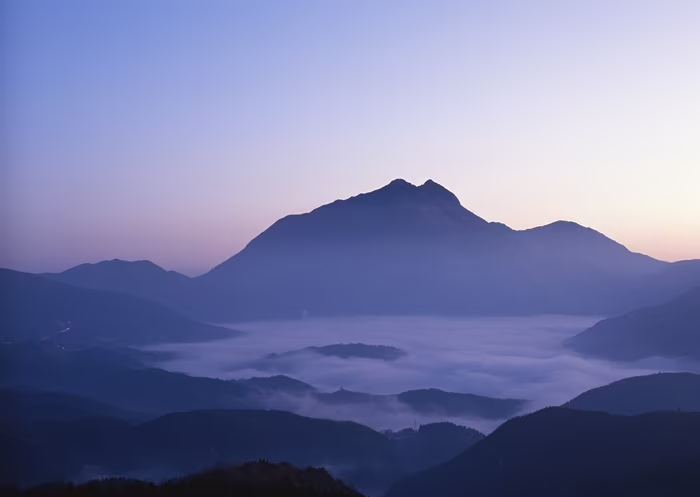
At first glance, Yufuin seems inevitable. A mountain, a basin, hot springs rising from the ground. It feels as though this town could only have become what it is. In fact, almost everything that makes Yufuin different was a choice.
Why Yufuin Feels Different
Yufuin sits inside a bowl.
The Yufuin basin is ringed on all sides by mountains, and Mount Yufu closes the northern end. It is a dormant stratovolcano at 1,584 metres. A closed valley traps mist, holds cold air overnight, and limits how far the town can spread. The mountains stop you.
Hot springs are everywhere here. Nearly 900 sources rise beneath the basin, feeding one of the largest concentrations of thermal water in Japan. The town appears small. The geothermal system beneath it is anything but.
Almost all of it is alkaline simple spring water. Clear, odourless, very gentle on skin. There are none of the sulphur pools or dramatically coloured waters you find twenty minutes down the road in Beppu. Yufuin's springs look like nothing. Their qualities reveal themselves only when you're in them.
Beppu and Yufuin are often mentioned together, as though they are variations on the same place. They are not. Beppu is a city of two hundred thousand people that happens to run on geothermal energy. Steam rises from drains and roadsides across the whole urban grid. The "hells" are pools of boiling mineral water in colours ranging from cobalt to blood-red. They sit next to souvenir stalls in what feels like an amusement park built on top of a volcanic field. It is genuinely strange. It earns your attention through spectacle.
Yufuin earns it differently. Or perhaps it doesn't try to earn it at all.
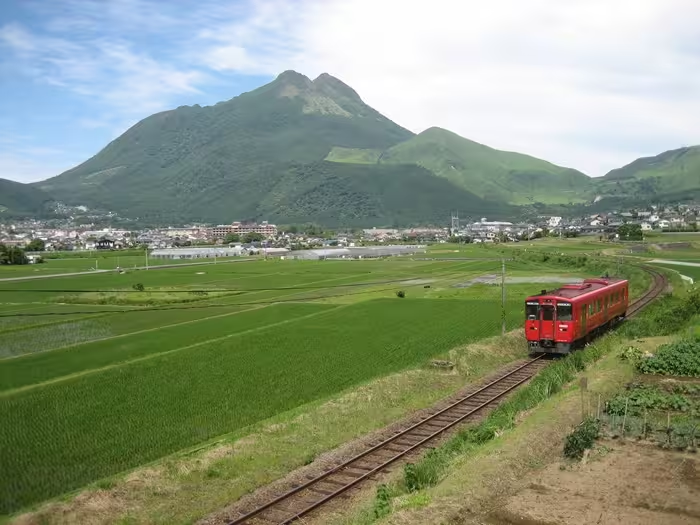
Photo: Yufu City
Walk out of the station. The mountain is directly in front of you. Not glimpsed between buildings, not visible if you turn the right way. Framed at the end of the tracks as though the station were built to face it.
It was.
The alignment was intentional. The railway was never supposed to come this far.
Early plans would have carried the line along the western edge of the basin, bypassing the town centre entirely.
A local merchant named Kinzaburo Ono fought to bring it closer. He persuaded planners to bend the route into a horseshoe curve that carried passengers into the heart of Yufuin and positioned the station so that Mount Yufu stood directly ahead as they arrived.
The curve became known as the Gold Curve. It was a small adjustment on a railway map.
It changed the way people entered the town.
A Town That Almost Became a Lake
In 1952, an engineer filed a proposal to dam the Yufuin basin.
The plan was for a hydroelectric reservoir. The valley's geography made it technically ideal. It was a closed bowl, ringed on all sides, with no natural outlet. The prefectural government reviewed it. The town council was prepared to accept it. What exists today as a place to stay, to walk, to arrive in by train and look up at a mountain from the platform almost didn't exist.
A group of young innkeepers and local businessmen organised opposition and forced the plan's cancellation the following year. They were not simply rejecting a dam. They were insisting that this basin was not empty land waiting to be used, but a place already worth protecting.
This was the first of three moments when Yufuin came close to becoming something else entirely.
The significance of the dam debate was not simply that the project failed.
It was that a generation of young residents had spent years arguing about what kind of place Yufuin should become.
When the dam was abandoned, that conversation did not end.
It became the foundation for almost every major decision that followed.
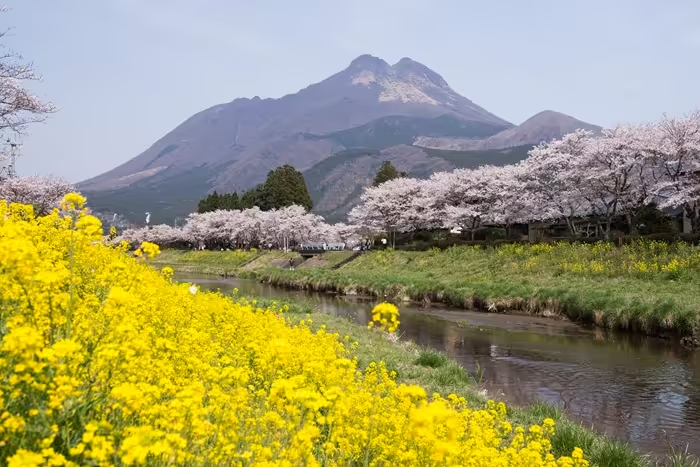
Photo: Oita Prefectural Tourism Association "Tourism Oita"
1971
The journey to Baden-Baden
The dam had been defeated.
The harder question remained.
If Yufuin was not going to become a reservoir, and it was not going to become another Beppu, what was it going to be?
By the 1960s, that question had become urgent. The post-war economy was pulling Japanese tourism toward large hotels, entertainment complexes, and package tours. Beppu, with its spectacle and its scale, was thriving. Yufuin, with its small inns and its quiet, was not.
The conversation that had begun during the dam debate continued. A new generation of residents, innkeepers, and business owners were still trying to define what kind of place Yufuin should become.
One of them was Kametaro Nakatani, who had inherited Kamenoi Bessou, an inn his family had operated since 1921. He read a paper by a forestry professor arguing that Yufuin should look to German mountain spa towns rather than follow the path of mass tourism. He shared it with two colleagues: Kunpei Mizoguchi of Tamanoyu and Koji Shide of Musouen.
In 1971, the three of them funded a fifty-day private trip through Europe.
They ended at Baden-Baden.
What they brought back was not an aesthetic. There were no plans for cobblestone streets or European-style facades. They brought back a word: Kurort. A place designed not for entertainment but for restoration. Visitors come to slow down. The town does not compete for their attention while they do.
The wider economy offered a simple model. Build bigger. Add more. Attract more. Baden-Baden was evidence of another one.
Late 1980s
The ordinance
By the 1980s, the pressure looked different. The question did not.
For three decades, Yufuin had been trying to answer the same thing: what kind of place should this be?
The bubble economy arrived with its own answer. Resort developers proposed large-scale hotel projects for the basin. Some were approved. Across Japan, similar projects were transforming hot spring towns into places that increasingly resembled one another.
Yufuin responded with another decision.
The town passed an ordinance. Land development was restricted to plots of 1,000 square metres or less. Building height was capped at ten metres.
Ten metres is roughly three storeys. Nothing in Yufuin towers. The ryokans are set back behind trees. The mountain remains visible from almost every street. None of it is accidental. A legal document the town wrote about itself made it so.
The ordinance is still in effect. The rice fields remained. The mountain remained visible. For the most part, the basin remained itself.
Or nearly.
The tension has not resolved. It has simply changed form.
What Those Decisions Look Like
Walk out of Yufuin Station and the first thing you notice is what isn't there.
No large signs. No taxi touts. No digital displays cycling through advertisements. The station building itself is wooden and low, designed in the 1990s by architect Arata Isozaki. It has a footbath on the platform. The town beyond it opens quietly, without announcing itself.
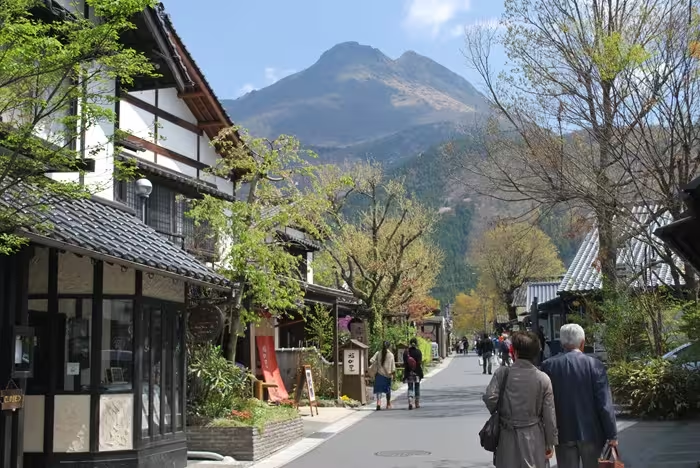
Photo: Yufu City
The buildings along the street rarely exceed two storeys. Behind many of them, you can see trees: the grounds of inns that chose to use their land for gardens rather than rooms. Mount Yufu appears and disappears between rooftops. There are almost no tall structures to break the sightline to the ridge.
You may not notice this consciously. You may simply feel that something is unusually calm here, that your eyes aren't being pulled in competing directions.
The feeling is subtle.
Most visitors never think about railway alignments, height restrictions, or decades of arguments over development.
They simply experience the result.
辻馬車
The Horse Carriage After the Earthquake
The clip-clop of hooves is one of the sounds most closely associated with Yufuin today.
It almost never happened.
In 1975, an earthquake struck the region. The physical damage was limited, but news coverage created a different problem. Reports made it sound as though Yufuin had been devastated. Visitors stopped coming.
The town needed a response.
Some of the people involved in Yufuin's emerging tourism movement had travelled through Europe a few years earlier. Among the things they remembered were the horse-drawn carriages they had seen there. The idea was simple enough to seem improbable: if visitors were no longer coming to Yufuin, perhaps Yufuin could create something they had never seen before.
The horses were purchased locally. The carriages were built locally. The drivers were not professionals. In the early years, some of them were innkeepers and tourism association leaders learning as they went.
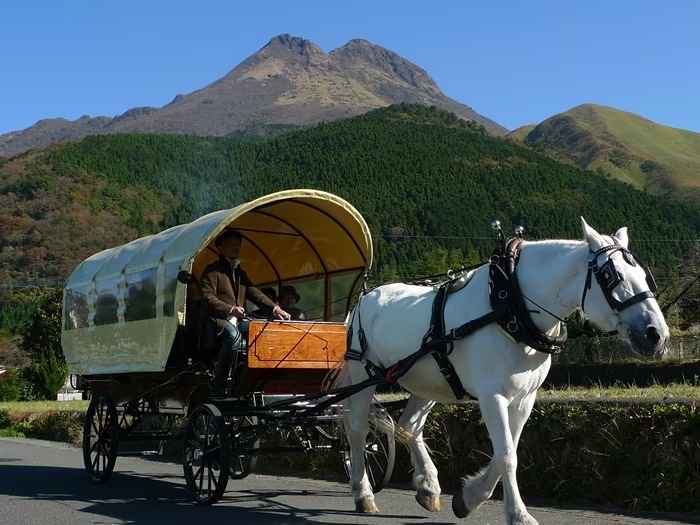
Photo: Oita Prefectural Tourism Association "Tourism Oita"
Not everyone was pleased.
Residents complained about the noise. They complained about horses escaping. They complained about manure in front of their homes.
It took more than a year before the carriage became part of everyday life.
Today, the route passes through rice fields and quiet roads at the edge of the basin. Visitors wave as it passes. Children stop to watch. The sound of hooves carries across the fields.
What began as a response to a crisis became part of the landscape.
Which Yufuin Are You Looking For?
By now, you have probably noticed a pattern. Yufuin rarely solved its problems by building bigger things. More often, it built institutions. The ryokan was one of them. If the streets reveal what Yufuin decided to preserve, the inns reveal what it decided to value.
There are more than ninety inns in Yufuin. The ones below are not necessarily the most well-known. They are simply useful places to understand how different people have answered the question of what a stay in Yufuin should be.
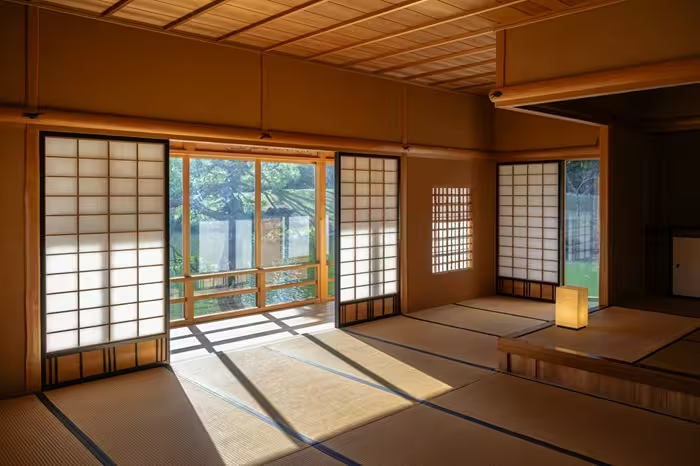
Photo by Viviana Nysaether on Unsplash
草庵秋桜
If this is your first ryokan
Your first ryokan stay rarely feels intimidating because of the bath or the meal. It is the uncertainty that stays with you. When should you bathe? Where do your shoes go? What happens if you misunderstand something?
Soan Kosumosu is the kind of inn that removes that uncertainty without drawing attention to the fact that it is doing so.
Every room combines tatami flooring with Western-style beds. The textures, proportions, and quiet rhythm of a traditional inn are all there, but without asking first-time guests to navigate unfamiliar sleeping arrangements. English-language support is available throughout the stay, and the four private baths can be reserved in advance, removing another small source of hesitation.
The building was renovated in 2017 by Eiji Mitooka, the designer behind the Seven Stars in Kyushu sleeper train. Rather than replacing the original structure, he treated it as something worth continuing. The beams remain. So do the proportions. Walking through the inn feels less like moving between old and new than between two generations of the same place.
Dinner follows the seasons rather than a fixed menu, served privately and without hurry. Afterward, Lake Kinrinko and the Yunotsubo Kaido are still close enough for an evening walk before the town falls quiet.
A first ryokan stay is really a first encounter with a particular kind of Japanese hospitality: attentive, structured, and unhurried. Soan Kosumosu lets you discover that rhythm naturally. By the time you leave, much of what seemed unfamiliar on arrival no longer does.
Soan Kosumosu, Yufuin
Close to Yunotsubo Kaido and Lake Kinrinko. All rooms with tatami and bed. Four private baths. English support throughout. Renovated by designer Eiji Mitooka.
Check availability on Rakuten Travel → Also bookable on Trip.com.If you want to walk the town and still come home to quiet
Hinoharu stands directly on the Yunotsubo Kaido. Step outside and you are immediately part of Yufuin: cafés opening for the morning, galleries, small shops, and, by afternoon, the slow movement of visitors making their way towards Lake Kinrinko.
Step back through the gate and the sound changes.
The inn is surrounded by mature trees that screen it from the street. The garden softens the noise until it feels unexpectedly distant. You can spend the day wandering through Yufuin, stopping wherever your attention settles, then return to an evening that feels entirely separate from it.
The hot springs draw from the inn's own source. There are communal open-air baths as well as private family baths that can be reserved. Rooms range from those with their own open-air bath to traditional tatami rooms for guests who prefer the shared facilities. Meals follow the seasons and are served either in your room or in a private dining space.
One of Yufuin's quiet pleasures is that the town never feels very large. Staying here allows you to experience both sides of it: the lively streets during the day, and the quieter rhythm that begins as soon as you return through the gate.
Hinoharu Ryokan, Yufuin
On Yunotsubo Kaido, close to Lake Kinrinko. Natural flowing hot spring, communal open-air baths and private family baths. Rooms with and without private bath. Website in English, German, French and Korean.
Check availability on Rakuten Travel → Also bookable on Trip.com.If you want more than the price suggests
Yadoya sits within walking distance of the Yunotsubo Kaido and Lake Kinrinko, close to the centre of Yufuin without ever feeling part of the crowds. The inn is compact and quietly confident. It does not try to impress through size.
Instead, it lets the water do the talking.
There are four private baths, each with its own character. Three are open-air: Yawaragi no Yu, Naka no Yu, and Goemon no Yu, named after the traditional iron cauldron bath of old Japan. The fourth is an indoor family bath. All draw from the inn's own natural hot spring source.
Rooms range from traditional tatami rooms to Japanese-Western and twin layouts. Breakfast is a Japanese set meal served with views of Mount Yufu. Dinner highlights seasonal produce from Oita Prefecture and seafood from the Bungo Strait, served privately.
In 2021, a national travel platform ranked Yadoya first among Kyushu ryokans for overall guest satisfaction. Many guests return. After a stay here, that feels less like a statistic than an expectation.
Yawaragi no Sato Yadoya, Yufuin
Close to Yunotsubo Kaido and Lake Kinrinko. Four private hot spring baths bookable by the hour. Japanese, Japanese-Western and twin room options.
Check availability on Rakuten Travel → Also bookable on Trip.com.If you want the quieter side of Yufuin
Gettouan sits in the wooded hills above the Yufuin basin, about ten minutes by car from the station. The name means a hermitage lit by moonlight. It is an appropriate beginning. From the moment you arrive, the town starts to feel more distant than the map suggests.
A suspension bridge leads from the main house to the cottages, crossing a narrow stream that you continue to hear throughout your stay. The eighteen detached cottages each have their own private open-air bath. At the heart of the property stands a 300-year-old farmhouse, carefully relocated and rebuilt here, while the communal baths look across to Mount Yufu beyond the trees. In early summer, fireflies gather along the stream after dusk.
Meals follow the seasons of Oita Prefecture, bringing together produce from the mountains and seafood from the coast. There is little reason to think about the town while you are here. Its cafés, shops, and streets remain only ten minutes away, yet they begin to feel part of another day.
Yufuin has always balanced two identities: a town to explore and a landscape to retreat into. Gettouan belongs firmly to the second. It is a place where the destination is not the town itself, but the quiet beyond it.
Gettouan, Yufuin
Ten minutes from Yufuin Station by car. 18 detached cottages each with private open-air hot spring bath. Relocated 300-year-old farmhouse. Stream, fireflies, Mount Yufu views.
Check availability on Rakuten Travel → Also bookable on Trip.com.If you are travelling as a group
Most accommodation in Yufuin is designed for couples, or perhaps a family of four. Misora Yufuin was designed with a different kind of trip in mind.
The property is a private villa on the quieter side of Yufuin Station, where the streets begin to give way to rice fields and open sky. Opened in 2023, it welcomes one group at a time, with space for up to fifteen guests. There is room to cook together, eat together, and linger long after the meal is finished. A terrace looks towards Mount Yufu, and the private open-air hot spring bath belongs only to the people you came with.
This is not a ryokan, and it does not try to be one. Meals are not provided. There is no fixed schedule to follow. The rhythm of the stay is shaped entirely by your group, whether that means cooking breakfast together, returning late after an evening in town, or sitting outside long after the day has ended.
The one thing it shares with Yufuin's traditional inns is the water. The bath is fed by a natural hot spring and looks towards Mount Yufu. After a day spent walking the town, visiting Lake Kinrinko, or exploring the countryside, returning to that bath together becomes part of the day's rhythm.
Most ryokan are built around quiet, private moments shared between one or two people. Misora offers a different way of experiencing Yufuin. Here, the moments worth remembering are the ones everyone shares.
Misora Yufuin
Private villa for exclusive use, accommodating up to fifteen guests. Fully equipped kitchen, private open-air hot spring bath, terrace with views of Mount Yufu, and parking for three cars.
Check availability on Rakuten Travel → Also bookable on Trip.com.Experiencing Yufuin Beyond the Main Street
人力車Seeing Yufuin at the right speed
Yufuin is a town that rewards walking. A rickshaw does not replace that experience. It changes it.
From the seat, you sit slightly above eye level. Instead of looking ahead to where you are going, you begin to notice the spaces between things: tiled rooflines, old garden walls, narrow lanes that disappear behind hedges, and glimpses of Mount Yufu that are easily missed from the pavement. The pace is slower than a bicycle, but steadier than walking. You spend less time deciding where to go and more time noticing where you are.
Ebisuya's guides do more than pull the rickshaw. They tell the stories that most visitors walk straight past. The route passes Kozenin Buddhist Temple, Unagihime Shrine, Bussanji Temple, and the paths around Lake Kinrin. Mount Yufu accompanies the route throughout. Along the way, the guides stop for photographs, answer questions, and explain details that rarely appear on information boards.
The difference is not simply that you cover more ground. It is that someone who knows the town is choosing what deserves your attention. Streets that might seem ordinary on foot become part of a story.
Courses range from 30 minutes to two hours. Two passengers share each rickshaw, while larger groups travel in multiple rickshaws together. Advance booking is recommended during weekends and peak travel seasons.
Yufuin Rickshaw Tour — Ebisuya
Guided jinrikisha tour from Yufuin Station. Route includes Kozenin Buddhist Temple, Unagihime Shrine, Bussanji Temple, and Lake Kinrin, with Mount Yufu throughout. Courses from 30 minutes to 2 hours.
Check availability on Viator →Arriving by the Yufuin no Mori
The journey to Yufuin does not begin when you leave the station. On the Yufuin no Mori, it begins long before you arrive.
Running between Hakata and Yufuin since 1989, the train was one of Japan's earliest sightseeing rail services. Rather than treating the journey as time to be endured, it turns it into part of the destination.
The carriages are built with a raised floor and oversized windows, lifting your view above the surrounding landscape. The route winds through forests, river valleys, and mountain tunnels before opening suddenly into the Yufuin basin. By the time Mount Yufu appears ahead, you have already watched the landscape that shaped the town unfold outside your window.
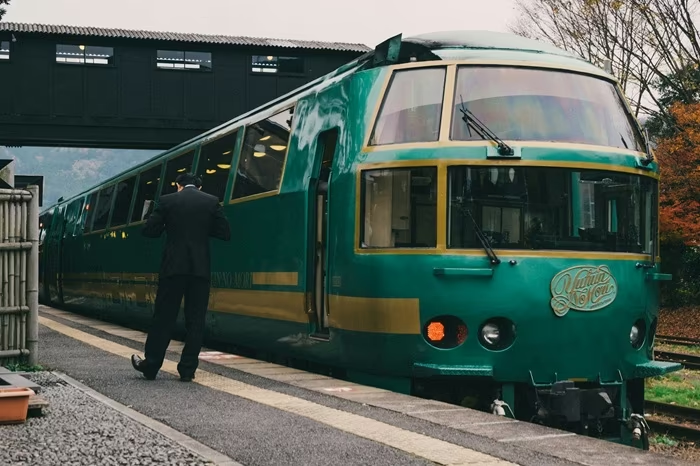
Photo by Tayawee Supan on Unsplash
Wood-panelled interiors, local food and drinks, and products from Kyushu reinforce the feeling that you are already travelling through the region rather than simply towards it. The current trains were designed by Eiji Mitooka, whose work also appears in Yufuin itself at Soan Kosumosu, creating a quiet connection between the journey and the stay.
The Yufuin no Mori is covered by both the JR Kyushu Rail Pass and the Japan Rail Pass. If you plan to continue to destinations such as Beppu or Kumamoto, a regional rail pass is often worthwhile. More importantly, it is one of the few trains where arriving feels as memorable as being there.
JR Rail Pass: Kyushu and All Japan
Covers the Yufuin no Mori from Fukuoka, plus Beppu, Kumamoto, and connections across Kyushu. Purchase before departure.
Compare passes on Klook →Questions
How do I get to Yufuin?
From Fukuoka (Hakata Station): the Yufuin no Mori limited express runs several times daily and takes approximately two hours and ten minutes. The route passes through mountain tunnels and forested valleys before descending into the basin. The wooden-interior train is worth taking for its own sake.
From Oita Airport: a highway bus takes approximately 55 minutes to Yufuin Station bus stop. From Beppu: Kamenoi Bus, approximately one hour. The JR Kyushu Rail Pass covers the Yufuin no Mori from Fukuoka and is worth calculating if you are visiting multiple destinations in Kyushu. All JR passes must be purchased outside Japan before departure.
How many nights should I spend in Yufuin?
Two nights, at minimum. One night is enough to see Yufuin. Two nights is enough to actually be in it.
The Kurort model the founders brought back from Baden-Baden was built around extended stays rather than day visits. A second night costs the same as the first and returns something the first night rarely does: the capacity to stop planning and simply be somewhere. The second morning's walk to the lake, when you already know where you are going, is different from the first.
Is Yufuin or Beppu better?
They are not the same kind of place, so the question does not have a direct answer.
Beppu is a city that built an economy on geological spectacle. The hells are extraordinary. The steam is everywhere. The scale is industrial. Yufuin built an economy on the deliberate absence of all of that. They are twenty minutes apart. One built an economy on spectacle. The other on restraint. Visit both if you can.
Do I need to speak Japanese to stay at a ryokan in Yufuin?
For the four inns described in this article, the language barrier is manageable. KAI Yufuin (Hoshino Resorts) has full English service. Kamenoi Bessou, Tamanoyu, and Sansou Murata have English-speaking staff at varying levels, and all three have experience hosting international guests.
A ryokan stay follows a predictable structure regardless of language: arrival, settling into the room, bathing, an evening meal, sleep, morning bath, breakfast, departure. The sequence is clear enough that most guests navigate it without difficulty. Booking in advance is advisable at all four properties. Confirm any dietary requirements in writing when you do.
What is the etiquette at a Japanese onsen?
Wash thoroughly at the shower station before entering the bath. Sit on the low stool and use the soap and shampoo provided. Entry to the thermal water is without clothing; swimwear is not worn. Long hair should be tied up before entering. Do not submerge your small towel in the water; rest it folded on the edge of the bath or on your head.
Tattoos are prohibited at most public communal baths in Japan. The private baths at the ryokans listed in this article are an exception. Confirm at booking if this applies to your situation. Conversation in the bath, where it occurs, is kept quiet. The water temperature in most onsen runs between 40 and 43 degrees Celsius; enter slowly.
The mountain shaped the basin. The people shaped the town.
The morning mist will lift. The mountain will remain.
Everything else depends on what the next generation decides to preserve.
This article contains affiliate links to accommodation and experience booking platforms. If you book through these links, Untranslated Japan may earn a small commission at no additional cost to you. All properties and experiences are selected editorially; this article was not sponsored.