
The Japanese word hara is widely recognised around the world. It literally means the belly or abdomen, but in Japanese it carries meanings that go far beyond the physical body, touching emotion, intention, composure, honesty, and the sense of a person’s inner self.
Why has the belly come to hold so much meaning in Japanese language and everyday life?
This article explores what hara means in Japanese, how attention to the body’s centre appears in movement, posture, eating, and everyday habits, and what modern science adds to our understanding of the connection between the gut and the brain.
The Language of the Gut
Long before scientists studied gut health or mapped the connection between the gut and the brain, the Japanese language had already placed something important in the belly: not just the stomach, but the self. A person's true intentions. Their courage, their honesty, their character.
In Japanese, hara (腹) means stomach. When someone speaks from their hara, they are not being sentimental. They are being truthful: showing what they actually think, stripped of what they wish you to believe.
You find it in everyday speech, in phrases people use without thinking.
Hara ga tatsu — the belly rises. Anger.
Hara wo waru — to split the belly open. To speak honestly.
Hara ga kuroi — a black belly. A person with dark intentions.
Hara ga suwaru — the belly settles. Composure under pressure.
Futoppara — a fat belly. Generosity of spirit.
These are not poetic metaphors. They are the working vocabulary of daily life. A Japanese speaker uses them the way an English speaker uses "heartfelt" or "cold-blooded", automatically, without pausing to consider the organ they have just invoked.
What English Puts in the Heart, Japanese Puts in the Belly
English often uses the heart to give physical form to emotion and character. A person may be big-hearted or cold-hearted. They can speak heart to heart, or mean something from the bottom of their heart.
This offers a useful way to understand hara. An English speaker rarely pictures an organ when saying “heartfelt,” and a Japanese speaker does not necessarily picture the belly when using an expression with hara. The body part is different, but in both languages it gives form to feelings and intentions that cannot be seen.
How “Opening the Belly” Became an Expression of Trust
Among the many expressions involving hara, one of the most revealing is hara o waru (腹を割る), literally “to split open the belly.” It means to speak frankly and reveal what one truly thinks. While English speakers may talk “heart to heart,” Japanese speakers open the belly. The expression turns honesty into something physical: opening what would normally remain hidden inside.
This idea appears in a well-known story about the preparation of unagi (freshwater eel). In Tokyo and the wider Kanto region, eel is traditionally split along the back. In Osaka and the Kansai region, it is split along the belly.
According to one commonly repeated explanation, this difference reflects the histories of the two regions. Kanto was closely associated with samurai culture, where cutting open the belly could evoke seppuku. The story suggests that opening an eel along the back avoided this uncomfortable association. Osaka, by contrast, developed as a city of merchants. There, the story connects opening the belly with hara o waru, and with the frankness and trust needed to do business together.
This explanation is better understood as a cultural story than as a firmly established account of how the two preparation methods developed. Even so, the way it has been told is revealing. A difference in preparing eel came to be explained through the meanings attached to the hara: honour and resolve on one side, openness and trust on the other.
Hara as the Body’s Centre
In Japanese practice, the body's centre has a name: tanden (丹田). It sits approximately three finger-widths below the navel, midway between the front of the body and the spine. It appears across many traditional Japanese martial arts and also plays an important role in Zen practice. The same emphasis on a stable physical centre can also be seen in the controlled posture and movements of tea practice.
The concept originates in Taoist thought, where tanden refers to the body's centres of vital energy. In Japan, as Zen Buddhism and seated practice took root from the thirteenth century onward, the lower tanden, located just below the navel, became the primary focus. From there, the idea became influential in martial arts, performing arts, and other forms of physical practice in Japan. In these practices, moving from the tanden is less about adding a special technique than about reducing unnecessary tension and keeping the body centred.
What makes tanden unusual is that it does not correspond to a single anatomical structure. There is no organ named tanden. And yet the region it describes is far from empty. At its centre sits the small intestine. Nearby is the iliopsoas, a deep muscle group that connects the upper and lower body and plays an important role in posture and movement. The instruction to “drop your awareness into the tanden” is often associated with deeper breathing, a steadier posture, and a greater sense of calm.
Modern research has also shown that the abdominal region is highly active neurologically. That does not mean tanden maps neatly onto modern anatomy, but it does make the long-standing attention to this part of the body interesting in a new way.
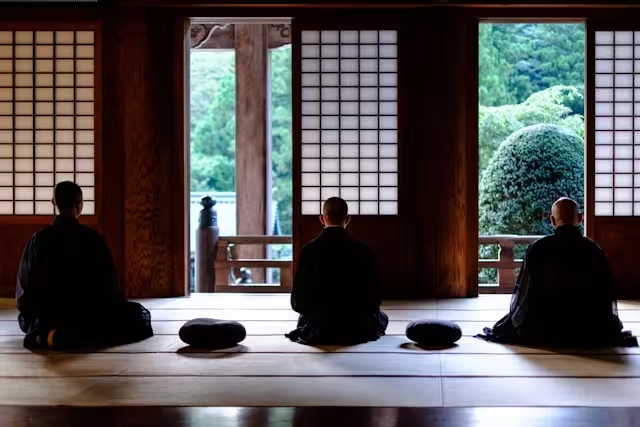
Photo by hidefumi ohmichi on Unsplash
Everyday Gut Health, Japanese Style
Attention to the hara also appears in the way people eat.
Restraint
Hara Hachi Bu — Stopping Before Full
Hara hachi bu — eat until you are eighty percent full — is often presented in the West as a longevity technique, a dietary protocol, something to practise. In Okinawa, where the phrase is most strongly associated, it is better understood as an everyday reminder to stop eating before feeling completely full, rather than as a formal health practice.
Because feelings of fullness do not always register immediately, hara hachi bu encourages you to stop before you feel completely full.
Rather than focusing on finishing what is on the plate, hara hachi bu asks you to pay attention to how your body feels as you eat.
SayuSayu: Warming the Centre
This inward attention also appears in ordinary routines.
Sayu — plain water, boiled and cooled slightly — is something people in Japan choose to drink as part of their daily routine, particularly those who are more conscious of health, beauty, or keeping the body warm. It may be drunk after waking, before meals, or before bed.
If you ask why, the answer may be simple: it feels warming or gentle on the stomach. That physical sensation matters here. Drinking sayu can become a small moment of turning attention inward, toward the hara and how the body feels.
To make sayu, water is simply brought to a boil and then allowed to cool to a comfortable drinking temperature. Some people use an ordinary kettle, while others prefer a traditional iron kettle. When water is boiled in a Japanese cast-iron tetsubin, a small amount of iron can dissolve into the water. Nanbu Tekki — Japanese cast iron has long been used for this kind of everyday boiling.

Photo by Jilly Noble from Pexels
AttentionChewing as Attention, Not Technique
In Japanese schools, including mine, children are often taught to chew their food thoroughly. Some school nutrition programmes even use the simple guideline of chewing each bite around 30 times.
Chewing begins the digestive process before food reaches the stomach. It breaks food into smaller pieces and mixes it with saliva, making it easier for the digestive system to process the meal. Chewing thoroughly can therefore reduce some of the work required later in digestion and make eating feel gentler on the hara.
Eating more slowly also gives the body more time to register fullness. As the meal continues, it becomes easier to notice when the hara is beginning to feel satisfied, rather than continuing to eat without noticing those signals.
In that sense, chewing is another small way of learning to listen to the body. The point is not simply to follow a rule about how many times to chew, but to notice how the body feels and respond to it.
What Modern Science Adds
Modern science gives us a biological framework for understanding something people have long experienced directly: the gut and the brain are in constant communication.
What the Gut-Brain Axis Actually Describes
In the 1990s, Columbia University researcher Michael Gershon helped popularise the idea of the enteric nervous system as a “second brain” in the gut. This network of hundreds of millions of nerve cells lines the gastrointestinal tract and communicates continuously with the brain, including through the vagus nerve.
The term gut-brain axis refers to this two-way communication between the digestive system and the brain. Signals travel in both directions through neural, hormonal, and immune pathways, helping to coordinate digestion, stress responses, appetite, and other bodily functions.
Around 90 percent of the body’s serotonin is produced in the gut. It does not travel directly to the brain, but serotonin signalling in the gut can influence the brain through pathways including the vagus nerve. This is one reason the relationship between digestion, stress, and emotion is more closely connected than it may first appear.
Where Science and Hara Overlap, and Where They Don’t
This is where modern science becomes interesting in the context of hara. Japanese expressions involving the belly come from language, culture, and lived experience, not from anatomy or neuroscience. They were never descriptions of the enteric nervous system.
At the same time, they reflect something people can recognise in their own bodies: emotion, tension, appetite, discomfort, calm, and instinct can all be felt physically in the abdomen.
The overlap is therefore not that Japanese culture discovered the gut-brain axis before science did. It is that both draw attention, in very different ways, to a basic human experience: what happens in the belly can affect how we feel, and how we feel can affect the belly.
When Health Is the Result, Not the Goal
Modern gut health often gives us things to do: take a probiotic, track symptoms, test the microbiome, or change what we eat. These tools can be useful, especially when there is a specific problem to solve. But they also reflect a particular way of approaching the body, as something we can measure, adjust, and try to improve.
The Japanese practices explored in this article begin somewhere slightly different. Hara hachi bu asks you to notice when the belly has had enough. Chewing slowly gives you time to recognise that feeling while also making digestion easier. Drinking sayu can draw attention to how the stomach feels. None of these requires a device or a number. They begin simply with noticing what is happening inside the body and responding to it.
That is the part of hara I find most interesting. It is a way of paying attention to the body. In language, in posture, and in everyday habits, the belly keeps appearing as a place where people turn their attention inward.
Health can be one result of responding well to those signals, but it does not have to be the reason for noticing them in the first place. I explored a similar pattern in how Japan approaches longevity more broadly. Many of the habits associated with long life are woven into ordinary routines rather than pursued as separate health interventions.
Perhaps that is the useful distinction. Modern science can tell us more and more about what is happening inside the gut. Hara offers something different: a reminder to pay attention to how the body feels from within.
Questions
What does hara mean in Japanese, and why does it appear in so many expressions?
Hara literally means the belly or abdomen. In Japanese, however, the word appears in many expressions about emotion, intention, composure, honesty, and character. This is why phrases such as hara o waru (to speak frankly) or hara ga tatsu (to become angry) use the belly to describe what a person feels or holds inside.
How is hara different from the modern idea of gut health?
Modern gut health usually focuses on the biological functions of the digestive system and how they can be measured, supported, or improved. Hara is different. It is not a medical or scientific concept, but a way the belly appears in Japanese language and everyday practices as something people notice and respond to. The emphasis is less on optimising the gut and more on paying attention to how the body feels from within.
What is hara hachi bu, and how does it relate to listening to the body?
Hara hachi bu means eating until you are about eighty percent full. Rather than treating it as a strict diet rule, it can be understood as a habit of noticing how the body feels while eating and stopping before reaching complete fullness. In the context of hara, the important part is the attention: recognising when the belly is beginning to feel satisfied and responding to that signal.
What is sayu, and why do some people in Japan drink it?
Sayu is plain water that has been boiled and allowed to cool to a comfortable drinking temperature. Many people in Japan, particularly those who are more conscious of health, beauty, or keeping the body warm, drink it as part of their daily routine. It may be taken after waking, before meals, or before bed. In the context of hara, what matters is the physical sensation: the warmth can draw attention inward and make you more aware of how the stomach feels.
What does modern science add to our understanding of hara?
Modern science helps explain some of the physical connections between the gut and the brain through the gut-brain axis, the enteric nervous system, and pathways such as the vagus nerve. This does not mean science has “validated” hara as a traditional concept. Rather, it gives us a biological framework for understanding why sensations in the belly can be closely connected with stress, emotion, appetite, and how we feel more broadly.