
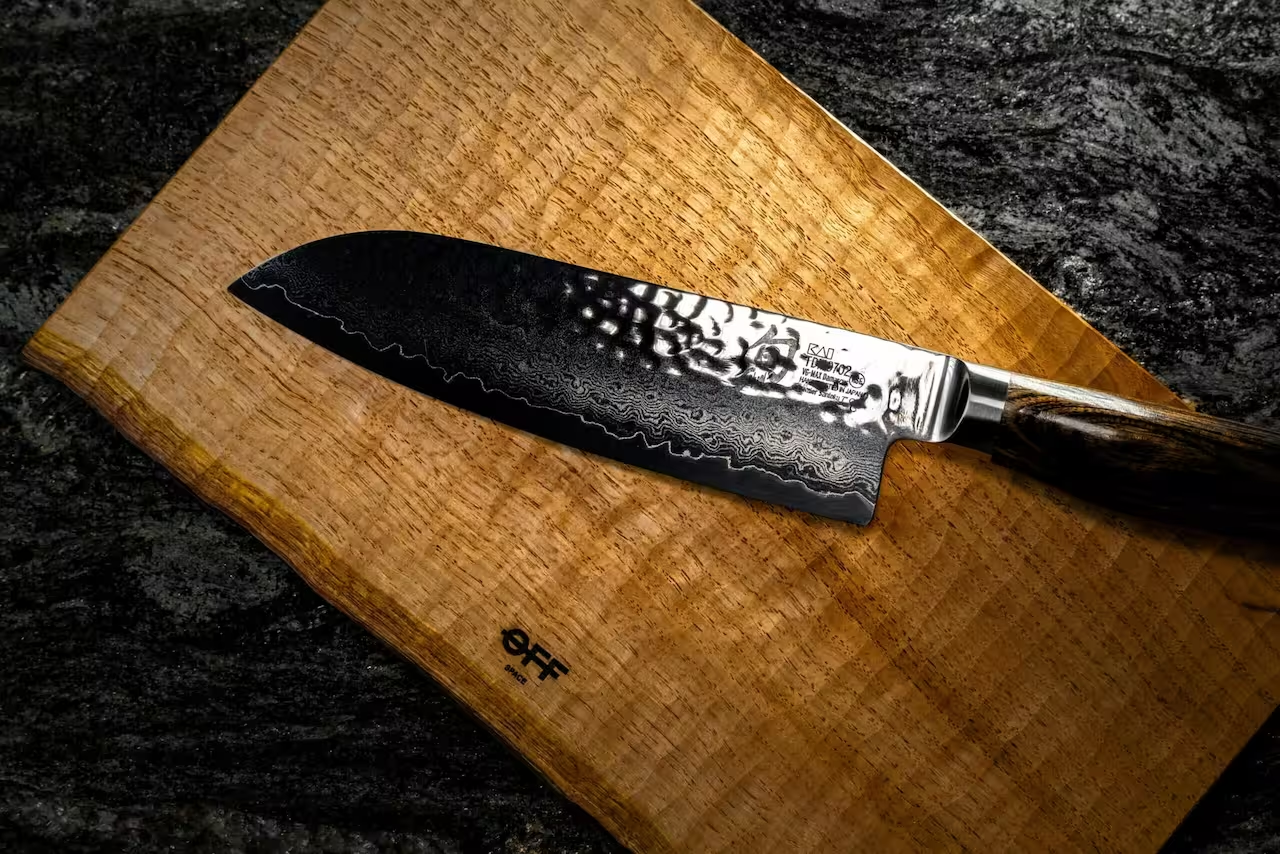
A Japanese kitchen knife is not simply a tool for cutting. It belongs to a long conversation between fire, steel, water, and the hand.
How Japan's Blade-Making Culture Survived
For centuries, the Japanese sword was the most visible expression of the country's blade-making culture. The skills required to produce one — forging, sharpening, polishing, shaping steel to precise tolerances — were carried by a small number of craftspeople who spent entire lifetimes inside that discipline.
In 1876, during the Meiji period, the government issued the Haitorei — an edict restricting the public wearing of swords. It did not eliminate blade-making. It redirected it. The sword gradually withdrew from everyday life. The knowledge behind it did not.
What followed was a gradual dispersal. The skills of the forge moved into tools, agricultural implements, craft objects. And into the kitchen knife.
This does not mean the kitchen knife is a sword in disguise. The history is more layered than that. A kitchen knife has always had its own lineage — separate workshops, separate traditions, separate standards. But what those traditions share with sword-making is a common attitude: that the edge is a serious thing, and that making it well takes a lifetime.
Precision, discipline, respect for material — the belief that a well-made edge can change the way the hand moves.
In the kitchen, that edge serves a different purpose. It is no longer an expression of status or force. It becomes an instrument of attention — a way of approaching an ingredient with care rather than pressure.
Why Cutting Matters in Japanese Cuisine
In Japanese cooking, cutting is not preparation for the meal. It is part of it.
Consider a fillet of white fish. The movement of the knife — whether it pulls cleanly through the flesh or compresses it — affects the texture on the plate, the way the surface catches the light, and the mouthfeel when eaten. A bruised cut releases moisture and changes the flavor. A clean cut preserves the natural integrity of the ingredient.
The same principle applies to vegetables. Run a sharp knife through a daikon radish for thin sheets of katsuramuki — the circular peeling cut used in Japanese cuisine — and the surface stays dry and clean, ready to absorb a dressing without weeping. You taste the difference in the finished dish, even if you cannot name it.
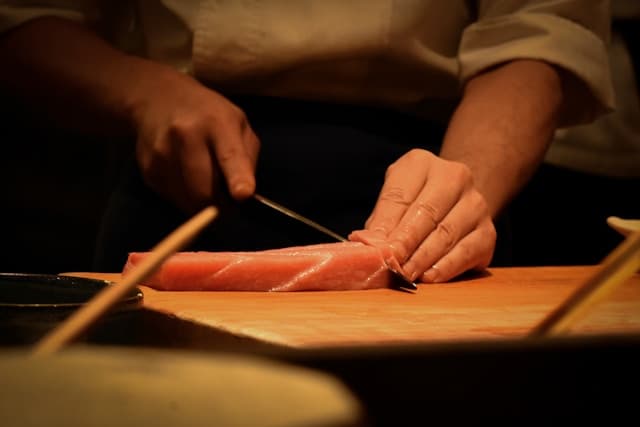
There is an expression in Japanese cuisine: Kasshu Hoju — cutting is primary, cooking follows. The idea is that before heat is applied, before seasoning begins, the cook must first understand the ingredient through the blade. The knife is where that conversation starts.
You notice this the first time you use a properly sharp knife on something delicate — a cucumber sliced paper-thin, a fillet of fish that needs to stay whole. The knife does not feel like it is cutting. It feels like it is following — moving with the grain of the ingredient rather than through it. That is what the expression means in practice.
A good knife does not make cooking louder. It makes the cook more attentive.
Sakai: Where the Knowledge Settled
Before it was a city of knives, Sakai was a city of trade. In the fifteenth and sixteenth centuries, it was known across Asia and into Europe as the Venice of the East — a self-governing port where merchant guilds ran the town, goods moved freely, and ideas arrived from distant places. The tea master Sen no Rikyu was born here. So was the particular openness to new materials and new demands that would eventually produce one of the world's most respected knife-making traditions.
The metalwork came earlier still. In the fifth century, craftspeople gathered in Sakai to build the tomb of Emperor Nintoku — the largest burial mound in the world by area. They brought forging knowledge with them, and they stayed. Across the following centuries, that knowledge moved through different forms: agricultural tools, weapons, firearms when Portuguese traders arrived in the sixteenth century. When tobacco culture followed shortly after, and the leaves required a blade precise enough to cut them finely without bruising them, Sakai's smiths were ready.
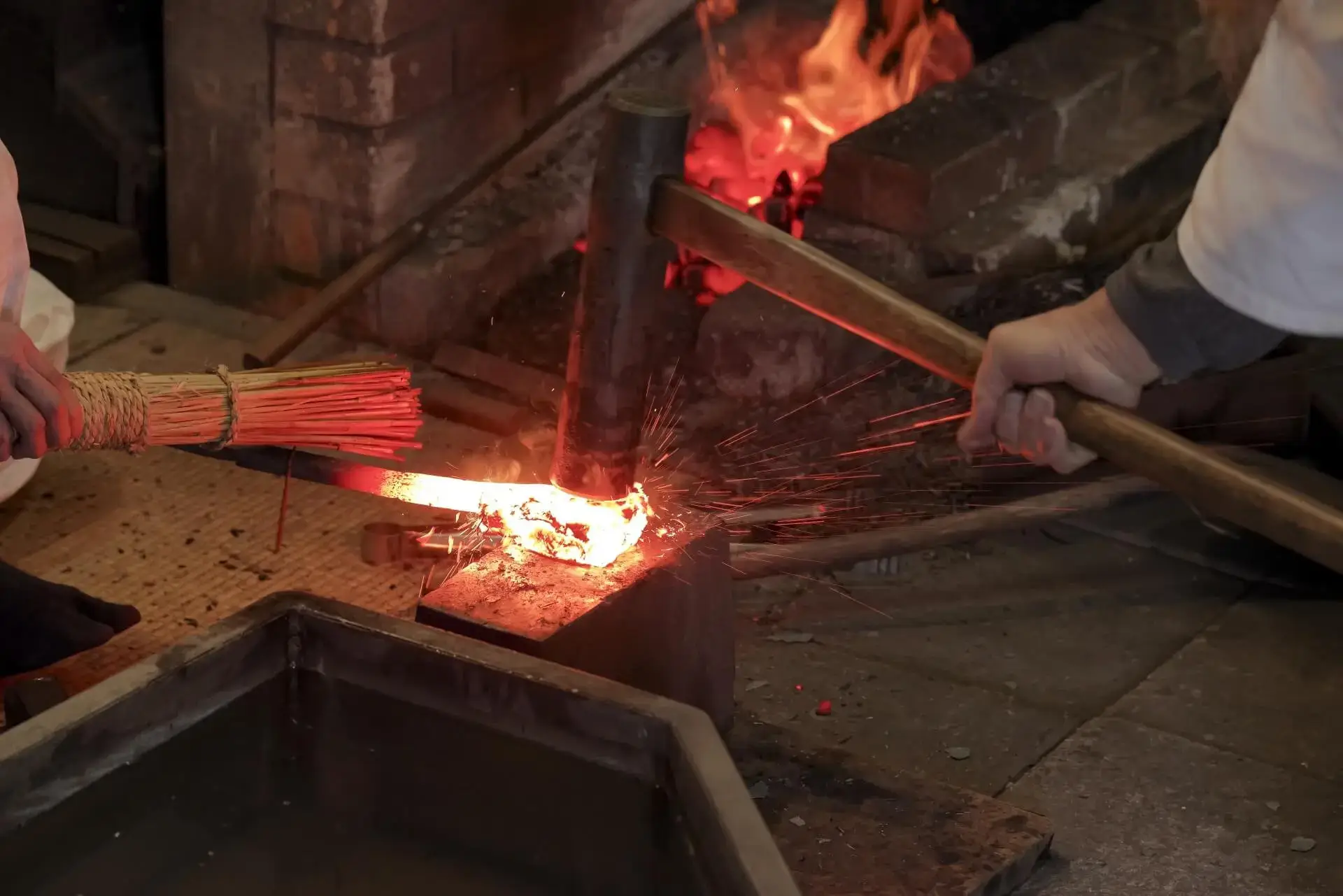
The tobacco knife made in Sakai was sharp enough that the Edo shogunate gave it an official seal — Sakai Kiwame, meaning "Sakai certified," stamped into the blade — and made it a government-sanctioned product distributed across Japan. It was the moment Sakai's name left the city and entered the national consciousness. The knowledge that had been accumulating for a thousand years now had a mark, and a reputation, and a reach.
The tobacco knife required precision that pressed food production could not achieve. Sakai's smiths had been building toward that precision for centuries without knowing what it would eventually serve.
What made that precision possible — and what still defines Sakai production today — is a division of labour so complete that it functions almost as a philosophy. One craftsperson forges the blade, working the steel through more than ten stages of heating and striking. A separate specialist sharpens it, moving through multiple grades of whetstone — sometimes more than ten — until the edge is ready. Another fits the handle, the final adjustment made by feel, aligning the weight of the blade with the weight of the wood until the balance is right. A fourth may engrave the maker's name. Each person in this chain has spent years, often decades, developing mastery of that single stage alone.
The result is not a knife assembled by many hands. It is a knife whose every stage was taken seriously as a discipline in itself. You feel this in the finished object — in the way it sits still in the hand, neither pulling forward nor pulling back, as if the weight has been considered rather than simply distributed.
That tradition is under pressure. Demand for Sakai knives has grown — professional chefs in Europe and the United States now seek them alongside their Japanese counterparts — but the number of craftspeople at each stage of the division has not kept pace. An order placed today may take longer to fill than it once did, not because the quality has declined, but because the chain of specialists is shorter than the demand requires. To buy a Sakai knife now is to participate, in a small way, in whether that chain continues.
At the furthest reach of that tradition sits the honyaki — a knife forged from a single piece of steel, hardened by the same quenching process as a Japanese sword, and marked by a wave pattern in the blade that no laminated knife can produce. It is the form that professional chefs speak of as an aspiration rather than a purchase.
Understanding Steel
The steel a knife is made from affects how sharp it can get, how long it holds that edge, and how much attention it asks of you. Before choosing a Japanese knife, it helps to understand what you are choosing between.
The carbon steels used in traditional Japanese knives — Shirogami (White Steel) and Aogami (Blue Steel) — both belong to a family known as Yasugi-hagane, developed by Hitachi Metals at their Yasugi plant in Shimane Prefecture, carrying forward a tradition of iron-working that stretches back to the tatara — the traditional clay furnaces used to smelt iron sand into steel — of the Chugoku mountains. The names come from the coloured paper Hitachi used to label each grade — white paper for one, blue for another — not from any quality of the steel itself.
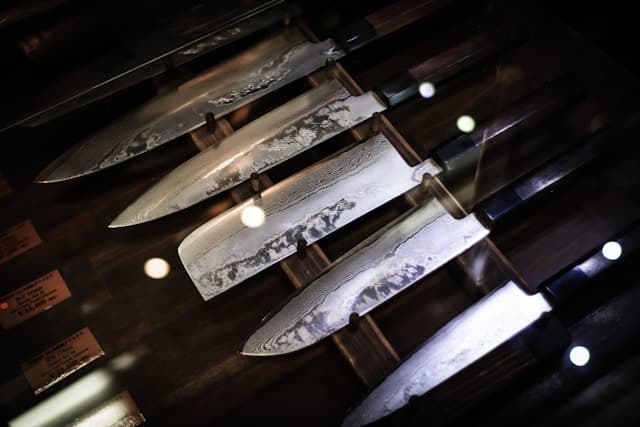
More resistant to rust and staining. Easier to maintain after daily use. High-grade stainless steels have narrowed the gap with carbon steel significantly. Gingami No.3 — often called Silver 3, or 銀三 — is a refined stainless used across mid-to-high range Japanese knives, valued for its balance of sharpness and durability. SG2 (also known as R2) sits at the top of the stainless category: a fine-grain powder steel that takes an edge approaching carbon steel while remaining largely rust-resistant. The most practical choice for most home cooks.
Valued for edge sharpness, edge feel, and the ease with which it can be sharpened on a whetstone. White Steel is the purer of the two: impurities reduced as far as possible, leaving a high-carbon steel that responds directly to the skill of the smith. In the hands of an experienced maker it produces a blade of exceptional sharpness; its unforgiving nature means the quality of the craft shows immediately. Blue Steel adds tungsten and chromium, increasing hardness and wear resistance — the edge holds longer, but requires more effort to restore. Both come in grades numbered by carbon content: No.1 carries more carbon than No.2, adding hardness at some cost to flexibility. Both must be dried immediately after use and kept away from acidic ingredients. Over time they develop a patina that many experienced users consider part of the pleasure of ownership.
A middle position between the two. It may offer some of the responsiveness of carbon steel with better resistance to corrosion. A reasonable choice for those who want performance without the full commitment of a carbon steel maintenance routine.
If you want ease of use and lower maintenance: stainless. If you value sharpness and edge feel above all, and are willing to dry the knife immediately after every use: carbon. If you are somewhere between: semi-stainless. There is no universally correct answer.
Edge Type and Handle
Double-Bevel
Most Santoku and Gyuto knives are double-bevel — sharpened on both sides, meeting at a symmetrical edge. This geometry is familiar to anyone who has used a Western kitchen knife, and it is suited to both right- and left-handed cooks. Double-bevel knives are practical for daily use, straightforward to sharpen at home, and ask nothing unusual of the person using them.
Single-Bevel
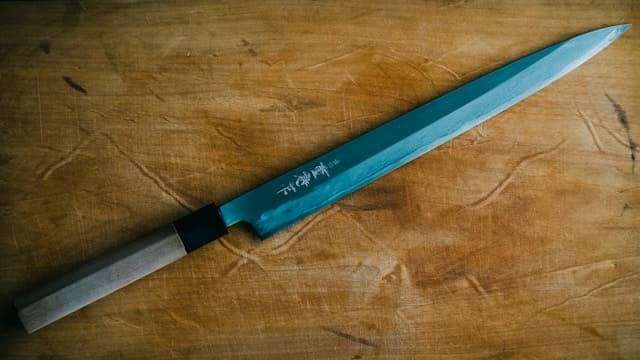
Traditional Japanese specialist knives — including the Yanagiba — are single-bevel. Only one face of the blade is ground to form the edge. The other side is not simply flat — it is slightly hollow, a concave recess known as ura-suki. This hollow creates a gap between the blade face and the food, which is why a single-bevel knife releases what it cuts rather than gripping it. When a Yanagiba draws through raw fish, the back face guides the cut cleanly away, leaving the surface of the slice undisturbed. The mouthfeel of sashimi, and the way it catches the light on the plate, depends in part on this geometry.
Single-bevel knives can achieve a more acute cutting angle than double-bevel. The edge is sharper in a narrower sense — it enters the ingredient at a finer angle, which is why the cellular structure of the fish is preserved rather than compressed. This is not a marginal difference. You notice it the first time you use one correctly.
The trade-off is technique and specificity. Single-bevel knives require more considered sharpening, and they are made for one hand — right-handed or left-handed. Confirm orientation before purchasing.
The Western Handle
Western-style handles — full-tang, riveted, symmetrical — are built for permanence. The steel runs the full length of the handle and is fixed in place. The grip tends to be heavier, and the balance sits closer to the middle of the knife. For cooks used to European or American kitchen knives, this is familiar ground.
The Wa-Handle
The traditional Japanese handle — wa — is built on a different principle entirely. The blade's tang is inserted into the wood rather than sandwiched within it, and it is not fixed with adhesive or rivets. This is not a structural compromise. It is a deliberate choice: the handle can be removed and replaced when it wears, while the blade continues its life. In a culture where a good knife is used for decades and then passed on, the idea that the handle is the disposable part — not the edge — makes a particular kind of sense.
The wood most commonly used is ho no ki — Japanese magnolia. It is light, resistant to moisture, and has a surface quality that becomes less slippery when wet. Professional cooks tend to favour handles with a suigyuu collar — water buffalo horn — where the wood meets the blade. The horn contracts slightly with use, drawing tighter around the tang over time. A handle that has been used for years holds the blade more securely than a new one.
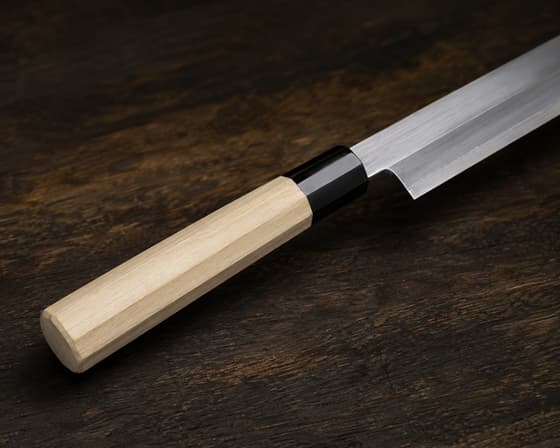
The wa-handle shifts the balance point forward, toward the blade. Less weight in the hand means more sensitivity at the edge — a different conversation between the cook and the ingredient.
The handles come in several cross-sections — oval, octagonal, D-shaped — each suited to a different grip and a different relationship between the hand and the knife. Octagonal handles give a more defined grip for precision slicing. Oval handles are the most comfortable for extended use. The right shape is the one that disappears in the hand: the one you stop thinking about.
Neither handle type is objectively better. A Western handle suits a cook who wants weight and solidity. A wa-handle suits a cook who wants to feel what the blade is doing. Both are serious choices, made for different kinds of attention.
Care and Maintenance
A Japanese knife asks for more attention than a mass-market blade. Not dramatically more — but consistently more. Treat it well and it becomes sharper and more familiar over time. Ignore the basics and the edge suffers quickly.
- Wash by hand only. Never the dishwasher.
- Dry immediately after washing, especially the blade.
- Avoid cutting bones, frozen food, or hard crusts unless the knife is designed for it.
- Use a wooden or plastic cutting board. Glass and ceramic damage the edge.
- Store the knife safely — a knife block, magnetic strip, or blade guard. Loose in a drawer damages the edge and is unsafe.
- Sharpen regularly on a whetstone. If you prefer to use a professional service, look for one that sharpens by hand on a whetstone rather than with an electric machine — the difference in steel removal is significant over the life of a good knife.
Carbon steel knives ask for one additional step: dry them thoroughly after any contact with acidic ingredients — vinegar, citrus, tomato — and consider a light oil coat if the knife will not be used for some time.
A good knife, maintained well, does not wear out. It sharpens faster with each use as the steel is worked in. The handle settles into the hand. The edge becomes part of the rhythm of cooking.
If you are based in Adelaide, Koi Knives in Clarence Park offers hand whetstone sharpening for Japanese knives, including single-bevel blades. For those elsewhere, a specialist knife shop that stocks Japanese knives is usually a reliable starting point — they will know who in the area understands the geometry involved.
Looking for specific knife recommendations across three essential types — Santoku, Yanagiba, and Gyuto — with entry, standard, and high-end options from Sakai's best makers?
Browse our curated knife guide →To sharpen your own knife at home, our guide to whetstones and sharpening technique covers everything from choosing a stone to the particular care that single-bevel knives require.
Frequently Asked Questions
What makes Sakai knives different from other Japanese knives?
Sakai's reputation comes from centuries of accumulated metalwork knowledge and a production method built around specialist division of labor. One person forges the blade. Another sharpens it. Another fits the handle. Each stage is handled by someone who has spent years — often decades — developing that specific skill. The result is a knife where every stage of production is taken seriously as a separate discipline.
What is the best Japanese knife for beginners?
For most people, a Santoku is the most practical first Japanese knife. It is shorter and more compact than many Western chef's knives, suited to vegetables, fish, and boneless meat, and does not require specialist technique to use well. It offers a clear introduction to what a refined Japanese edge can do without the commitment of a more specialist blade.
Should I choose stainless or carbon steel?
Choose stainless if you want a reliable, lower-maintenance knife for daily use. Choose carbon steel if you prioritize maximum sharpness and edge feel, and are willing to dry the knife immediately after every use and keep it away from moisture. High-grade stainless steels have closed the gap significantly in recent years — but for those who want the traditional feel of Japanese edge steel, carbon remains the reference point.
What is a Yanagiba used for?
The Yanagiba is used primarily for slicing sashimi and raw fish. Its long, narrow blade is designed to draw through the ingredient in a single pulling motion — rather than sawing — preserving the texture and clean surface of the fish. It is a specialist's knife and is not usually recommended as a first Japanese knife for general cooking. For those who prepare sashimi regularly, or want to understand Japanese knife culture in depth, it expresses something essential about precision and restraint.
Is a Gyuto the same as a Western chef's knife?
Similar in purpose, but not identical. A Gyuto typically has a thinner blade, lighter weight, and more precise edge geometry than many Western equivalents. It handles meat, fish, and vegetables with equal ease, and suits cooks who want the versatility of a chef's knife with a more refined feel. It is often the knife that experienced home cooks reach for most often once they have moved past their first Japanese blade.
Are Japanese knives difficult to maintain?
Not difficult — but consistent. Stainless and semi-stainless models are practical for everyday use. The main requirements apply to any good kitchen knife: hand wash, dry immediately, sharpen regularly, store safely. Carbon steel asks for slightly more attention around moisture and acidic ingredients. Many users find that daily care routine becomes part of the pleasure of owning a well-made blade.
Are Japanese knives suitable for left-handed users?
Double-bevel knives — most Santoku and Gyuto — are suitable for both right- and left-handed users, though handle shape can still matter. Single-bevel knives, including most Yanagiba, are often made specifically for right-handed use unless otherwise specified. Always confirm orientation before purchasing a single-bevel knife.
To hold one is to hold a small part of Japan's craft history — not preserved behind glass, but alive in the hand.
Some links on this site lead to affiliate partners. If you purchase through them, Untranslated Japan may earn a small commission at no additional cost to you. Our editorial standards remain independent. We only feature products that meet our criteria for craftsmanship, usefulness, transparency, and cultural integrity.
Sources consulted for the Sakai section:
Sakai Tourism & Convention Bureau — 世界が注目する「堺の刃物」の魅力 — sakai-tcb.or.jp
Jikko Hamono — 堺包丁の魅力とは? — jikko.jp
Morita Messer — 堺の歴史 — messer-morita.de
Osaka Convention & Tourism Bureau — 600年の歴史を誇る日本3大刃物産地 — osaka-info.jp
Jikko Hamono — 本焼包丁の魅力と秘密を徹底解説 — jikko.jp
Sources consulted for the Edge & Handle section:
Jikko Hamono — 和包丁の柄の材質・種類について — jikko.jp
Tojiro — ハンドル・柄の構造 — tojiro.net
Sources consulted for the Steel section:
Jikko Hamono — 包丁の材質、SG2と銀3の違いを解説 — jikko.jp
Honmamon — 白紙、青紙、銀紙…鋼の種類について — honmamon.jp