
A knife that cannot be sharpened is not a knife. It is an object that happens to have an edge — for now.
Knowing When to Sharpen
A knife dulls gradually, which makes the moment of dullness easy to miss. The change is not sudden. You compensate, unconsciously, applying more pressure, adjusting your angle. By the time the blade feels slow, it has been slow for some time.
Two signals are worth attending to. The first: cut an onion and notice whether your eyes water. A sharp knife severs the cells cleanly; a dull one crushes them, releasing the compounds that sting. The second: slice raw fish and examine the cut surface. A sharp edge leaves a clean face that catches the light evenly. A dull edge drags, and the surface shows it — rough, slightly compressed, dull in the way that tells you the knife has been telling you something for weeks.
For most home cooks using their knife daily, sharpening once or twice a month is the right rhythm. Frequency depends on use, steel, and cutting board. Carbon steel sharpens more readily and may need attention more often. High-grade stainless holds its edge longer but requires more effort to restore. A wooden or composite board preserves the edge; glass and ceramic destroy it.
Understanding Whetstones
A whetstone is not simply an abrasive surface. It is the tool through which you understand the blade — its current condition, where it needs attention, how the steel responds. Electric sharpeners and pull-through devices remove metal quickly, but they cannot read the edge. A whetstone requires you to.
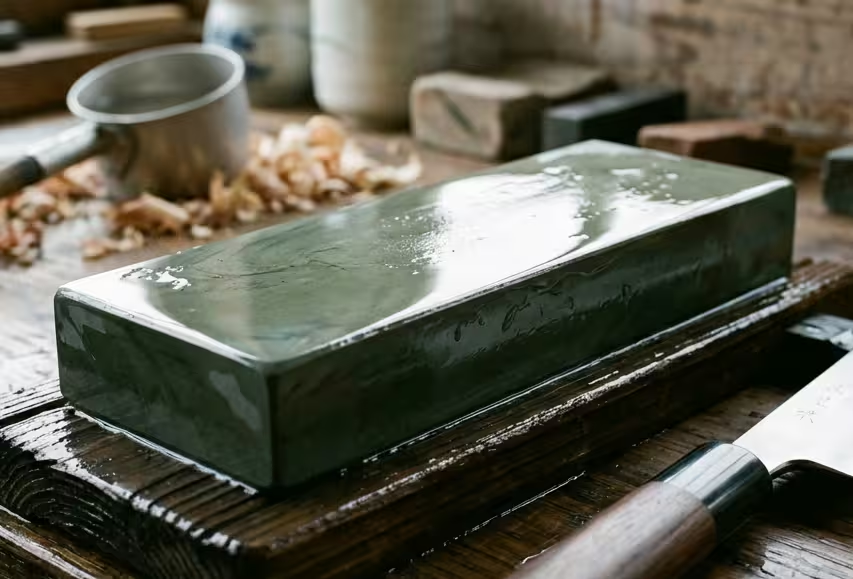
Whetstones are graded by grit — a number that describes the coarseness of the abrasive particles. Lower numbers remove metal faster and are used to correct damage or reshape an edge. Higher numbers refine the edge progressively, until the surface is smooth enough to cut cleanly without tearing.
For repairing a chipped or heavily damaged edge. Removes metal quickly. Not needed for routine sharpening — use only when the edge has been significantly compromised.
The stone for everyday sharpening. A #1000 grit stone is the standard starting point for most Japanese knives in regular use. This is where the edge is rebuilt.
Refines and polishes the edge after medium work. Reduces the microscopic serration left by coarser stones, producing a smoother, more refined cutting surface.
For most home cooks, a single medium stone (#1000) is sufficient for regular maintenance, with a fine stone (#3000 or higher) for finishing when you want the edge at its best. If you are starting with a quality Japanese knife in reasonable condition, begin here. Note that grit classifications vary between manufacturers — what one maker calls medium, another may label differently. The ranges above reflect a practical middle ground across the major Japanese whetstone producers.
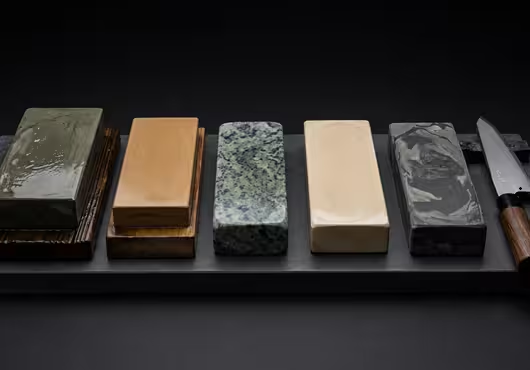
Beyond grit, whetstones differ in material. Synthetic whetstones — made from abrasive particles bound together with a bonding agent — are the most widely available and cover the full range of sharpening needs. The most common bonding method is vitrified (ceramic-bonded), which produces a firm, consistent stone suited to carbon and stainless steel alike; magnesia-bonded stones are softer and release more slurry, making them particularly effective for stainless steel. Ceramic whetstones use a vitrified bonding process — abrasive particles fused with a ceramic binder at high temperature — which produces a denser, more consistent cutting surface. They hold their shape longer and many do not require soaking before use; they are the choice of most serious home cooks and professionals. Natural whetstones, quarried from specific deposits in Japan, produce a finish that many experienced users find distinctive — but they are expensive, variable in behaviour, and better suited to those who already sharpen well. For anyone beginning with Japanese knives, a synthetic or ceramic whetstone in the right grit range is the correct starting point.
King KW-65 Combination Whetstone #1000 / #6000 with Stand
A magnesia-bond synthetic whetstone covering both everyday sharpening (#1000) and finishing (#6000) in a single tool. Soak for five to ten minutes before use. Suitable for stainless and carbon steel Japanese knives. The stand keeps the stone stable on the counter during use. A practical, well-priced starting point for anyone building a sharpening practice.
View at Hocho-Knife →Shapton Ha-no-Kuromaku Professional Ceramic Whetstone #1000
A vitrified ceramic whetstone from Shapton, one of Japan's most respected whetstone manufacturers. No soaking required — splash water on the surface and begin. Cuts consistently, holds its shape well, and suits both carbon and stainless steel. The #1000 grit is the core stone for regular maintenance; pair with a finer stone for finishing work on high-carbon knives.
View at Hocho-Knife →The Sharpening Process
Sharpening is not difficult. It requires patience, consistency, and the willingness to go slowly until the motion becomes reliable. The goal is not speed. It is an angle held without wavering, repeated until the edge responds.
The steps below describe sharpening a double-bevel knife. Single-bevel knives follow the same preparation, but differ at Steps 4 and 5 — see the section that follows.
- Soak the stone
Submerge the whetstone in water for five to six minutes before use. The water lubricates the surface and carries away the fine metal particles produced during sharpening. Keep a container of water nearby and add more as the surface dries during the session.
- Secure the stone
Place the stone on a damp cloth or a purpose-made stone holder. It must not move while you work. Instability transfers into inconsistency in the edge.
- Set the angle
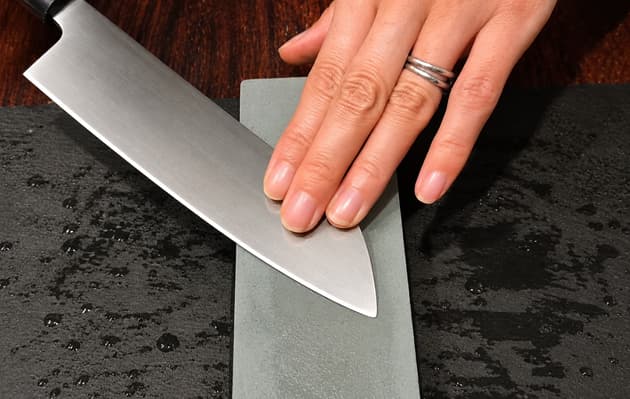
There are two angles to hold throughout sharpening. The first is the lift angle: hold the blade against the stone at 10 to 15 degrees — the gap between the spine and the stone surface should be roughly 7 to 10 millimetres. This is narrower than most people expect. Rest one or two fingertips lightly on the flat of the blade to feel whether the angle is holding. The contact between steel and stone should feel even — a faint, consistent resistance rather than a grinding or skipping sensation. Maintain this angle without variation throughout the stroke. Letting it shift produces an uneven edge.
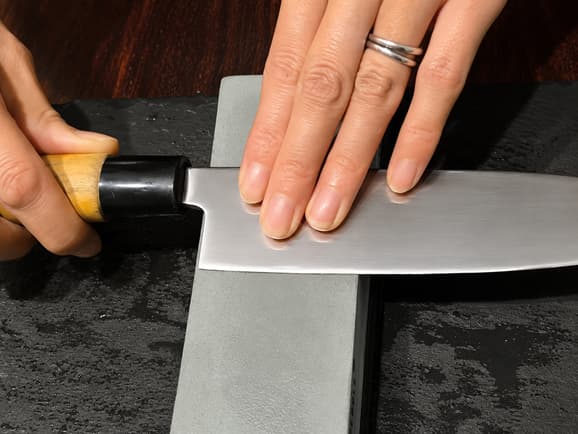
The second is the direction angle: viewed from above, hold the blade at 45 degrees across the stone. This applies to both the front and back face. The only exception is the area near the ago — see Step 5. - Sharpen the front face
With three fingertips of your free hand resting lightly on the flat of the blade — pressing the area you are currently working — push the knife forward across the stone, moving from heel to tip in a slow, even arc. The motion should feel deliberate and quiet. A grey-black slurry will form on the stone surface as the metal is worked; this is correct. Do not rinse it away — it continues to abrade. Work along the length of the blade in sections, roughly ten strokes per section.
As you sharpen, a kaeri will begin to form along the edge — a thin ridge of metal that has been pushed over to the opposite face all along the cutting edge, from heel to tip. When it appears evenly along the full length of the blade, it is the sign that the steel has been worked all the way through and the front face is done. To check, place a fingertip on the opposite face and slide it parallel to the blade surface toward the edge — not across it. You will feel a faint catch, like the edge of a piece of paper, running the length of the blade. If it is absent in any section, return to that area and add more strokes before checking again. - Sharpen the back face
For double-bevel knives: repeat on the other side at the same 45-degree direction angle, two to three strokes per section. When working near the ago — the heel of the blade where it meets the handle — the handle will contact the stone before the heel can reach it. At this point, rotate the knife so the blade runs perpendicular to the stone — 90 degrees viewed from above. This allows the heel to lie flat and be worked cleanly without the handle interfering. For single-bevel knives: see the section below. The back face requires different handling.
- Remove the kaeri
Lay the back of the blade flat on the stone — no angle — and draw it lightly two or three times. This removes the kaeri without rounding the edge. Finish on a fine stone if you are going further, or rinse and dry the blade if the medium stone is sufficient for today.
- Wash and dry
Rinse the blade with water and a little neutral detergent to remove the metal particles left by sharpening. Dry thoroughly before storing, especially carbon steel. The edge you have just made is at its most vulnerable now — treat it accordingly.
The Single-Bevel Difference
Single-bevel knives — the Yanagiba, the Deba, the Usuba — sharpen differently from double-bevel blades, and the difference matters. The back face of a single-bevel knife is not simply flat. It carries a slight hollow — ura-suki — ground into it during manufacture. This hollow is structural. It must be preserved.
When you sharpen the front face of a single-bevel knife, a kaeri forms on the back face — the same thin sliver of folded metal that appears in double-bevel sharpening, but here it requires particular care to remove. Because the back carries the ura-suki hollow, any angle applied to the back face risks abrading the hollow itself. The only safe method is to lay the back face completely flat on the stone — no angle whatsoever — and make two or three light strokes. The ura-suki means that only the area nearest the cutting edge touches the stone; the hollow never contacts it. This is by design: the kaeri is lifted away quickly, with minimal steel removed from the back, and the hollow is left undisturbed.
Use a finishing stone (#3000 or finer) for the back face. Coarser stones remove material too quickly and make it harder to control how much steel is taken from the back. The hollow is not something that can be restored at home — protect it accordingly.
Over years of sharpening, the ura-suki gradually diminishes as the front face is worked back. When the hollow becomes too shallow, the knife loses the quality of its release — the way food separates cleanly from the blade after each cut. At that point, the knife goes to a professional grinder who can re-hollow the back. This is not a repair for a whetstone at home.
Caring for the Stone
A whetstone that is not flat cannot sharpen accurately. With use, the surface of any stone develops a hollow at the centre — the area that contacts the blade most frequently wears faster than the edges. A concave stone produces a convex edge, which is the opposite of what you want.
Flatten the stone regularly using a lapping plate or a dedicated flattening stone. The frequency depends on use — for home cooks sharpening monthly, checking for flatness every few sessions is sufficient. Hold the stone up to the light and look across the surface. Any hollow will be visible.
- Rinse the stone after every session to remove accumulated metal particles and slurry.
- Allow the stone to dry completely before storing. Storing a wet stone encourages cracking in temperature changes.
- Store flat, not on its edge. A stone stored on its edge may warp or crack if knocked.
- Check for flatness regularly. A hollow surface produces an inaccurate edge and makes consistent sharpening impossible.
- Natural stones require different handling from synthetic stones — follow the maker's guidance if using a natural finishing stone.
The stone and the knife are in a long relationship. Both deserve the same attention.
Naniwa Flattening Stone (Small)
A flattening stone for restoring a level surface to your whetstone. As a whetstone is used, it develops a hollow in the centre — the area that contacts the blade most often. A dished stone produces an uneven edge and should be flattened regularly. With water on both surfaces, rub the whetstone back and forth across the flattening stone in straight strokes until the surface is level again.
View at Hocho-Knife →Frequently Asked Questions
How do I know when my knife needs sharpening?
Two reliable signals: cut an onion and notice whether your eyes water more than usual — a dull blade crushes the cells rather than severing them, releasing more of the compounds that sting. Or slice raw fish and examine the cut surface; a sharp knife leaves a clean, even face, while a dull one leaves a slightly rough or compressed surface. If you are applying noticeably more pressure than you used to, the blade has already been dull for some time.
What grit whetstone should I start with?
For regular maintenance of a knife in reasonable condition, a #1000 medium stone is the right starting point. This handles everyday sharpening for both stainless and carbon steel. A coarse stone (#200–400) is only needed when the edge is chipped or significantly damaged. A finishing stone (#3000–5000) refines the edge after medium work and is worth adding if you want the blade at its best. A combination stone with #1000 on one side and #3000 on the other covers most needs.
What angle should I hold the knife at?
For Japanese knives, 10 to 15 degrees — the gap between the spine and the stone surface is roughly 7 to 10 millimetres. This is narrower than the angle used for Western knives, which reflects the thinner geometry of Japanese blades. The angle matters less than consistency: holding 12 degrees perfectly throughout produces a better edge than alternating between 10 and 15.
Can I sharpen a single-bevel knife the same way as a double-bevel?
No. The front face of a single-bevel knife is sharpened normally, but the back face must be laid completely flat on the stone — no angle — for two or three light strokes only. The back carries a hollow ground into it during manufacture, called ura-suki, which must be preserved. Applying an angle to the back, or sharpening it aggressively, destroys this hollow and cannot be repaired at home. Use a finishing stone for the back face, not a coarse or medium stone.
How often should I flatten my whetstone?
Check for flatness every few sharpening sessions. Hold the stone up to a light source and look across the surface — any hollow is visible. How quickly it develops depends on how much you use it and which section of the stone you work on. For home cooks sharpening monthly, checking every three or four sessions is sufficient. A concave stone produces an inaccurate edge, so flattening regularly is as important as sharpening itself.
Should I use a sharpening service instead of doing it myself?
Both have a place. A sharpening service — particularly one familiar with Japanese knives — can restore an edge that has been neglected or damaged beyond what home sharpening can correct. They can also re-hollow the ura-suki on single-bevel knives when it has worn down over years of use. For routine maintenance between professional sharpenings, a whetstone at home is the right tool. Learning to sharpen your own knife also deepens your understanding of what the blade is and how it works.
Every sharpening session returns the knife to what it was. Do it long enough and you begin to understand what it is.
Some links on this page lead to affiliate partners. If you purchase through them, Untranslated Japan may earn a small commission at no additional cost to you. Our editorial standards remain independent. We only feature products that meet our criteria for craftsmanship, usefulness, and cultural integrity.
Sources consulted for this article:
Tojiro — ハンドル・柄の構造 / 砥石角度 — tojiro.net
Tojiro — 砥石の選び方 — tojiro.net
Tsukiji-go / 築地有次 — 和包丁の研ぎ方・お手入れ方法 — tsukiji-go.jp
Sakai Ichimonji Mitsuhide — 和包丁(片刃包丁)の研ぎ方 — hocho.ichimonji.co.jp
Sakai Ichimonji Mitsuhide — プロがおすすめする砥石の選び方 — hocho.ichimonji.co.jp
Jikko — 砥石の種類と選び方 — jikko.jp
Jikko — 片刃包丁の研ぎ方(初心者向け) — jikko.jp
Togiya — 初心者必見!砥石の選び方ガイド — togiya2020.com