
A Surprisingly Uncomfortable Way to Relax Takes Off in Japan
Have you ever stood at the edge of a cold sea, dipped in just your toes, and found yourself unable to go any farther?
I have. Cold water takes a certain amount of resolve, and if it feels anything like the sea in winter, I certainly wouldn't volunteer to get in.
And yet, in Japan, a style of sauna that includes deliberately plunging into cold water has become increasingly popular.
You heat your body in the sauna, step straight into a cold bath that is often around 15–17°C (59–63°F), then sit outside and do absolutely nothing. And you don't just do it once. You repeat the cycle several times.
For most of my life, I thought of a sauna as simply the hot room tucked into the corner of an onsen or a large public bathhouse. Some people used it, some didn't, but I never thought of it as something you'd go out of your way to experience.
So when I realised Japan had been going through a sauna boom for several years now, my first thought was:
Why sauna, and why now?
The more I looked into it, the less this seemed like a simple sauna trend.
Among the people particularly drawn to this new sauna culture, apparently, were business owners, startup founders and others whose working lives involve constant decisions, pressure and stress.
Why would people who are already exhausted after finishing work deliberately sit in an intensely hot room, get into cold water, and then do it all over again?
If relaxation were the only goal, soaking quietly in a hot spring would seem much easier.
But as I kept looking, I began to realise that the sauna I had always known, the one attached to an onsen or public bath, wasn't quite the same thing as the sauna that has become so popular in Japan today.
The First Clue Was in the Sauna I Already Knew
Why sauna now? And why has it started attracting even busy businesspeople and company owners?
Looking into it, I realised that understanding this shift meant going back to when sauna first began spreading in Japan.
Modern Finnish-style sauna is generally thought to have arrived in Japan in the late 1950s.
One of the people most closely associated with its introduction was Ujitoshi Konomi, who ran Tokyo Onsen, a bathing facility in Ginza. Konomi was also a member of Japan's clay shooting team, and during the 1956 Melbourne Olympics he saw foreign athletes using saunas. After returning to Japan, he installed one at his own facility.
A sauna was later built in the athletes' village for the 1964 Tokyo Olympics, bringing it to wider attention. As health lands and large public bath complexes became more common in the decades that followed, sauna gradually became a familiar part of Japanese bathing.
Japan already had a culture of bathing facilities where people soaked in hot water, washed, rested, and sometimes stayed for a meal or massage. Sauna did not arrive as a completely separate culture. It was folded into something that already existed: the Japanese bath.
That was the sauna I had grown up seeing, the one attached to an onsen or a large public bathhouse. And that turned out to be the first clue to what came later: in Japan, sauna had entered as part of an existing rhythm of bathing and resting, not as something apart from it.
So how did that become the modern routine of sauna → cold bath → rest?
The People Drawn to Sauna Were Not Who I Expected
If the story ended here, it would simply be about sauna gradually becoming part of Japan's existing bathing culture.
But that alone did not explain the boom happening now.
When I looked at the data, I found that sauna was more popular among younger employees and businesspeople than I had expected.
In a 2026 survey of 800 employees in their 20s to 50s, 50.8% of sauna users said sauna had had a positive effect on their work at some point. Among people in their 20s, that figure rose to 60.5%, and among those in their 30s, to 60.1%.
Another analysis by VALUES used its web behaviour tool Dockpit to examine people who had actually searched for "sauna" online. It found that people searching for sauna included a higher proportion of high-income users than internet users overall. The same analysis also found that the share of people in their 20s among sauna searchers had risen from around 15% in 2020 to roughly 32% by 2022.
What caught my attention next was how strongly sauna seemed to appeal to people working in SaaS. A 2023 survey of 1,002 SaaS sales professionals found that 91.1% said they liked sauna, and more than 60% of those respondents used one at least once a week.
With numbers like these, sauna begins to look like something more than a hot room you happen to use while visiting an onsen or a large public bath.
It was striking that people working under constant pressure and making frequent decisions seemed particularly likely to connect sauna with staying sharp at work and feeling better physically and mentally.
Why were busy people, in particular, making sauna part of their routine?
The answer started to become clearer once I understood what "going to the sauna" actually means in Japan today.
What Are People Actually Doing in the Sauna?
The first thing I discovered was that the kind of "sauna" now popular in Japan involves much more than sitting in a hot room and sweating.
At its core is a simple sequence:
sauna → cold bath → rest
You warm your body in the sauna, cool it rapidly in a cold bath, then sit down and rest. And you repeat the whole sequence several times.
Heat Kicks the Body's Cooling System Into Gear
The first stage is to heat the body thoroughly in the sauna.
In a high-temperature environment, both skin temperature and core body temperature begin to rise. The body responds by sending more blood to the skin, producing sweat and increasing the heart rate, all in an effort to release heat. These responses are regulated by the hypothalamus and the autonomic nervous system. In other words, you are not simply "feeling hot" in a sauna. Your circulatory and sweating systems are working hard to keep your body temperature within a safe range.
While the body is under this intense heat stress, the brain is also continually processing signals about temperature, heart rate and breathing.
Once the body is thoroughly warmed, the next step is the exact opposite: cold.
Cold Water Sends the Body in the Opposite Direction
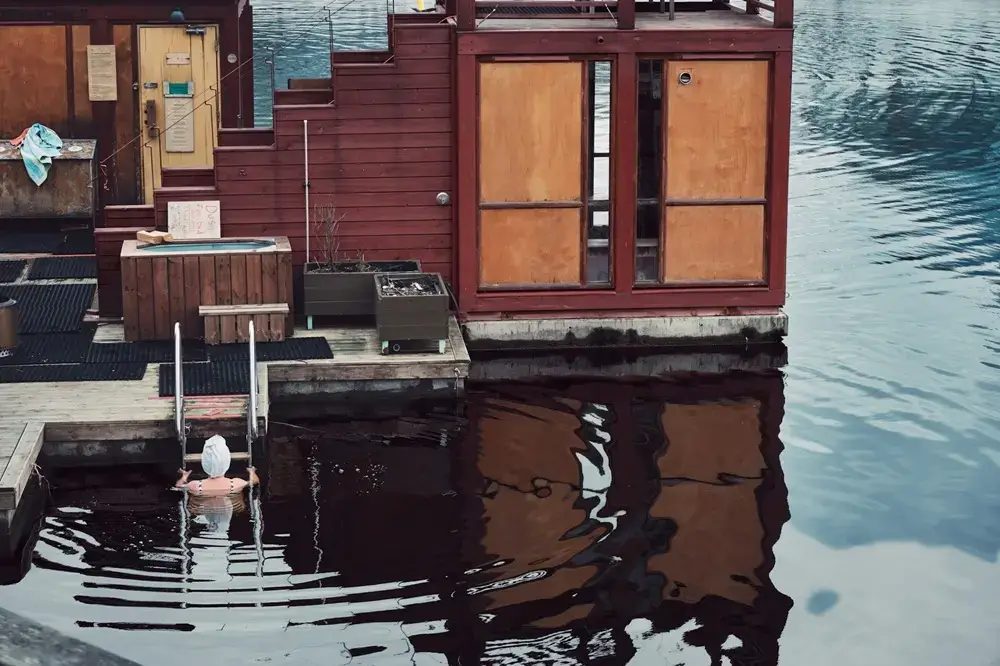
When a heated body enters cold water, the skin cools rapidly. Blood vessels near the skin constrict to reduce heat loss, while the sympathetic nervous system is strongly activated. Breathing rate and blood pressure can rise temporarily, and levels of substances involved in the stress response, including noradrenaline, increase.
Noradrenaline helps constrict blood vessels to conserve heat, while also increasing alertness. That involuntary gasp when you first enter cold water, or the sudden sensation of becoming intensely awake, is part of the body's defensive response to abrupt cold exposure, known as the cold shock response.
A moment earlier, the body was trying to release heat. In the cold bath, it suddenly switches into a state of heightened alert, trying to conserve it.
After that sharp physiological shift, the body moves into the third stage.
During Rest, Brain Waves and Heart Rate Begin to Shift
After getting out of the cold bath, you dry off and sit down to rest.
It may look as though nothing is happening, but inside the body, the changes continue.
A small Japanese study involving 20 healthy adults, published in 2023, measured brain activity in participants who completed three rounds of sauna, cold bath and rest.
During the resting phase, researchers observed increases in alpha and theta waves, both of which are commonly associated with relaxed states such as resting quietly with the eyes closed.
The same study found that heart rate decreased after the full sauna session, while participants also reported physical relaxation and changes in mood. Researchers also observed changes in the brain's response to sound, suggesting that fewer attentional resources may have been needed to process external stimuli.
It is during that final period of rest that Japanese sauna enthusiasts describe reaching the particular feeling they keep coming back for.
This Feeling Even Got a Name: Totonou
The word commonly used for this distinctive post-sauna feeling is totonou.
It is generally said to have entered sauna vocabulary around 2009, when a well-known sauna enthusiast who goes by the name Nurezukin-chan was at Shiraginsou in Hokkaido with fellow sauna-goers. While trying to describe the feeling they were experiencing, the word totonou, roughly "everything has fallen into place", apparently felt right.
The expression later spread among enthusiasts through Katsuki Tanaka's manga Sado, before reaching a much wider audience when the series was adapted for television in 2019.
The word did not create a new physical sensation. Its real significance was that people could finally talk about an experience that had previously been difficult to describe.
"I really felt totonou yesterday."
"This cold bath makes it easy to reach totonou."
"The route from the cold bath to the outdoor rest area is ideal for reaching totonou."
Once the feeling had a name, people could describe their own experience and share ways of recreating it.
And so sauna, cold bath and rest became more than a sequence for using three different facilities. It became a shared process for reaching totonou.
Why Busy People Find So Much Value in Sauna
By now, I was beginning to see an answer to the question I had started with.
Why are people who spend their days making difficult decisions and working under pressure so drawn to sauna, and why do so many of them turn it into a regular habit?
It may be because sauna offers more than a brief sense of refreshment. Several different benefits, from mental clarity to recovery, can overlap within a single routine.
Deep Relaxation, With the Brain Still Awake
What follows sauna, cold bath and rest is more than simple recovery from fatigue: the body can feel deeply relaxed while the mind remains surprisingly clear and alert.
Yasutaka Kato, representative director of the Japan Association of Sauna, explains this in physiological terms. Sauna and cold water strongly activate the sympathetic nervous system. Once the body moves into the resting phase, the parasympathetic nervous system quickly becomes dominant. But stimulating substances such as adrenaline do not disappear from the bloodstream at the same speed. According to Kato, their effect takes around two minutes to fall by half.
That short delay creates an unusual overlap: the body is deeply relaxed, but the mind still feels awake.
Brain-wave studies have also found changes associated with relaxation after sauna, alongside activity in areas involved in sensation and perception. This may be close to the physiological state people are describing when they say they are not simply "resting", but experiencing totonou.
Digital Detox and Clearing the Mental Noise
For people who are constantly taking in information and making decisions, another appeal of sauna may be the chance to step away from the noise in their own heads.
Kato explains that while blood flow increases throughout much of the body in a sauna, blood flow to the brain decreases. Sauna may also quiet some of the brain activity that keeps our thoughts running in the background. That includes the default mode network, which is active when our minds wander, as well as networks we use when concentrating on something.
At first, you may still be thinking about work, messages or what needs to be done next. But after several rounds, it becomes harder to keep running through complicated thoughts.
There is also a much simpler reason: you cannot take your smartphone into the sauna. No email, no notifications, no news. Nothing new is coming in.
Katsuki Tanaka, author of Sado, has said that regular sauna use gave him more time to reflect, and that the way he wanted to spend his day, and the things he wanted to do, became clearer.
Sauna does not add more input. Instead, it may create a kind of subtractive space where information drops away and thoughts have room to settle.
When Mental Space Turns Into Ideas
Once some of that mental noise falls away, another possibility appears: ideas.
In brain-wave experiments conducted by Kato and his colleagues, distinctive activity was observed in part of the right temporal lobe after sauna, a region involved in integrating sensation, perception, memory and emotion. For these right-handed participants, that is the less dominant side of the brain.
Kato has also said that when he experiences totonou and is not thinking about anything in particular, ideas sometimes appear unexpectedly.
That does not mean sauna makes people more creative.
Still, stepping away from work and letting go of complicated thoughts may create room for new ideas. For some people, that time away from work may ultimately feed back into the work itself.
Better Sleep, Better the Next Day
For busy people, sauna's value may not stop at how good it feels in the moment. It may also carry into the next day, through sleep.
In a sleep study conducted by Kato and his colleagues, participants fell asleep more quickly after using sauna, and the first period of deep sleep lasted longer. Kato refers to this first stretch of deep sleep as the "golden time", describing it as an especially important part of the sleep cycle.
For people who cannot simply add more hours to their sleep, getting more deep sleep within the time they already have could be particularly valuable.
Tanaka has also said that as sauna became part of his routine, he began to notice improvements in how he felt physically and became more aware of what kind of daily rhythm helped him perform well. He now structures his day around work, sauna, meals and sleep.
A More Relaxed, More Equal Way to Connect
Sauna can also be surprisingly social.
Unlike long dinners involving alcohol or a round of golf, people can connect in a relatively short amount of time. With work clothes and job titles largely out of the picture, some people find it easier to relax and speak more openly than they normally would.
A survey of younger employees found that, as a setting for internal communication, sauna was rated more attractive than drinking or dining together. Respondents gave reasons such as being able to speak honestly while relaxed, finding it easier to talk regardless of age or position, and building rapport in a shorter amount of time.
That combination may be another reason busy businesspeople find sauna so appealing.
Then Japan Started Designing Spaces Around Totonou
Once a culture takes root, the spaces around it begin to evolve too.
In Japan today, simply having a sauna room is no longer enough. People pay attention to details such as whether the cold bath is immediately accessible, how smoothly they can move from the cold bath to the resting area, how deep the bath is, how many chairs are available for resting, and whether they can rest in the open air.
Facilities have responded by designing the sauna, cold bath and rest area as parts of one continuous experience.
Modern Finnish-style sauna arrived in Japan in the late 1950s, but within Japan's bathing culture it developed into a routine built around sauna, cold bath and rest, along with the idea of totonou. Today, that sequence can shape the layout of the building itself.
Once I understood that, I wanted to see what these spaces actually looked like.
Recently, some hotels and ryokan have gone beyond shared saunas in large bathing areas. Private rooms and suites may now include their own sauna, cold bath, onsen bath and outdoor resting space, allowing guests to try the full sequence at their own pace.
Below are two places where that experience has been built directly into the stay.
Fuji View Sauna Ryokan Shizuku
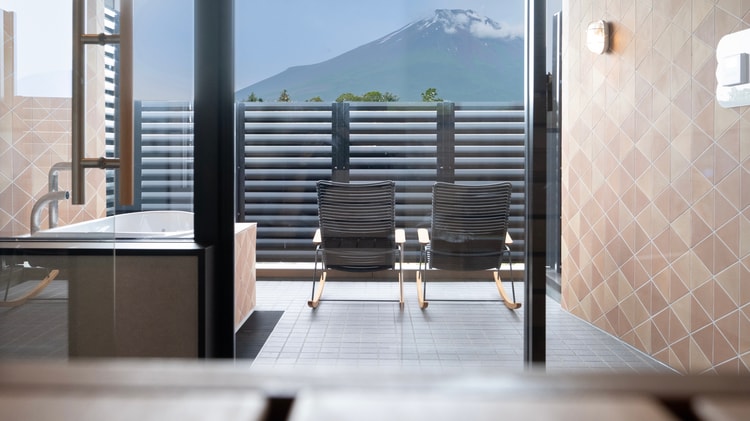
At Fuji View Sauna Ryokan Shizuku, Mount Fuji is part of the sauna experience itself.
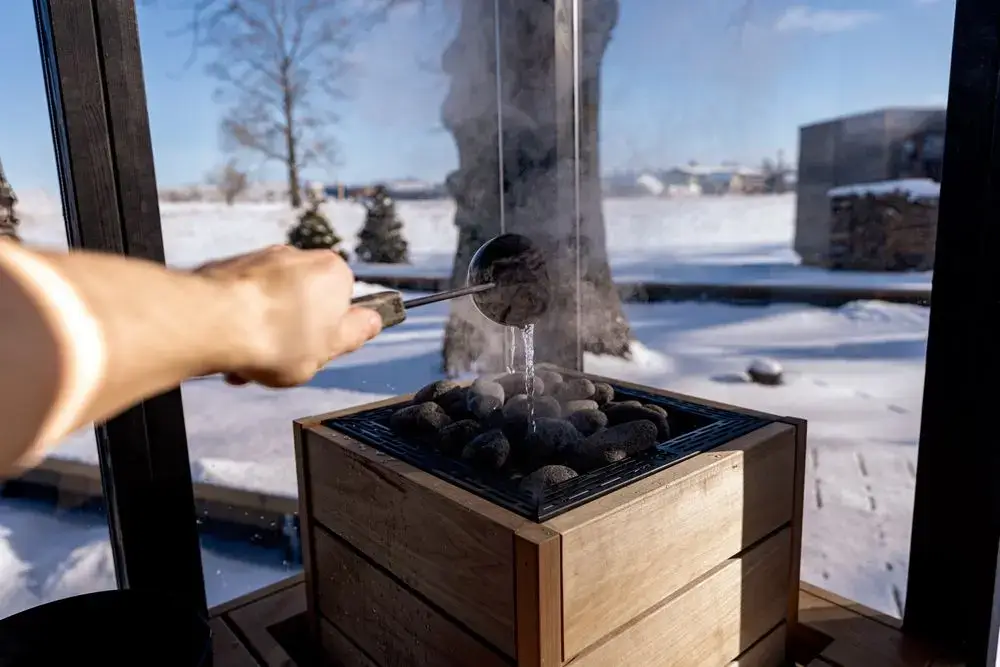
All 14 guest rooms have a private sauna and their own space for resting afterward. Guests can pour water over the sauna stones for self-löyly, then cool down in a cold bath filled with underground water from Mount Fuji.
In the rooms facing the mountain, the sequence continues with a view of Fuji as you rest. Some suites also have a private open-air bath and an outdoor resting area, making it possible to move through sauna, cold bath and rest entirely in your own space.
At Shizuku, Mount Fuji becomes part of the rhythm of heating up, cooling down and sitting quietly afterward.
Ryokan & Sauna Yorozuya Hita
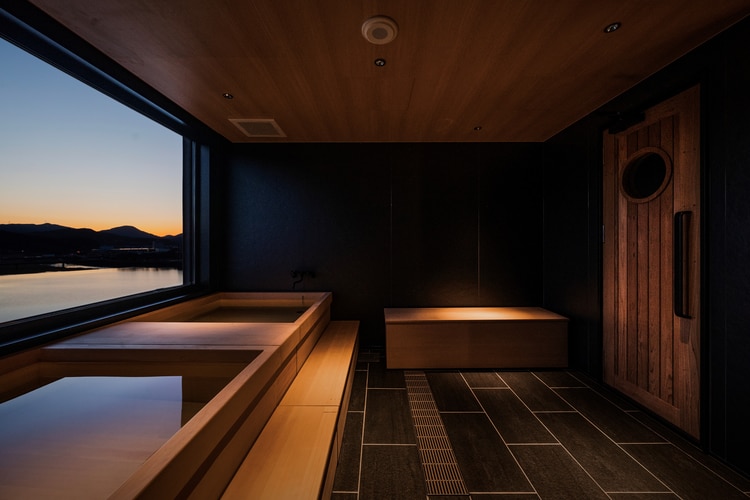
At Ryokan & Sauna Yorozuya Hita in Oita, everything is built around the sauna itself.
All eight rooms are designed as sauna suites, each with a private sauna, cold bath, onsen bath and resting space. The saunas were designed with Dai Matsuo of TTNE, one of the best-known figures in Japan's contemporary sauna scene.
Across the property, there are four different sauna concepts, with details inspired by Hita and the surrounding region. Guests can enjoy self-löyly using a local kabosu citrus aroma, while the cold baths are kept at around 16.5°C.
In rooms on the upper floors, the resting stage comes with views over the Mikuma River. The sauna, cold bath and resting space at Yorozuya are planned together as one layout, letting the entire sequence happen smoothly inside a single private room.
Frequently Asked Questions
What does totonou mean in Japanese sauna culture?
Totonou is the word Japanese sauna enthusiasts use for the distinctive state that can follow repeated rounds of sauna, cold bath and rest. Sauna-goers often describe it as a feeling of deep physical relaxation combined with a sense of mental clarity. The term became popular among sauna enthusiasts before spreading more widely through Katsuki Tanaka's manga Sado and its television adaptation.
How cold is the water in Japanese sauna cold baths?
Many Japanese sauna cold baths are kept at around 15–17°C (59–63°F), although the temperature varies by facility. Some are colder, while others are designed to feel more approachable for beginners. The goal is not to stay in as long as possible, but to cool down before moving into the resting phase.
Do you have to use the cold bath to experience totonou?
The cold bath is a central part of the sauna → cold bath → rest sequence associated with totonou, but it is not something you should force yourself to do. If cold water feels overwhelming or you have a health concern, it is reasonable to cool down more gradually instead. The experience should never depend on pushing through discomfort that feels unsafe.
How many rounds of sauna, cold bath and rest do people usually do in Japan?
Three rounds is a common guideline. Sauna researcher and physician Yasutaka Kato recommends repeating the sauna → cold bath → rest sequence around three times, particularly for beginners. There is no need to force yourself to complete a set number of rounds, however. How long you stay in each stage should depend on how your body feels.
Why has sauna become so popular with businesspeople in Japan?
There is no single reason. Surveys and interviews suggest that some users connect sauna with mental clarity, physical recovery, better sleep, time away from digital input and more relaxed social interaction. For people who spend much of the day under pressure or making decisions, several of those benefits can overlap within one routine.
References
Sauna Brought My Life Into Balance Too: Katsuki Tanaka, Author of the Manga Sado — YouTube.
A Study on Neural Changes Induced by Sauna Bathing: Neural Basis of the Totonou State — peer-reviewed research article.
Survey on Sauna and Work Among 800 Employees in Japan — TAMADIC Health Management Research Institute / PR Times.
Survey on Sauna Habits Among SaaS Sales Professionals in Japan — MM Research Institute / PR Times.
What Search Data Reveals About Japan's Sauna Boom and Younger Users — VALUES / Manamina.
Warming to the Appeals of the Sauna — Highlighting Japan, Government of Japan.
Continue Reading

This article contains affiliate links. If you book an experience through one of these links, Untranslated Japan may earn a small commission at no additional cost to you.