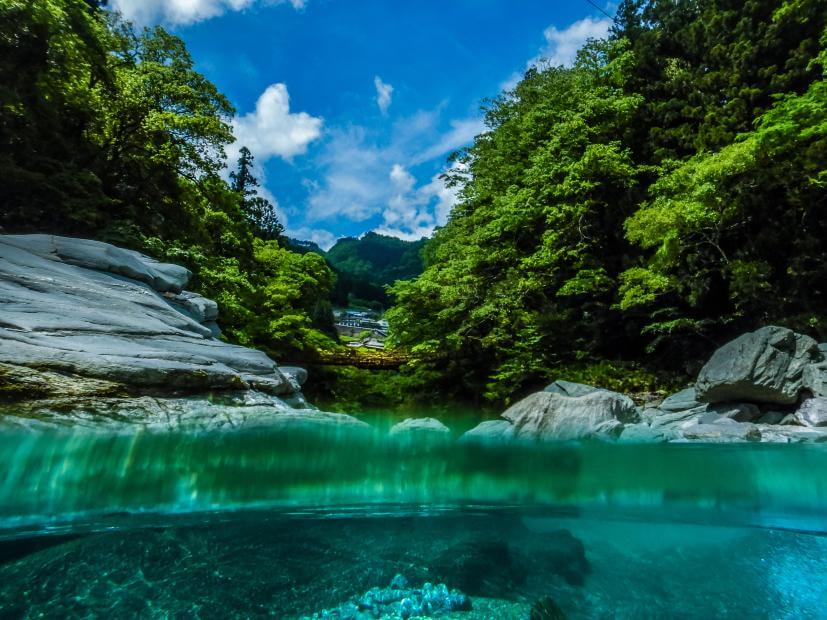
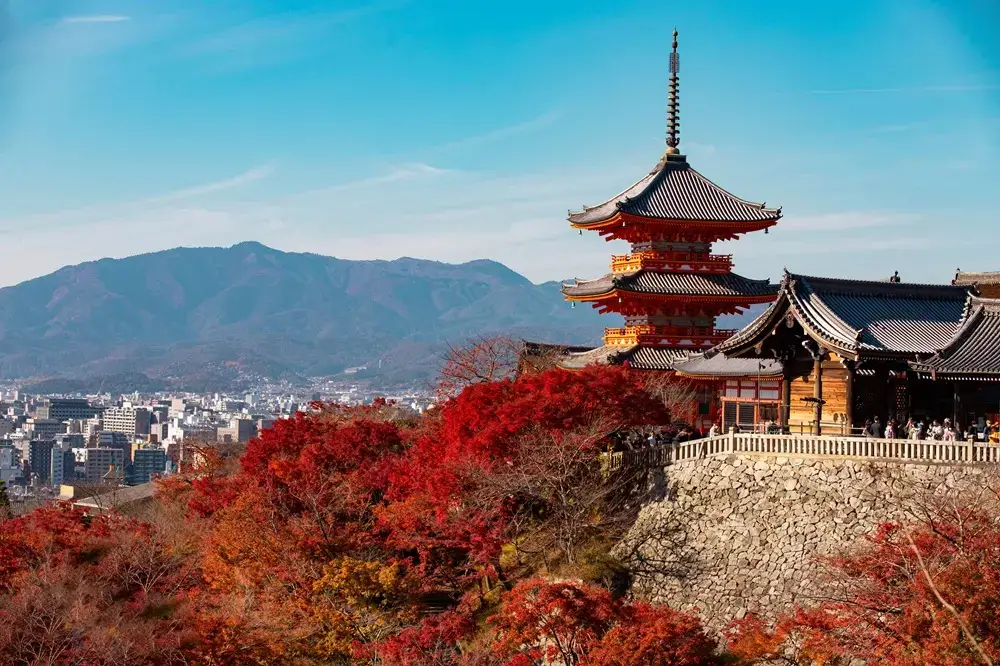
In November, when the air has turned clear and autumn is deepening, I will be travelling to Okayama with my family.
When I first started planning the trip, I didn't expect us to stay very long. But the more I searched online, the more landscapes and places I found that I wanted to see, and our stay somehow grew into four days and three nights. Compared with a typical sightseeing itinerary for Okayama, three nights in one place may seem almost indulgently long.
Among them, there are three that I am especially drawn to: the white walls and old storehouses of Kurashiki's Bikan Historical Quarter, Bizen ware shaped by clay and fire, and Inujima, where the remains of an industrial past still stand in the Seto Inland Sea.
Before I go, I want to understand each of them a little better. I have always found that knowing the story behind a place changes the way I see it. Perhaps understanding something of these places before I arrive will make seeing them for myself all the more meaningful.
Explore Okayama
Kurashiki Bikan Historical Quarter
My hairdresser is from Okayama, and when I told her about our trip, she was so excited that she seemed almost as pleased as if she were the one going.
"If you're going to Okayama, this place is lovely, and you should go there too," she said, one recommendation following another. Of all the places she mentioned, the one she spoke about with particular enthusiasm was the Kurashiki Bikan Historical Quarter.
I am slightly embarrassed to admit that when I first heard the name Bikan Chiku (district), I did not immediately know which place she meant. I knew there was a famous area in Okayama with beautiful white-walled streets, but I had never properly connected that image with the name.
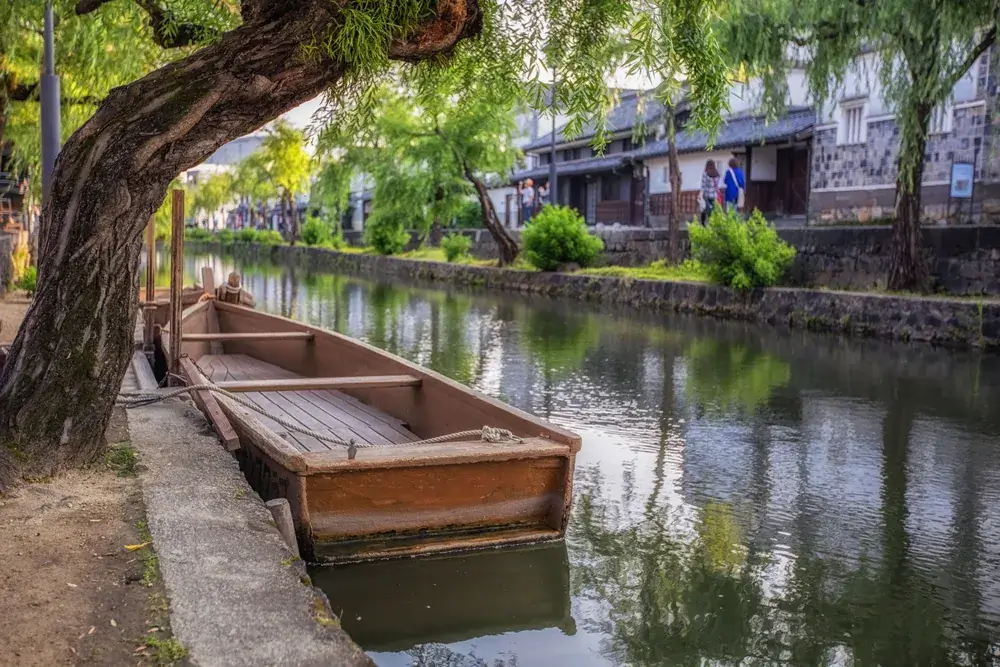
I took out my phone and searched. The screen filled with familiar-looking scenes: willows bending over the Kurashiki River, white-walled storehouses lining the water.
"Ah, that place."
At last, the name and the images clicked together in my head.
Her eyes lit up as she told me about a little cake shop tucked down a side street, a shop filled with handmade objects, a café where she liked to spend time, a wine bar that made her want to sit with a glass in the evening, and, more than anything, a street where she could simply wander around.
These were places she had actually enjoyed in her own life there. Once I realised that, my image of the Bikan Historical Quarter shifted a little. To me, it had been a tourist destination where an old townscape had been preserved. To a local person, it could also be somewhere to buy a cake or have a coffee. I found myself thinking how wonderful it must be to talk about a place you've lived in with that kind of affection.
This made me curious about the town, so I started reading about its history. During the Edo period, Kurashiki became a tenryō, a territory under the direct control of the Tokugawa shogunate, and prospered as a commercial town centred on its river port. Small boats moved along the calm surface of the Kurashiki River. Rice, cotton, and other goods were loaded and unloaded, and merchandise arrived from different regions. The white-walled storehouses and rows of merchant houses that now define the district were part of the infrastructure that supported that busy trade.
I was also surprised to learn how many different periods are represented in the streets we see today.
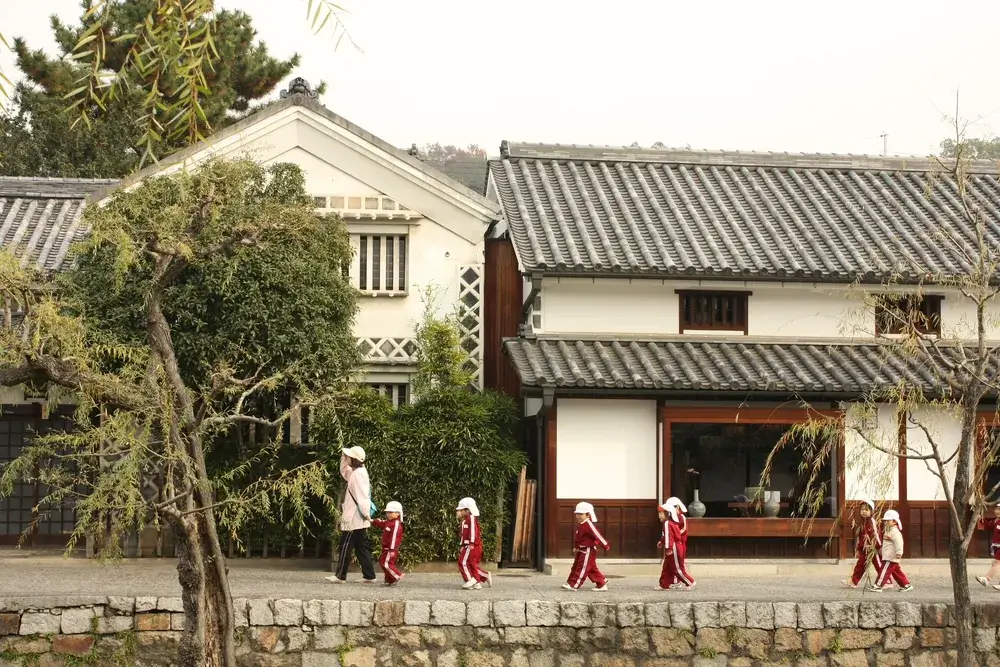
There are Edo-period townhouses and storehouses with white walls and geometric namako-kabe, a distinctive pattern of dark tiles crossed by raised white plaster. Nearby are Meiji- and Taishō-era buildings that absorbed Western architectural influences, followed by buildings from the Shōwa period.
Walking through Kurashiki means moving through several periods at once. Materials and architectural details from different eras sit beside one another, leaving traces of each within the same town.
Learning this made me wonder how so much of that layered townscape had survived. During Japan's rapid economic growth, older buildings were disappearing from cities across the country. In Kurashiki, efforts to protect the historic townscape began comparatively early in the postwar period.
The preservation movement grew from a desire to protect the art, folk craft, and character of daily life that local people valued as unplanned development began to change the town.
The movement began around the Ōhara Museum of Art and grew outward, drawing in local figures, cultural advocates, and people who lived in the town, eventually developing into municipal efforts to preserve the streetscape.
Today, many of these historic buildings have found new uses. Former storehouses and lattice-fronted townhouses now house cafés, shops, galleries, and wine bars.
Reading about the town's history brought me back to what my hairdresser had told me. I could picture people meeting friends, drinking coffee, and spending time in buildings that have been treasured for generations. I began to understand why she spoke about Kurashiki with such affection.
Edo, Meiji, Taishō, Shōwa, and the present. I want to walk through Kurashiki and see for myself how these different periods overlap within a single town.
Bitchu Kurashiki Budoshu Sakaba— A small wine bar known for seasonal dishes and carefully chosen wine pairings. Reservations recommended.
Heisuiken— A food lover’s treasure trove of carefully selected products from across Japan.
Honmachi-dori— An old street where traditional townhouses, a sake brewery, cafés, and galleries share the same neighbourhood.
Stay
Stay Inside Kurashiki’s Historic Quarter
Stay in a former merchant residence at Ryokan Kurashiki, surrounded by the historic streets explored in this article. Wabunka’s private stay can also be paired with a guided experience in Kurashiki.
Alongside Kurashiki's white-walled streets, there is something else in Okayama that I particularly want to see: Bizen ware.
Japan has ceramics in an extraordinary range of colours and styles, but there is something about the rugged, unadorned appearance of Bizen ware that particularly draws me in.
I love its stripped-back simplicity and the earthy, substantial feeling it seems to have. No two pieces look quite the same. To me, it feels as though Bizen ware belongs to a world completely opposite to the digital one I spend so much of my daily life immersed in. Even without knowing much about Bizen ware, I find myself wanting to reach out and run my fingers over its surface.
When I began looking into Bizen ware more closely, what fascinated me most was how those expressive surfaces are actually created.
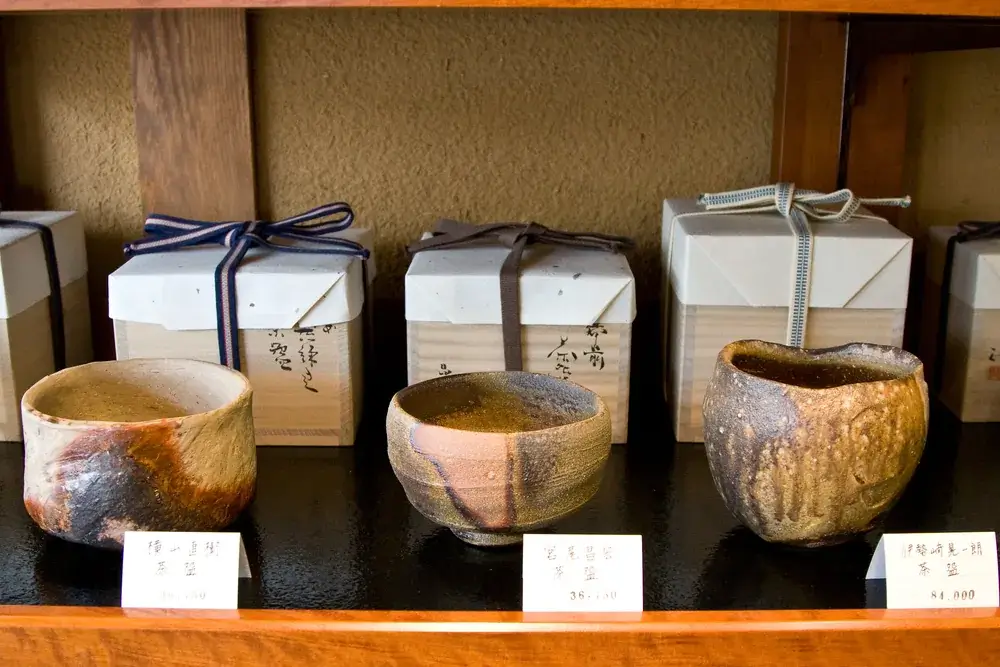
Bizen ware is traditionally made without painted decoration or glaze. Vessels formed from local clay are placed inside a wood-fired kiln and fired at temperatures above 1,000°C for days. During the firing, flames move around the pieces and wood ash settles over them. The colours and markings I had been drawn to are traces of what happened inside the kiln.
I discovered that these different effects even have their own names.
There is goma, or "sesame", where wood ash settles and melts onto the surface, creating speckled markings. Hidasuki, or "fire cord", leaves vivid reddish-brown lines where straw has touched the vessel. Sangiri can create deep grey or bluish tones where pieces are affected by ash and conditions inside the kiln.
What is especially interesting is that the maker cannot completely control these patterns. But neither are they simply left to chance. Craftspeople draw on experience and intuition when deciding where each piece should sit in the kiln, how the flames are likely to travel, and where the ash may fall. Each vessel is positioned with an idea of what might happen next.
I think it is this meeting of human intention and the unpredictable nature of fire that makes Bizen ware so fascinating.
I was also drawn to the idea that Bizen ware continues to change as it is used. Over years of being held, filled, washed, and used in everyday life, its surface can gradually develop changes in colour, sheen, and texture. I love the thought that a piece already unlike any other might become even more personal through the years I spend using it.
My hairdresser also told me that a Bizen mug is perfect for drinking beer on hot summer evenings. She says the beer stays colder for longer and tastes even better that way.
Just imagining myself lifting that cool cup, with all those thoughts about earth and fire still in my head, makes November feel much too far away.
Places to Visit for Bizen Ware
Imbe Pottery District— The pottery-making area around Imbe Station, with kilns, shops, and galleries to explore.
Meikō Kiln (明光窯)— A Bizen ware kiln to look up when exploring the pottery-making area; check visiting arrangements in advance.
Tōbidō (陶備堂)— A long-established specialist shop for Bizen ware in Kurashiki.
Tōkichi (陶吉)— A pottery shop in Bizen City offering a selection of Bizen ware, including pieces for everyday use.
Quiet House— A small studio specialising in contemporary Bizen ware, with a gallery open on Saturdays and Sundays.
Hare no Kuni Okayamakan— An Okayama speciality shop featuring local crafts, including Bizen ware, and regional foods.
Experience
Experience Bizen Ware with a Master Potter
Visit the kiln of Bizen ceramic artist Jumpei Kaneshige and discover how clay, fire and ash shape this centuries-old craft. The private experience also includes the chance to work with Bizen clay yourself.
Inujima is a small island in the Seto Inland Sea, and if our family plans allow it, I would like to visit on my own. Why alone?
I love travelling with my family. I love seeing everyone have a good time and sharing those experiences together. On the other hand, when I am with other people, part of my attention is always directed outward. Are they enjoying themselves? Are they tired? Where should we go next?
Travelling with someone means sharing what is in front of you and exchanging words about what you feel. Yet the more I read about Inujima, the more I began to feel that this was one place where I wanted to set all of that aside.
I want to walk without watching anyone else's expression or reaction, concentrating only on my own senses. I do not want to immediately explain what I see or attach a reason to it. I would even like to stop translating everything into quick words such as "beautiful" or "amazing".
When I began tracing Inujima's history, I discovered layers of time behind the stillness of the photographs I had been looking at.
In 1909, a copper smelter was built on the island. At a time when the smelter was operating at full pace and the island's granite quarrying industry was also thriving, Inujima was filled with industrial activity and several thousand people lived there.
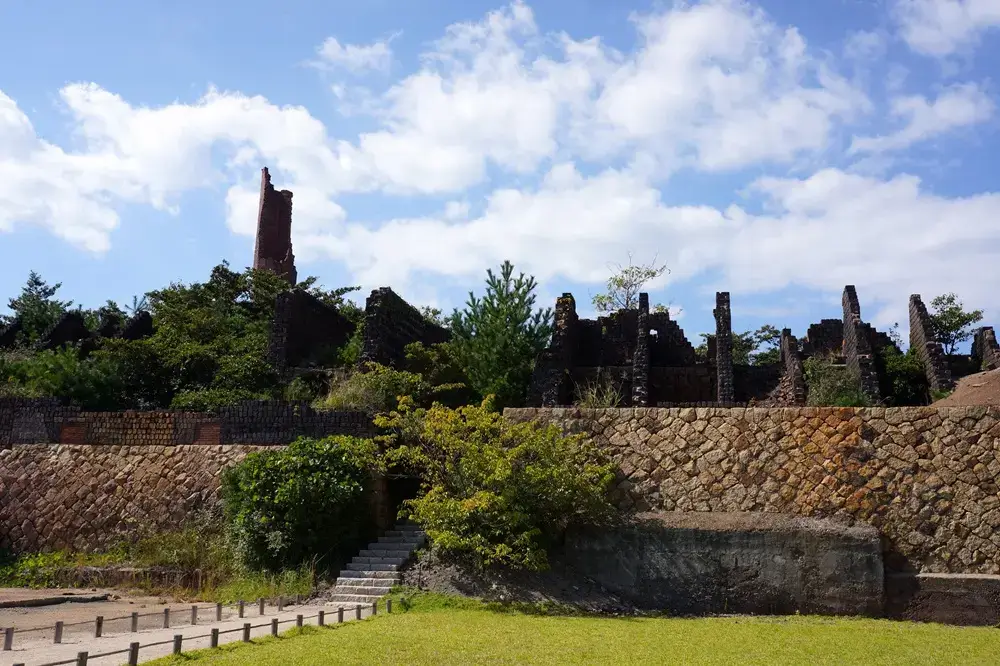
But that intensity lasted only about a decade. When copper prices collapsed, the smelter ceased operations. Many of the people who had worked there left the island, while its enormous brick chimney and industrial ruins remained, exposed to the salt air.
Nearly nine decades after the smelter closed, in 2008, those remains became the foundation of the Inujima Seirensho Art Museum.
What interests me deeply is that the old smelter was not demolished to make way for a clean new museum building. Weathered karami bricks, made from slag produced during copper smelting, the remains of the factory, and the tall chimney were incorporated into the site rather than erased. Contemporary architecture and art were added to what was already there.
And the art does not stop at the former smelter. In the village where islanders still live, the Inujima Art House Project uses old houses and other spaces throughout the settlement. Beside the everyday lives of the people who still call the island home, traces of its industrial prosperity and contemporary art exist side by side.
From what I have read online, people seem to respond to Inujima in very different ways. Some describe feeling as though they have wandered into another world, while others say they felt nothing particularly special.
I wonder which I will be. Or perhaps I will feel something entirely different. I think even that uncertainty is part of what makes me want to go.
I can imagine taking my time in the sea breeze, thinking about the many people who once worked here and what their everyday lives might have been like. Or perhaps I will end up on the shore, completely absorbed in looking for pieces of the granite for which Inujima was once known.
I like the thought of leaving the day open and seeing where my curiosity takes me.
Inujima Art House Project— Art installations set among the houses and streets of the island’s residential village.
Hōden Port— The departure point for boats travelling to Inujima.
Inujima Ticket Center Café— A café near the island’s ticket centre where visitors may find local dishes such as sōmen served with sweet red-bean soup and sea bream rice balls.
What is the Kurashiki Bikan Historical Quarter known for?
The Kurashiki Bikan Historical Quarter is known for its white-walled storehouses, traditional merchant houses, and picturesque canal. Many of these buildings date from the Edo period, when Kurashiki prospered as a centre of trade. Today, the district is home to museums, galleries, cafés, and shops, making it a place to explore both the town's history and its present-day culture.
Where can I see and buy Bizen ware in Okayama?
Imbe, in Bizen City, is one of the best places to explore Bizen ware at its source. Pottery studios, kilns, galleries, and shops are concentrated around Imbe Station. You can also find Bizen ware in Kurashiki and central Okayama, making it possible to discover this traditional pottery without travelling all the way to the production area.
How do I get to Inujima from Okayama?
Inujima is reached by passenger boat from Hōden Port in Okayama City. Travellers using public transport can reach the port area by bus from central Okayama, although services may be limited. It is worth checking both the bus and ferry timetables before setting out, particularly if you plan to visit the art museum and installations on the same day.
What can I see on Inujima?
The island's best-known attraction is the Inujima Seirensho Art Museum, which incorporates the remains of a former copper smelter. The Inujima Art House Project brings contemporary artworks into the island's residential village. Beyond the art, visitors can explore the small settlement and coastal scenery, where traces of Inujima's industrial history remain visible.
How many days should I spend in Okayama?
Two or three days can provide time to explore some of Okayama's major attractions, but the ideal length depends on your interests and transport plans. We have planned four days and three nights for our family trip, allowing time for Kurashiki, Bizen ware, and potentially Inujima, alongside a few other places that have caught our attention.
Some links in this article are affiliate links. If you book or buy through them, Untranslated Japan may earn a commission at no additional cost to you. Recommendations are selected for their relevance to readers.