Yabakei, Oita: Guide to Kyushu's Most Layered Hidden Gorge
Discover the faith, landscape, local cuisine and secluded onsen of Yabakei, from the hand-carved tunnels of Ao no Domon to the ancient stones of Rakanji.

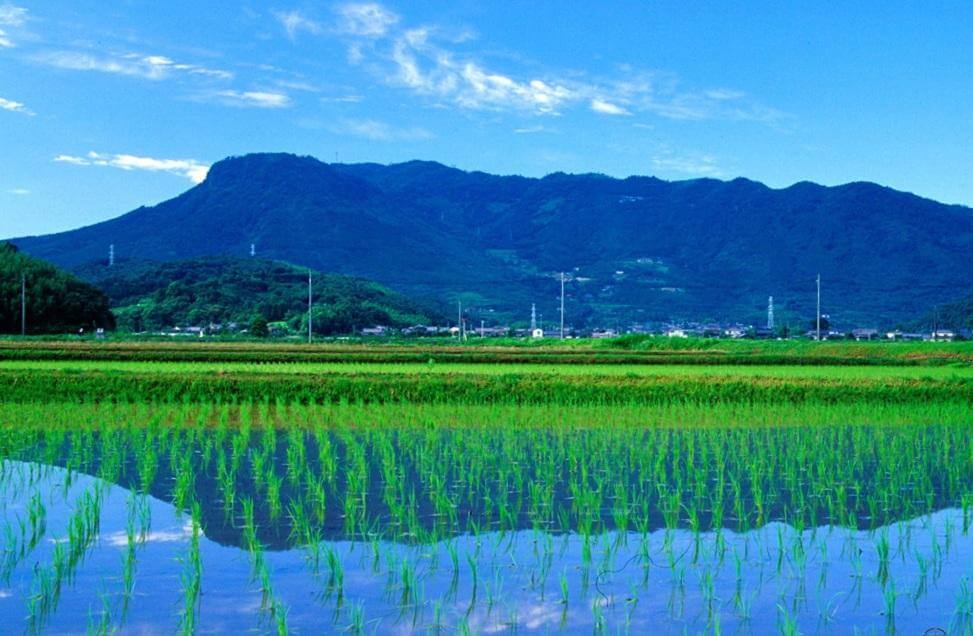
Photo by Nakatsu Yabakei Tourism Association
Yabakei is known as one of Japan's three great autumn foliage destinations. But autumn is only the reason many first arrive. Step into the gorge and the temperature falls, the Yamakuni River reaches you before it appears, and you begin walking a path that people have followed for more than a thousand years.
Rakanji Temple & Ao no Domon: Faith That Shaped Yabakei
You arrive expecting a temple. A famous tunnel. Historical sites worth an afternoon.
Instead, a pattern begins to emerge.
Again and again, the people who came to this valley made choices that seem, at first, slightly unexpected. They built where the cliff already offered shelter. They carved a passage through the rock instead of around it. They returned to the same mountains, the same caves, the same river, generation after generation.
At first, these seem like separate stories.
By the time you leave Yabakei, they no longer do.
Rakanji Temple · 羅漢寺
The Mountain Was Already a Temple
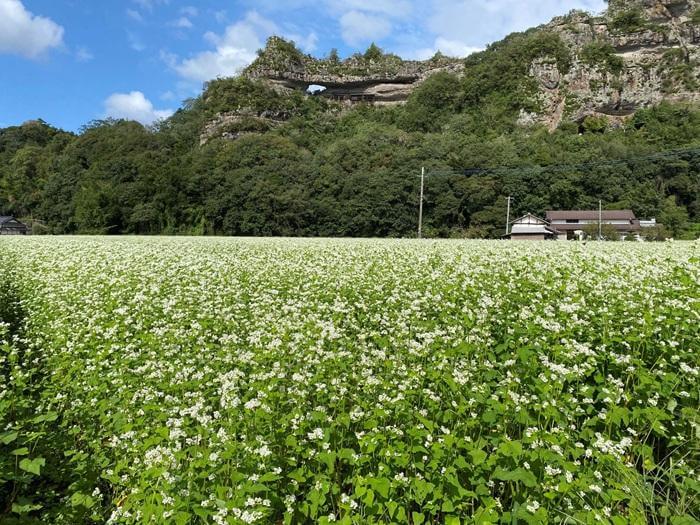
Photo by Nakatsu Yabakei Tourism Association
In 1338, a Zen monk named Engan Shogaku stood before Mount Rakan and made a decision that still shapes every visit here.
He did not look for an easier place to build.
He accepted the one already before him.
The overhanging rock offered shelter. The caves opened naturally into the mountain. The cliff itself possessed the quiet proportions of a sacred place.
Rakanji did not begin by changing the mountain.
It began by seeing it differently.
Walking up the stone steps today, you pass figures pressed directly into the rock face. Not standing apart from the mountain, but becoming part of it. Inside the cave known as Murokutsu, Japan's oldest collection of stone Five Hundred Arhats has watched over this valley since 1359. Around 3,770 stone figures are scattered throughout the temple grounds. No two faces are the same.
Local people say that if you look carefully enough, you will eventually find someone you know.
The difference becomes clearer once you are standing inside it.
The stone approach asks more of you, but it also gives more back. With every flight of steps, the ordinary world slips a little further away. The stone figures appear gradually, almost without announcement, until the mountain itself seems to be watching with them. The walk from the car park to the main hall takes around fifteen to twenty minutes.
Before visiting, check the official information page for current entry requirements, permitted items, and visiting rules. Allow at least an hour. The destination matters less than the pace at which you arrive.
Ao no Domon · 青の洞門
The Tunnel Carved by Hand Over Thirty Years
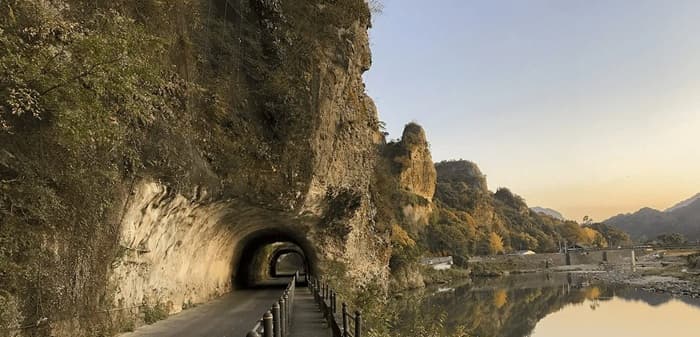
Photo by Nakatsu Yabakei Tourism Association
A short walk from Rakanji, another decision waits in the rock.
In 1735, the monk Zenkai began cutting into the base of the Kyoshuho cliff. He hired stonemasons and worked alongside them, chisel and hammer against rock, for more than thirty years. The tunnel they completed: 342 metres in total, with 144 metres carved entirely by hand. It became Japan's first toll road, the fees paying for the work to continue.
Perhaps the most striking part is not the scale of the labour.
It is who the labour was for.
Zenkai had watched travellers lose their lives on this dangerous stretch of cliff. Most of the people who would one day pass safely through the tunnel had not even been born when he began. He would never know their names. He would never see them arrive. He spent three decades making the journey safer for people he would never meet.
The original hand-carved section remains open today. Run your fingers across the chisel marks, and the rhythm of each strike is still there beneath your hand. Then step back into the light. The valley is unchanged. The river still moves below the cliff.
The tunnel no longer feels like part of the landscape. It feels like part of the valley's memory.
Walk Yabakei with a Local Guide
Moving through this landscape with someone who knows its layers changes what you notice. A guided walk through Hon-Yabakei, from Ao no Domon to Rakanji, connects the physical and the human in ways that are difficult to reach alone.
Walk through it with a guide →Hitome Hakkei & Shin-Yabakei: The Landscape That Defines Yabakei
Outside the temple, the valley opens again.
The cliffs step back. The river finds its voice. Ridge after ridge fades into the distance, each one softer than the last.
It would be easy to think that this landscape simply waited to be admired.
It did not.
Just as earlier generations decided where to pray, later generations quietly decided how this valley should be seen, where people should pause, and which moments were worth carrying home.
The scenery is ancient.
The way you experience it is not.
Shin-Yabakei · 深耶馬渓
Hitome Hakkei: One View, Eight Peaks
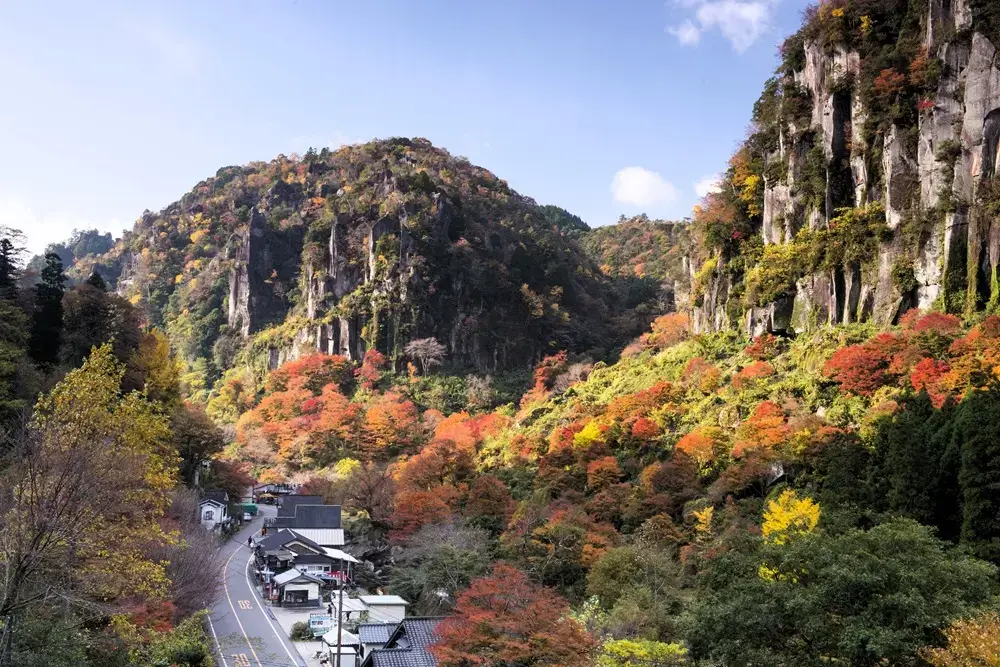
Photo: Oita Prefectural Tourism Association "Tourism Oita"
In 1818, the poet Rai Sanyo travelled through this gorge and gave it the name Yabakei. His writing spread far beyond Kyushu. Artists followed. Travellers followed. Yet the valley most visitors now associate with Yabakei was one he never saw.
The deepest section of the gorge, Shin-Yabakei, remained difficult to reach until the Meiji period, when a local official named Murakami Dencho pushed a road through the mountains. Only then did the valley open to later generations.
Within Shin-Yabakei is a viewpoint called Hitome Hakkei. The name means "one glance, eight views." From a single spot, eight distinct peaks come into view at once.
Someone chose this place.
Someone decided that this should be where visitors first understand the valley.
The peaks themselves carry names. Sennin-iwa, Meoto-iwa, Gunkan-iwa: Hermit Rock, Couple Rock, Warship Rock. None of those names existed in the stone. People noticed shapes, shared stories, and passed those names from one generation to the next.
Stand here knowing those names, and you begin to notice the same conversation.
Autumn draws the largest crowds, when maples and zelkova trees typically turn in mid to late November. But return in mist, fresh summer green, or winter snow, and the valley seems to tell a different story each time.
The rocks have not changed.
Only the way you learn to see them.
Sarutobi Sentsubo · 猿飛千壺峡
Sarutobi Sentsubo: Where Water Carved Stone
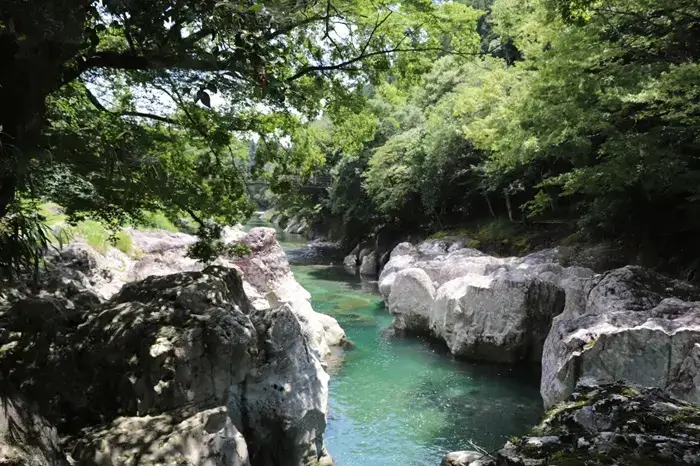
Photo by ダヴィンチ
Long before anyone named this valley, built a bridge, or chose a viewpoint, the river had already begun its work.
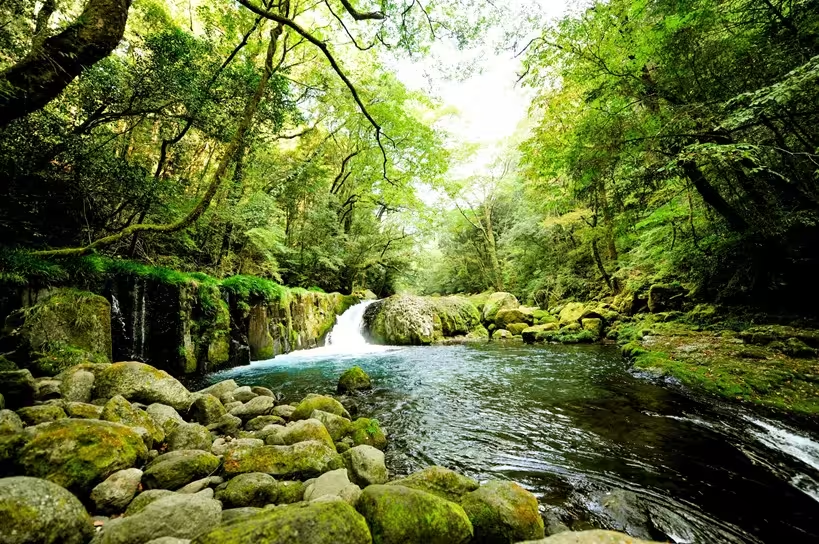
Near the headwaters of the Yamakuni River lies Sarutobi Sentsubo, where hundreds of circular potholes have been carved into the rock. Each one began with a single pebble caught in the current, turning slowly in the same place, year after year, century after century. Some are no larger than a hand. Others are wide enough to stand inside. The river is still making them today.
A walking trail follows the water downstream towards Mabayashikyo, where the gorge narrows and the cliffs close in around the river. The walk takes around thirty to forty minutes.
It is difficult to hurry here.
Not because the path is demanding, but because the valley keeps reminding you how slowly it was made.
Maple Yaba Cycling Road · メイプル耶馬サイクリングロード
Maple Yaba Cycling Road: Where Trains Became Bicycles
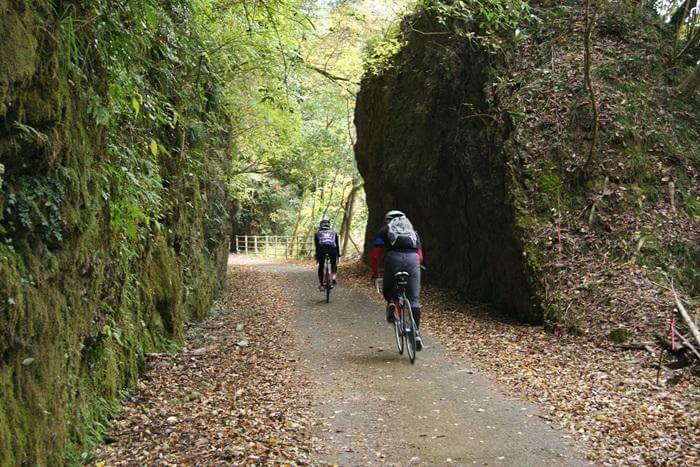
Photo: Oita Prefectural Tourism Association "Tourism Oita"
When the Yabakei Railway closed in 1975, after more than sixty years of carrying passengers through the valley, the tracks could easily have disappeared.
Instead, the community made another decision.
Rather than removing the railway, they gave it a different purpose. In 1982, the line reopened as the Maple Yaba Cycling Road, a 36-kilometre route following the original course of the Yamakuni River.
The railway had already solved the difficult work. Its gentle gradient, carved for trains, now carries cyclists almost effortlessly through the valley. The old tunnels remain. The iron bridges still cross the river. Former station platforms appear unexpectedly between stretches of forest.
Only the speed has changed.
At bicycle pace, the valley begins to unfold differently. You notice the river crossing from one side of the path to the other. The air cools as the gorge narrows. Light shifts almost unnoticed beneath the trees. What once carried people quickly through the landscape now quietly encourages them to stay inside it a little longer.
Cycling the full route takes around three to four hours. Bicycles, including electric-assisted models, can be hired from the Yabakei Cycling Terminal. If you prefer a shorter ride, the ten-kilometre section to Honyabakei takes about an hour and connects naturally with Ao no Domon on foot.
Perhaps that is the railway's final journey. Not taking you somewhere faster, but teaching you that this valley was never meant to be hurried through.
Explore the Valley by Bicycle
The former railway line through Yabakei becomes, on a bicycle, one of the most considered ways to move through a Japanese landscape. Guided cycling experiences are available for those who want the route explained as they ride.
Explore the valley by cycling →Yabakei stretches across a much larger area than many first-time visitors expect. Ao no Domon and Rakanji lie in Hon-Yabakei, while Hitome Hakkei sits around 22 kilometres further south in Shin-Yabakei. A car offers the greatest flexibility. From Nakatsu Station, buses reach the main sites in Hon-Yabakei, while Shin-Yabakei requires a transfer with only a handful of services each day. It is possible to see both areas in a single day, though staying overnight allows the valley to unfold at a gentler pace.
By now, you have climbed stone steps, followed the river, and travelled through old railway tunnels.
Without really noticing it, you have begun moving at the valley's pace.
That is usually the moment when you realise you are hungry.
In Yabakei, even hunger has a geography.
Where and What to Eat in Yabakei: The Flavours of the Valley
Perhaps you noticed it without thinking about it.
The valley leaves remarkably little room for fields.
Steep slopes rise almost directly from the river. The narrow strips of level ground disappear almost as soon as they appear.
This is not simply part of the scenery.
It is the reason the meal waiting for you could only have come from a place like this.
River & Mountain · 川と山
Soba: A Landscape That Could Be Eaten
The steep valley leaves little room for broad fields, but buckwheat asks for very little.
It thrives in cooler mountain climates and has been grown in Yabakei for generations, making use of the narrow patches of cultivable land scattered along the valley. What first appears to be a limitation quietly becomes an advantage.
The signature dish of Yabakei is its soba. Buckwheat grown in the valley is milled using stone grinders, a process that preserves the grain's fragrance in a way that industrial milling does not. New harvests are released twice a year: summer soba, pale green and fresh, and autumn soba, deeper in flavour and richer in sweetness.
The most popular preparation is yamakake soba: buckwheat noodles with freshly grated jinenjo poured over them. Jinenjo is Japanese mountain yam, grown wild in the hills above the valley. Unlike cultivated yam, it develops slowly in the mountain soil, producing a stickiness and depth of flavour that farmed varieties rarely match. Folded into the soba, it becomes less a topping than part of the landscape itself.
The river gave shape to the valley.
The mountains decided what could grow.
The bowl simply brings them together.
Forest · 山
When the Forest Became the Pantry
The forests above the gorge hold wild boar and deer. In Yabakei, these animals have long been part of the local food cycle. Not because the people here were particularly skilled hunters, but because the land gave them no other option. Both appear across a range of preparations: sashimi, hot pot, simmered dishes, jerky, steak, curry, shabu-shabu. The ingredients change with the cook and the season. What remains constant is that the meat comes from the mountains you can see from the table.
The relationship between the valley and its food is an old one. Literary travellers who came to admire the scenery during the Taisho era also wrote about the river fish and game served along the way. The same mountains that shaped the landscape also filled the table.
Preservation · 保存
Maki-gaki: The Art of Preserving Autumn
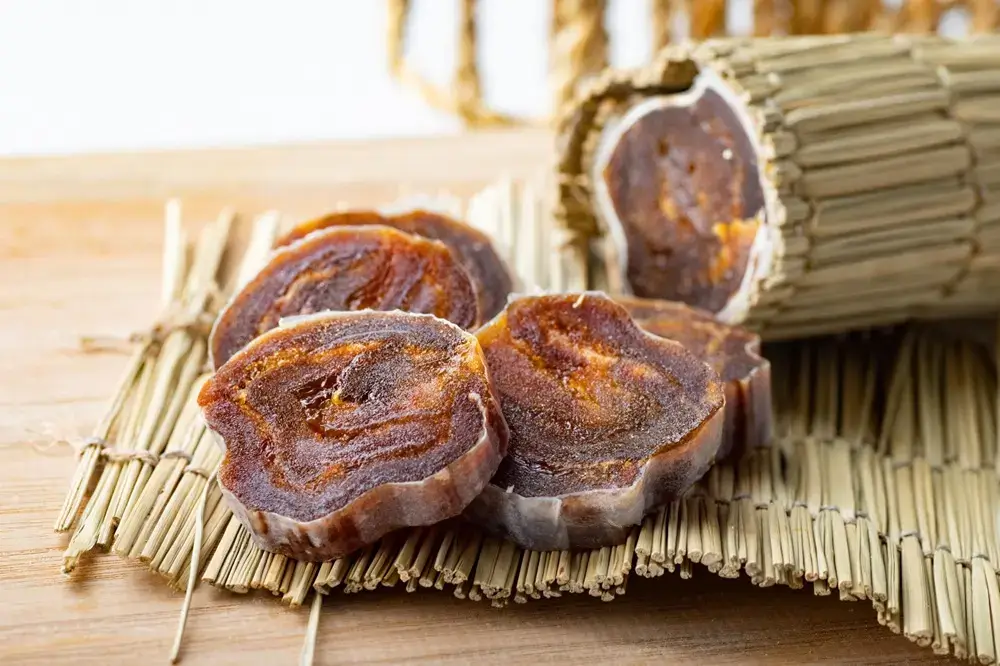
Photo by bibi33
Maki-gaki has been made in this region since the Tenpo era, roughly the 1830s. Local kawazoko persimmons are dried, then the flesh alone is layered repeatedly and wrapped in straw. No skin, only the concentrated fruit, pressed into a dense cylinder. Cut in cross-section, each slice delivers an immediate richness that fresh persimmon does not prepare you for. It pairs well with cream cheese, and those who know it reach for it alongside wine. It travels well, too. Which is why it has been carried home from Yabakei for nearly two centuries.
Where to Eat · 食事処
Where to Taste the Valley
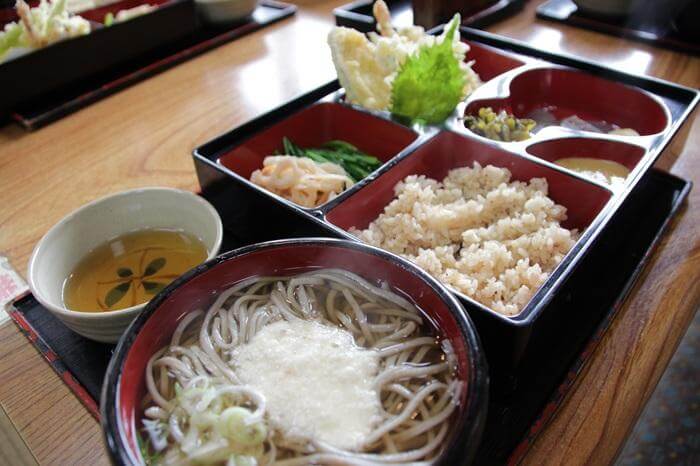
Photo: Oita Prefectural Tourism Association "Tourism Oita"
In Hon-Yabakei, close to Ao no Domon, a handful of small restaurants and tea houses gather near the gorge. Zenkai Chaya serves the kind of food that belongs to this stretch of road: dango-jiru, the thick hand-rolled noodle soup that is a staple across Oita Prefecture, and yamakake soba. Nearby, Domon Patio (Japanese-language website) offers a local produce buffet. Best visited at lunch, as service typically closes by around 15:00.
Around Hitome Hakkei in Shin-Yabakei, the restaurants that line the approach to the viewpoint lean toward the same ingredients: soba, river fish grilled over charcoal, mountain vegetables gathered from the slopes above the road. The pace is slower here. Tables face the gorge. There is no particular reason to eat quickly.
Further into the valley, near the Yabakei Dam in Kakisaka, Tenryu (Japanese-language website) sits apart from the main tourist routes. The restaurant works directly with local hunters. The game that arrives in the kitchen, boar and deer taken from the mountains above, is handled without compromise. The boar lava-stone grill set, cooked at the table, is one of the most direct ways to eat this landscape. Suppon (Japanese softshell turtle), sourced from the Yabakei valley, also appears on the menu.
A practical note for all of these: kitchens in this part of Yabakei often close by mid-afternoon. Arriving for lunch, rather than planning a late meal, is the more reliable approach.
Where to Stay · 郷土料理と宿泊
Nabeya: The Valley, Served at the Farmhouse
If you would rather bring the valley home with you, there is another option. Nabeya (Japanese-language website), a 150-year-old farmhouse, can arrange for Tenryu's seasonal hot pots to be delivered before check-in. Instead of eating at the restaurant, you prepare the meal yourselves around the farmhouse table, letting the evening unfold at the same pace as the valley outside.
The building now called Nabeya began as a tea house on the road through Yabakei. Someone decided it should not become an empty relic. Today, guests book the entire farmhouse for themselves: one building, one party, in the way travellers once stopped at a mountain tea house rather than a room within a larger establishment.
Guests who book at least seven days in advance can choose from botan nabe (wild boar), momiji nabe (venison), kamo nabe (duck), kammuri jidori chicken, suppon (softshell turtle), or unaju (grilled eel). The meal is delivered to the farmhouse refrigerator before arrival, together with preparation instructions, so dinner becomes part of the stay rather than something waiting elsewhere.
The owner carries a longer ambition for this place. The valley around Nabeya holds an abundance of susuki pampas grass. The plan is to harvest it, restore the farmhouse roof to its original thatched form, and develop susuki as a regional material: a local product grown from land that has been quietly thinning of people and voices. The farmhouse is a beginning, not an endpoint.
Nabeya — Farmhouse Stay, Yabakei
A 150-year-old tea house restored as a whole-property farmhouse stay. Tenryu's seasonal hot pot sets delivered before arrival. The food and the building are from the same valley.
View rooms and Tenryu dinner experience →Also available via Trip.com →
Yabakei Hot Springs: Where the Day Comes to Rest
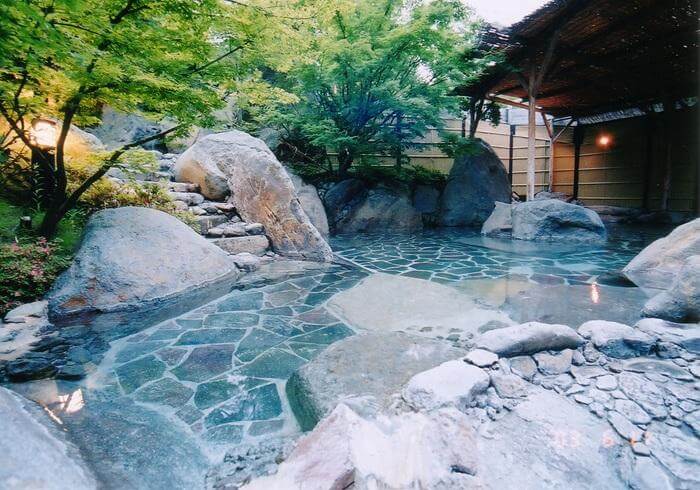
Photo: Oita Prefectural Tourism Association "Tourism Oita"
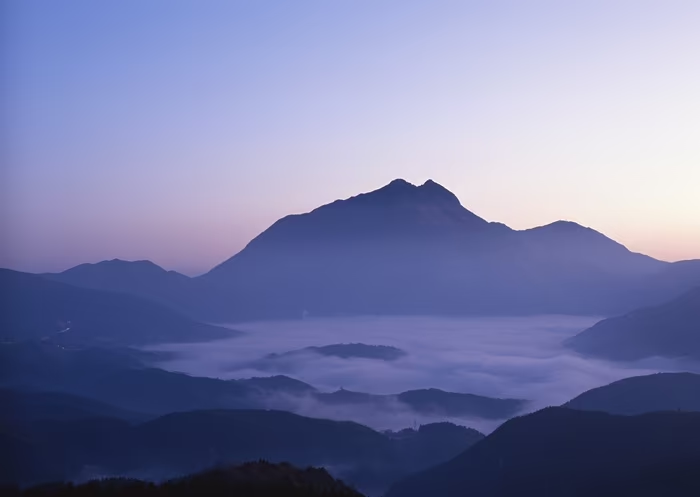
The hot springs of Yabakei rise from the same geology that shaped its cliffs, caves, and river gorge. Beneath Hachimenzan, a mountain revered as sacred since the Heian period, groundwater warmed deep underground returns quietly to the surface. The sacred mountain and the onsen share the same geological origin.
Oita Prefecture has more hot spring sources than any other prefecture in Japan. Most visitors know this through Beppu or Yufuin. The onsen at Yabakei is quieter than either: less famous, less developed, and more closely tied to the landscape around it.
The waters here are mostly classified as simple alkaline springs. Soft on the skin and free from the strong sulphurous scent of more volcanic springs, they invite long, unhurried baths. After a day spent walking the gorge, they feel less like another attraction than a natural continuation of the landscape itself.
Day Baths · 立ち寄り湯
For Those Passing Through
Near Hitome Hakkei in Shin-Yabakei, the public bath known as Momiji no Yu offers an open-air rock bath and an octagonal rotenburo, both looking across the valley, for around ¥510. The buildings are modest. The view extends across the same cliffs and forests you have been walking through all day.
Further into the mountains, beyond the point where most visitors turn back, lies Tororo no Yu. The owner and his family spent three years building it by hand: the changing rooms, the outdoor baths, even the path that leads down to the water. The rotenburo sits beside a clear mountain stream beneath an open canopy of trees. In autumn, maple leaves surround the bath. At night, with little artificial light reaching this far into the valley, the stars emerge with unusual clarity. The spring itself is a simple alkaline bath: mild, smooth, and free from the strong mineral scent of Oita's more volcanic waters.
Where to Stay · 温泉宿泊
For Those Staying Overnight
Someone decided that the best way to end a day in Yabakei was to remain a little longer. A day trip shows you Yabakei. Staying overnight lets you see a different side of it. The gorge in the morning, before other visitors arrive, before the light becomes even and bright, is a different place from the gorge in the afternoon. The mist, if there is any, has not yet lifted from the river. The cliffs are a different colour.
Kogane Sansou sits at the foot of Hachimenzan, which means the onsen here draws from the same rock that shaped every cliff face you walked past today. The spring is a simple alkaline water: clear, almost odourless, with a softness that settles into the skin without announcing itself. Outdoor baths, indoor baths, and private family baths encourage you to move between them slowly rather than treating the onsen as a single stop before bed.
Kogane Sansou — Onsen Ryokan, Hachimenzan
At the foot of Hachimenzan. Outdoor baths, private baths, indoor bath. The natural conclusion to a day spent moving through Yabakei's gorge, forest, and river.
Check room availability via Trip.com →In Shin-Yabakei, beside Hitome Hakkei, Rokumei-kan places you inside the view rather than simply bringing you to it. The building shows its age, but the rooms look directly across one of Yabakei's most celebrated landscapes. In autumn, the maples fill the windows. In early summer, fireflies drift through the valley after dark. Meals follow the seasons as closely as the scenery, with mountain vegetables, wild yam, ayu, and other local ingredients prepared by the owner himself. It is the kind of inn where the landscape remains the main attraction, even after you have stepped indoors.
Yabakei Onsen Rokumei-kan — Shin-Yabakei
A Taisho-era ryokan beside the gorge at Hitome Hakkei. Source-drawn baths facing the cliff formations. The sound of the Yamakuni River through the window.
Check room availability via Trip.com →Also available via Rakuten Travel →
Questions
When is the best time to visit Yabakei?
Autumn is the most visited season, with maple and zelkova trees typically turning colour in mid to late November at Shin-Yabakei's Hitome Hakkei viewpoint. The gorge is genuinely spectacular at this time, though also significantly busier.
Every season has a distinct character. Spring brings new growth that fills the cliff faces with green. Summer keeps the gorge noticeably cooler than surrounding lowlands, which makes July and August a practical time to visit. Winter occasionally brings snow to the upper valleys, and the rock formations look entirely different against white. The Sarutobi Sentsubo potholes and Ao no Domon are worth seeing in any season.
Can I visit Yabakei without a car?
Hon-Yabakei, including Ao no Domon and Rakanji Temple, is reachable by bus from Nakatsu Station (approximately 25 minutes to the Ao no Domon stop). Shin-Yabakei and Hitome Hakkei require a transfer at Kakisaka and are served by weekday buses only — there is no direct bus service on weekends or public holidays.
The Maple Yaba Cycling Road offers an alternative: the route begins near Nakatsu Station and bicycle hire is available at the Yabakei Cycling Terminal, midway along the path. For a car-free visit focused on the river valley and Hon-Yabakei, cycling is the most rewarding option. Covering both Hon-Yabakei and Shin-Yabakei without a car in a single day requires careful planning around bus schedules.
If you plan to explore multiple areas of Yabakei or combine it with Yufuin or Beppu, renting a car gives you the most flexibility. Compare car rental options on Klook →
Is Yabakei worth an overnight stay, or is a day trip enough?
A day trip from Fukuoka or Oita covers the main sites. But the case for staying overnight is not about seeing more places. It is about experiencing the gorge at the hours when visitors are absent. Early morning mist on the Yamakuni River, the light on the cliff faces before the day becomes bright and flat, the particular quiet of a rural valley after dark: these are not available on a day trip.
If you are going to the effort of reaching Yabakei, one night is worth adding.
What is the difference between Yabakei and Shin-Yabakei?
Yabakei refers to the broader gorge area, which encompasses multiple sub-valleys along the Yamakuni River and its tributaries. Hon-Yabakei (Main Yabakei) is the section closest to Nakatsu City, where Ao no Domon and Rakanji Temple are located. Shin-Yabakei (Deep Yabakei), located approximately 22 kilometres further south, is the section known for Hitome Hakkei and the most concentrated rock formations.
The two areas have distinct characters. Hon-Yabakei is defined by specific landmarks and human history: the tunnel, the temple. Shin-Yabakei is defined by the landscape itself and is where most autumn foliage visitors concentrate.
How long does it take to reach Yabakei from Fukuoka?
By car, Yabakei is approximately 90 minutes from central Fukuoka via the Kyushu Expressway to Nakatsu IC. By public transport, take the Shinkansen from Hakata to Kokura (approximately 15 minutes), then the JR Sonic limited express to Nakatsu Station (approximately 30 minutes), then a local bus to Hon-Yabakei (approximately 25 minutes). Total travel time by public transport is roughly 90 minutes to two hours depending on connections. From Oita city, the journey by car takes approximately one hour.
If you are combining Yabakei with Yufuin, Beppu, or other destinations in Kyushu, a JR rail pass covers the Sonic limited express and can represent good value. All passes must be purchased outside Japan before departure. Compare JR passes on Klook →
Disclosure: This article contains affiliate links. If you book accommodation or experiences through the links above, Untranslated Japan may earn a small commission at no additional cost to you. All properties and experiences featured are chosen for editorial reasons. This content has been produced with AI assistance and reviewed by a human editor prior to publication, in accordance with our affiliate partner guidelines.